Is Residing a House With Hardie Plank Worth the Investment?
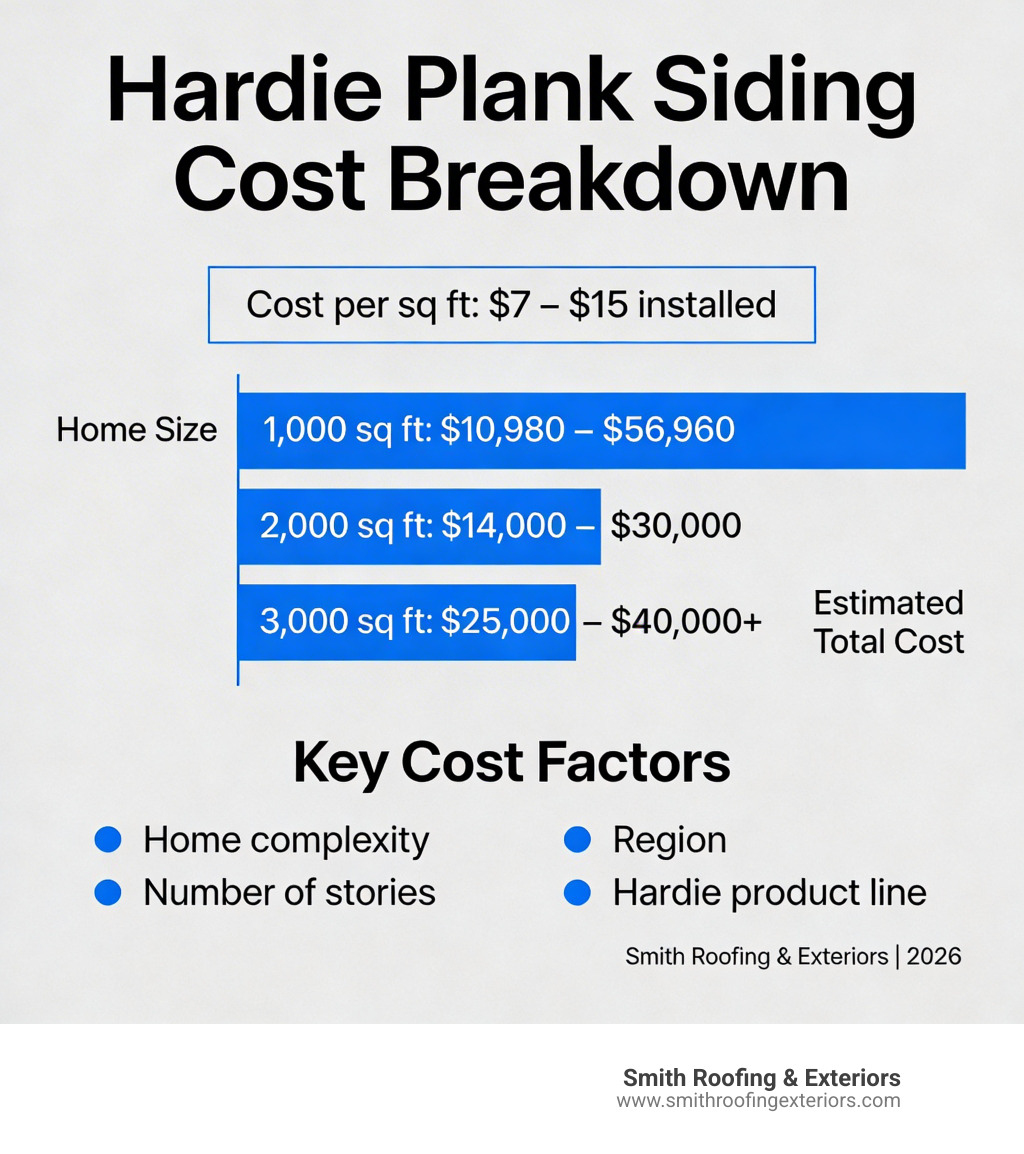
The cost to reside house with Hardie Plank typically falls between $7 and $15 per square foot installed, with most homeowners spending $14,000 to $30,000 for an average 2,000-square-foot home.
Here’s a quick snapshot to help you budget fast:
| Home Size | Estimated Total Cost |
|---|---|
| 1,000 sq ft | $10,980 – $56,960 |
| 2,000 sq ft | $14,000 – $30,000 |
| 3,000 sq ft | $25,000 – $40,000+ |
Costs vary based on home complexity, number of stories, your region, and the Hardie product line you choose.
For Wisconsin homeowners, harsh winters, moisture, and wind can destroy weaker siding fast. Hardie Plank — a fiber cement product made by James Hardie — is built to handle exactly that. It resists rot, pests, fire, and impact. And unlike wood, it won’t warp or decay after a brutal freeze-thaw cycle.
That durability comes at a higher upfront price than vinyl. But many homeowners find the long-term savings on repairs and repaints — plus an average 80% return on investment at resale — make it the smarter choice over time.
I’m Matt Smith, owner of Smith Roofing & Exteriors, and I’ve helped countless Wisconsin homeowners navigate the cost to reside house with Hardie Plank — from small ranch homes to large two-story builds. In this guide, I’ll walk you through everything you need to budget confidently for your project.
Understanding the Total Cost to Reside House with Hardie Plank by Home Size
When we sit down with homeowners in Fort Atkinson or Lake Geneva, the first question is always about the “bottom line.” Because every home is unique, we look at the total exterior wall square footage—not just the footprint of your house.
The cost to reside house with Hardie Plank scales directly with size. A 1,000-square-foot cottage requires significantly fewer “squares” (a roofing and siding term for a 100-square-foot area) than a sprawling 3,000-square-foot colonial. Generally, for a standard 2,000-square-foot home in Southeastern Wisconsin, you can expect a total investment between $20,000 and $30,000, though high-end customizations can push this higher.

Average Cost to Reside House with Hardie Plank per Square Foot
To get a more granular view, let’s break it down by the square foot. On average, the total installed cost ranges from $7 to $15 per square foot. This is split between two main categories:
- Materials: Hardie Board materials typically cost between $4 and $9 per square foot. For example, a single HardiePlank lap board (12 feet long) might cost around $10 to $12.
- Labor: Labor in the Midwest generally runs between $4.50 and $8.50 per square foot.
It is worth noting that Hardie Board is significantly sturdier than its competitors. While standard 0.040 and 0.048 inches thick vinyl siding is common, Hardie Plank’s fiber cement composition (sand, cement, and cellulose fibers) provides a much deeper, more authentic wood-grain texture and superior protection.
| Component | Cost per Square Foot |
|---|---|
| Basic Materials | $4.00 – $9.00 |
| Professional Labor | $4.50 – $8.50 |
| Total Installed | $8.50 – $17.50 |
Factors Influencing Installation Complexity
Why is there such a wide range in pricing? It usually comes down to the “degree of difficulty.” If we are working on a simple, single-story ranch in Delavan, the labor is straightforward. However, if your home has multiple stories, steep gables, or intricate architectural details, the price will climb.
Key factors that add to the labor cost include:
- Scaffolding: Multi-story homes require specialized equipment and safety setups, adding 10% to 30% to labor costs.
- Complexity: Dormers, turrets, and wrap-around porches require more precise cuts and more time.
- Condition of the Home: If your current exterior shows Signs It’s Time to Call a Siding Replacement Company, such as rotting wood underneath, we have to fix those structural issues before the new Plank goes up.
Hardie Board Styles and Material Variations
One of the reasons we love James Hardie products is the sheer variety. You aren’t stuck with just one “look.” Depending on your home’s style—whether it’s a modern farmhouse in Elkhorn or a classic Victorian in Whitewater—there is a Hardie style to match.
- HardiePlank Lap Siding: The most popular choice. It offers a classic look and typically costs $1.00 to $3.00 per square foot for the material alone.
- HardieShingle Siding: Perfect for Cape Cod styles or accent gables. These mimic cedar shingles but won’t rot. Expect to pay $2.00 to $4.00 per square foot for materials.
- HardiePanel Vertical Siding: Often used for a “Board and Batten” look. This is modern and sleek, costing roughly $2.00 to $5.00 per square foot.
- Artisan Collection: This is the premium “luxury” line. It’s thicker, creates deep shadow lines, and carries a higher price tag due to the extra weight and installation time.
ColorPlus® Technology vs. Pre-Primed You have a big choice here: do you buy the boards pre-primed and paint them after installation, or go with ColorPlus® Technology? ColorPlus® boards have the color baked on at the factory. While they cost $1 to $2 more per square foot upfront, they save you the $1,800 to $4,500 cost of a professional paint job and come with a 15-year limited finish warranty.
Hidden Expenses in the Cost to Reside House with Hardie Plank
When budgeting, don’t just look at the boards and the hammers. There are “hidden” costs that every homeowner should account for:
- Old Siding Removal: Tearing off your old vinyl or wood typically costs $1,000 to $3,000. If we find asbestos or lead paint, those costs can rise significantly.
- Weather Barriers: You need a high-quality house wrap (like HardieWrap®) to keep moisture out. This usually adds $1,300 to $4,000 to the project.
- Trim and Soffits: Don’t forget the corners, window trim, and eaves! Trim work can add $1,500 to $4,000.
- Permits: Depending on whether you are in Jefferson or Burlington, local permits can range from $150 to $500.
While some might consider a cheaper route, we often explain Why Opt for Vinyl Siding Replacement as a budget alternative, but for those who want the “forever home” durability, Hardie is the gold standard.
Hardie Board vs. Alternative Siding Materials
How does the cost to reside house with Hardie Plank stack up against other options? It’s generally the “middle-to-high” ground.
- Vinyl Siding: The most affordable. Vinyl usually costs $3 to $12 per square foot installed. However, it can melt in high heat, crack in Wisconsin winters, and often needs replacing every 20 years.
- Wood Siding: Beautiful but high maintenance. Cedar can cost $10 to $18 per square foot. It requires staining or painting every few years to prevent rot and woodpecker damage.
- Stucco or Brick: These are usually the most expensive, often exceeding $20–$30 per square foot.
When you look at the average prices of materials, Hardie Board offers a “set it and forget it” value that vinyl simply can’t match.
Long-Term ROI and Home Value
Hardie Board isn’t just an expense; it’s an investment. On average, residing your home with fiber cement offers an 80% Return on Investment (ROI). That means if you spend $20,000 on siding, your home’s resale value could increase by roughly $16,000 to $17,000.
Beyond the resale price, you gain peace of mind through:
- Fire Resistance: Hardie Board is non-combustible and won’t ignite when exposed to a direct flame.
- Pest Protection: Termites and carpenter ants can’t eat fiber cement.
- Weather Durability: Its impact resistance is legendary—it can withstand hail and flying debris that would shatter vinyl or dent aluminum.
Professional Installation Process and Savings Tips
Installing Hardie Plank is not a weekend DIY project. Fiber cement is heavy—about 300 pounds per 100 square feet—compared to vinyl’s 60-70 pounds. It requires specialized saws to manage silica dust and specific fastening techniques to maintain the 30-year warranty.
Our typical installation process looks like this:
- Tear-off: We remove the old siding and inspect the sheathing (OSB) for damage.
- Prep: We install a weather-resistant barrier and flashing around windows and doors.
- Installation: Boards are cut and nailed according to James Hardie’s strict “Best Practices” manual.
- Finishing: We caulk joints and touch up any paint to ensure a seamless seal.
How to Save Money on Your Project:
- Off-Season Scheduling: If you can wait until late fall or early winter, you might save 5% to 10% on labor costs.
- Bundle Services: At Smith Roofing & Exteriors, we often provide discounts if you bundle your siding with a new roof or gutter installation.
- Choose a Standard Style: Choosing a standard lap siding in a popular color is usually more cost-effective than custom-ordered shingles or premium Artisan lines.
- Get Multiple Quotes: We always encourage homeowners to get 3 quotes. Just make sure you’re comparing “apples to apples”—ensure the other contractors are using genuine James Hardie products and following warranty-compliant installation methods.
Frequently Asked Questions about Hardie Board Costs
How long does it take to reside a house with Hardie Plank?
For an average-sized home (1,500 to 2,500 square feet), the process typically takes 3 to 7 days. If your home is multi-story or has complex architectural features, it may take up to two weeks. Weather also plays a factor—while we work year-round in Southeastern Wisconsin, heavy snow or rain can cause minor delays.
Does Hardie Plank siding lower home insurance costs?
In many cases, yes! Because Hardie Plank is fire-resistant (Class A fire rating) and storm-resistant, some insurance companies offer discounts on homeowners’ premiums. It’s always worth calling your agent in Fort Atkinson or Edgerton to see if an upgrade will lower your monthly bill.
Is Hardie Board more expensive than vinyl siding?
Upfront, yes. The cost to reside house with Hardie Plank is typically 2 to 3 times higher than basic vinyl. However, because Hardie lasts 30 to 50 years and requires far less maintenance and fewer repairs, it often ends up being the cheaper option over the life of your home.
Conclusion
Residing your home is a major decision, but choosing Hardie Plank is one of the smartest ways to protect your property in Southeastern Wisconsin. While the initial cost to reside house with Hardie Plank might seem high, the combination of durability, fire resistance, and incredible curb appeal provides a value that lasts for decades.
At Smith Roofing & Exteriors, we pride ourselves on being your local Fort Atkinson experts. Whether you are in Lake Mills, Walworth, or right here in town, our team is dedicated to transparent pricing and superior craftsmanship. We don’t just slap boards on a wall; we ensure your home is protected from the elements for the long haul.
Ready to see what Hardie Plank can do for your home? Upgrade Your Home with a Quality Siding Replacement Company and contact us today for a professional consultation and a detailed, honest estimate. We look forward to helping you transform your home!