Why Roof Maintenance How Often You Do It Matters More Than You Think
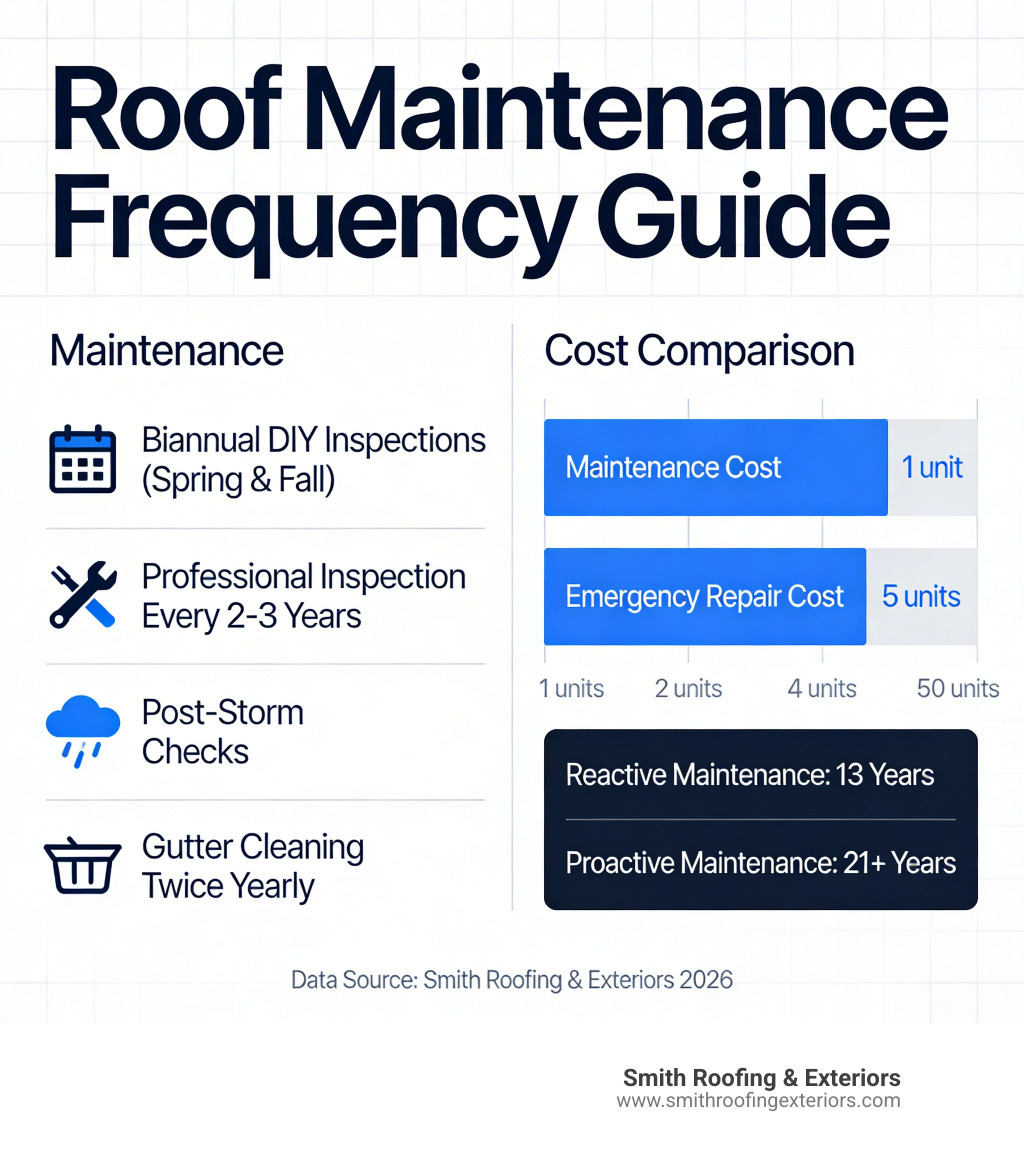
Roof maintenance how often you perform it can be the difference between a roof that lasts 25+ years and one that fails in 13. Here’s the quick answer:
| Situation | Recommended Frequency |
|---|---|
| General inspection | Twice a year (spring and fall) |
| Professional inspection | Every 2-3 years |
| After severe weather | Immediately following the event |
| Older roofs (10+ years) | Biannually, minimum |
| Gutters and debris clearing | At least twice a year |
Your roof takes a beating every single day — from Wisconsin’s freeze-thaw cycles, heavy snow loads, spring storms, and summer heat. Most homeowners don’t think about their roof until there’s a leak. By then, the damage is already done.
Here’s a sobering fact: 80% of roofs are replaced prematurely simply because of skipped maintenance. And for every $1 you invest in preventive care, you save roughly $5 in emergency repairs down the road.
The good news? Staying ahead of problems doesn’t require much time or money — just a consistent schedule and knowing what to look for.
I’m Matt Smith, owner of Smith Roofing & Exteriors, and after years of helping Wisconsin homeowners protect their roofs through harsh seasons, I’ve seen how a simple roof maintenance how often routine separates a $500 repair from a $15,000 replacement. Let’s walk through exactly what you need to know.
The Golden Rule: How Often Should You Inspect Your Roof?
If you want to keep your home dry and your bank account happy, the golden rule of roofing is the “Biannual Checkup.” We always tell our neighbors in Fort Atkinson and Lake Mills to plan for a roof inspection twice a year—once in the spring and again in the fall.
Why these specific times? Think of it as preparing for and recovering from Wisconsin’s heavy lifting seasons. In the spring, you’re looking for damage caused by heavy snow loads and the brutal freeze-thaw cycles of winter. In the fall, you’re clearing out the summer’s debris and ensuring the system is watertight before the first snowflake falls.
Beyond the calendar, you must also perform a post-storm assessment. After a severe windstorm or hail event in Southeastern Wisconsin, don’t wait for a drip in the living room. Grab a pair of binoculars and do a quick visual check from the ground.

According to Annual Maintenance and Roofing Tips for Every Homeowner, proactive care is the only way to ensure your manufacturer’s warranty remains valid. Most people don’t realize that warranties often require proof of regular maintenance to honor a claim.
Seasonal Factors and Severe Weather
Living in places like Jefferson or Edgerton means our roofs face unique challenges. The freeze-thaw cycle is particularly nasty; water gets into small cracks, freezes, expands, and turns a tiny gap into a major leak.
Ice dams are another local favorite (and by favorite, I mean a roofer’s nightmare). When snow melts on the upper parts of your roof and refreezes at the cold eaves, it creates a dam that backs water up under your shingles. Regular maintenance ensures your attic insulation and ventilation are working together to prevent this.
When severe weather hits, documentation is your best friend. Take photos of your roof (from the ground!) and keep a log of when inspections occurred. This paper trail is invaluable if you ever need to file an insurance claim for hail or wind uplift damage.
Roof Maintenance How Often: Frequency by Material
Not all roofs are created equal. The material protecting your home dictates roof maintenance how often requirements. While a metal roof is like a tank, asphalt shingles are more like a high-quality pair of shoes—they need a bit more regular attention to stay in top shape.
| Material | Avg. Lifespan | Professional Inspection Frequency | Key Vulnerability |
|---|---|---|---|
| Asphalt Shingles | 20-30 Years | Every 2 years | Granule loss & curling |
| Metal Roofing | 50+ Years | Every 3-5 years | Fastener tightness & oxidation |
| Tile/Slate | 50-100 Years | Every 2-3 years | Cracking & slipping |
| Flat Roofs (TPO/EPDM) | 15-25 Years | Bi-annually | Ponding & seam failure |
Understanding how roof maintenance can help extend the life of your roof starts with knowing what you’re standing under. A proactively maintained roof can see its lifespan jump from 13 years to over 21 years on average.
Determining Roof Maintenance How Often for Asphalt Shingles
Asphalt shingles are the most common choice in Walworth and Delavan, but they are also the most sensitive to aging. You should perform a visual check at least once a year, but once that roof hits the 10-year milestone, you need to step it up to a strict biannual schedule.
Look for “balding” shingles—this is when the protective granules wash off and end up in your gutters. Without these granules, the asphalt is exposed to UV rays, which causes the shingles to become brittle and crack. If you see curling edges or shingles that look like they’re “clawing,” your roof is crying out for professional help.
Metal, Tile, and Flat Roof Requirements
Metal roofs are incredibly durable, but they aren’t “set it and forget it.” In Wisconsin, the expansion and contraction from temperature swings can loosen fasteners. We recommend checking these every few years to ensure the seals are still tight and no oxidation is forming.
Tile and slate roofs are heavy and last a lifetime, but the individual tiles can crack under the weight of a fallen branch or a heavy hailstone. These require a specialized eye to ensure no moisture is seeping through small fissures.
Flat roofs, often found on commercial buildings in Elkhorn or Lake Geneva, are the divas of the roofing world. Because they don’t have a steep pitch to shed water, they are prone to “ponding.” If water sits for more than 48 hours, it can eat through the membrane. These systems need semi-annual checks to ensure drainage points are clear and sealants haven’t failed.
Essential Tasks for a Healthy Roofing System
Maintenance isn’t just about looking at shingles; it’s about the entire ecosystem. Here is why why regular roof maintenance is crucial for homeowners: it protects the structural integrity of your entire house.
- Gutter Cleaning: Clogged gutters back up and rot your fascia boards and roof deck.
- Debris Removal: Leaves and sticks trap moisture against shingles, leading to rot.
- Tree Trimming: Branches scratching against your roof act like sandpaper, removing granules with every breeze.
- Flashing Repair: The metal around your chimney and vents (flashing) is the most common leak point. Inspecting the sealant here is vital.
Managing Moss and Algae Growth
If you have a north-facing roof or lots of shade trees in your yard, you’ve likely seen those dark streaks or fuzzy green patches. This isn’t just a cosmetic issue. Moss acts like a sponge, holding water against your shingles and eventually lifting them up, allowing water to reach the wood underneath.
According to research on environmental factors for moss and algae growth, wet climates and shade are the primary culprits. You can manage this by installing zinc or copper strips at the ridge of the roof. When it rains, the metal ions wash down and kill off the growth. For existing moss, never use a pressure washer! A gentle “soft wash” with a bleach-and-water solution is the safe way to go.
Attic Ventilation and Interior Signs
Sometimes the best way to inspect a roof is from the inside. Proper attic ventilation is the “secret sauce” of roof longevity. If your attic is too hot in the summer or holds moisture in the winter, your shingles will essentially “cook” from the inside out.
During your annual check, head into the attic with a flashlight. Look for:
- Water Stains: Even small rings on the wood indicate a slow leak.
- Mold or Mildew: A sign of poor ventilation and trapped moisture.
- Light Peeking Through: If you can see daylight where you shouldn’t, water can get in too.
- Matted Insulation: This suggests water has been dripping and compromising your home’s energy efficiency.
Learning how roof inspections can save homeowners thousands in repairs usually starts with catching these interior signs before they become “ceiling-collapsing” problems.
Professional vs. DIY: Roof Maintenance How Often Should You Call an Expert?
We love a handy homeowner, but there’s a limit to what you can safely do. DIY maintenance should be restricted to what you can see from the ground or a ladder. Walking on a roof is dangerous for you and can actually damage the shingles if you don’t know where to step.
Professional teams use advanced tools like drone technology to get high-resolution photos of every nook and cranny. We also utilize thermal imaging to detect “cold spots” in your roof, which often indicate hidden moisture or failing insulation that the naked eye would miss.
There are 5 benefits of professional roof maintenance that you simply can’t get on your own: safety, specialized equipment, warranty validation, early leak detection, and peace of mind.
When to Hire a Certified Contractor
You should call a professional like Smith Roofing & Exteriors if:
- Your roof is over 10 years old.
- You have a steep pitch or multiple stories.
- You see visible damage like missing shingles or rusted flashing.
- You need a certified inspection report for an insurance company or a home sale.
A roofing contractor can extend the life of your roof through simple maintenance by catching the “invisible” issues, like failing gaskets on plumbing vents or minor shingle delamination, before they escalate.
Frequently Asked Questions about Roof Maintenance
How does neglecting maintenance impact insurance claims?
This is a big one. Most homeowners’ insurance policies contain a “neglect clause.” If a leak causes $10,000 in damage, but the adjuster determines the leak was caused by years of uncleaned gutters or unaddressed moss growth, they may deny the claim. Regular documentation of your roof maintenance how often schedule proves you’ve exercised “reasonable care,” making the claims process much smoother.
What are the most common maintenance mistakes?
The number one mistake is using a pressure washer on shingles. It blasts away the protective granules and can actually force water under the shingles. Second is “out of sight, out of mind.” Just because it isn’t leaking today doesn’t mean the system isn’t failing. Finally, avoid “DIY flashing patches” with a tub of roofing tar. These are temporary fixes that often trap moisture and cause more rot in the long run.
How often should gutters be cleaned as part of roof care?
At a minimum, twice a year. However, if your home in Burlington or Walworth is surrounded by oak or maple trees, you might need to clean them quarterly. Clogged gutters are the primary cause of foundation cracks and rotted roof edges. Ensure your downspouts are clear and directing water at least 5-10 feet away from your foundation.
Conclusion
At Smith Roofing & Exteriors, we believe that a little bit of foresight goes a long way. Whether you are in Fort Atkinson, Jefferson, or anywhere in Southeastern Wisconsin, your roof is your home’s first line of defense. By following a consistent roof maintenance how often schedule—checking things yourself twice a year and calling us every few years for a professional deep dive—you can ensure that defense stays strong for decades.
Don’t wait for the ceiling to start dripping. Explore our comprehensive roof maintenance services today and let our experienced local team give your roof the care it deserves. Whether it’s a minor repair or a preventative plan, we offer transparent pricing and the peace of mind that comes with a job done right. Give us a call—we’re here to help, 24/7.