Why Clogged Gutters Are a Bigger Problem Than You Think
Clogged gutters cause roof leaks — and that’s just the beginning of the damage they can do to your home.
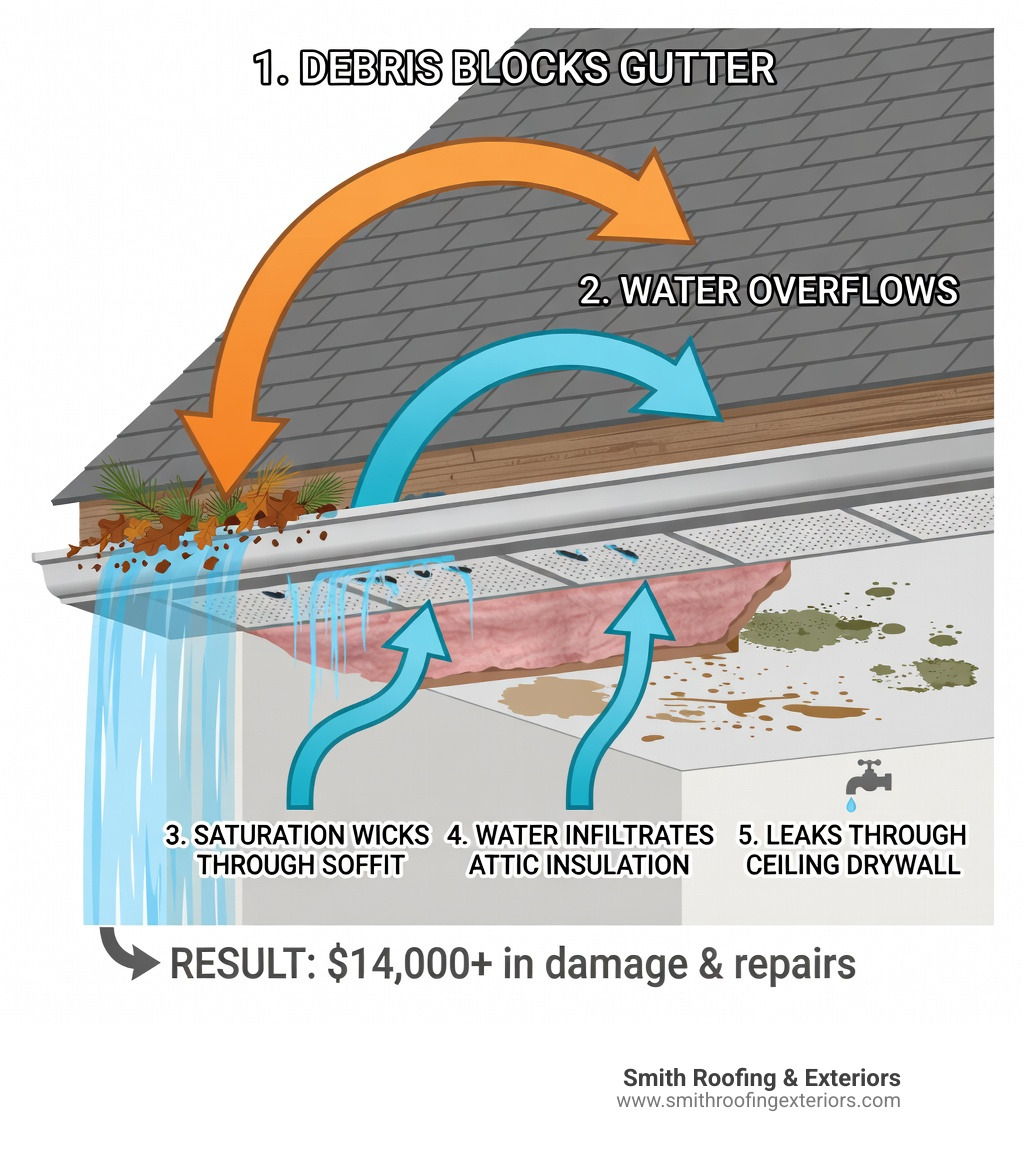
Here’s a quick look at how it happens:
- Debris blocks the gutter — leaves, twigs, and dirt pile up and stop water from draining.
- Water backs up — instead of flowing to the downspout, water sits and overflows.
- Overflow soaks the fascia board — the wood behind your gutter gets saturated and starts to rot.
- Water wicks into the soffit — moisture travels inward through vented openings under your eaves.
- Water reaches the attic — it seeps under shingles or through the roofline into your attic.
- Ceiling damage appears — stains, sagging drywall, mold, and structural rot follow.
That chain reaction can turn a $160 gutter cleaning into a $14,000 insurance claim. According to industry data from the Insurance Information Institute, water damage and freezing account for 25% of all home insurance claims — making it the second most common claim type after wind and hail damage.
And here in Wisconsin, harsh winters and heavy leaf fall make gutters especially vulnerable.
I’m Matt Smith, owner of Smith Roofing & Exteriors, and after years of inspecting roofs and exteriors across rural Wisconsin, I’ve seen how often clogged gutters cause roof leaks that homeowners mistake for much costlier roofing failures — catching it early makes all the difference.
The Mechanics: How Clogged Gutters Cause Roof Leaks
To understand how clogged gutters cause roof leaks, we first have to look at the physics of water. Your roof is designed to shed water downward, using gravity to pull rain into the gutters and away from your home. When your gutters are packed with leaves, pine needles, and grit, that water has nowhere to go. It pools, becomes heavy, and begins to seek out any path of least resistance.
One of the most common ways this happens is through water backup. When the gutter is full, the water level rises until it reaches the edge of your roof shingles. In a heavy Wisconsin downpour, this water doesn’t just sit there; it pushes upward under the edge of the shingles and the underlayment. This is especially dangerous because the “drip edge”—the metal flashing meant to protect your roof’s perimeter—can be overwhelmed, allowing water to soak directly into the wooden roof decking.
Once the decking is wet, it begins to rot. This softens the wood, making it easier for more water to penetrate during the next storm. Furthermore, the weight of the water-logged debris and standing water can cause the gutters to sag. When they sag, the pitch of the gutter is ruined, creating even more pooling. It’s a vicious cycle that makes 5 Reasons to Fix Gutter Problems ASAP a priority for any homeowner in Fort Atkinson or Lake Geneva.
How Clogged Gutters Cause Roof Leaks via Ice Dams
In Southeastern Wisconsin, we deal with a specific winter nightmare: the ice dam. While many people think ice dams are strictly a “roofing” issue, clogged gutters are often the primary catalyst.
The process follows a freeze-thaw cycle. Heat escaping from your attic melts the snow on your roof. This meltwater flows down to the eaves, which are colder because they overhang the house. If your gutters are clogged with frozen fall debris, the meltwater has nowhere to drain. It hits the “dam” of frozen leaves and ice in the gutter, backs up onto the roof, and refreezes.
This ice pushes its way under your shingles. When the sun comes out or the temperature rises slightly, the ice under the shingles melts, but it can’t flow off the roof because of the ice dam in the gutter. Instead, it leaks directly into your home. This process doesn’t just damage shingles; it can ruin your roof decking and structural rafters.
Can Clogged Gutters Cause Roof Leaks and Ceiling Stains?
The short answer is a resounding yes. When water infiltrates the roofline or backs up behind the fascia, it doesn’t stay in the attic. Gravity eventually pulls it down through your insulation. Wet insulation loses its R-value (insulating power), which means your heating bills in the winter will skyrocket.
Eventually, that water hits your ceiling drywall (sheetrock). You’ll first notice a small, tea-colored stain or a faint “musty” smell. If left unaddressed, the drywall will weaken, sag, and eventually crumble or collapse. This isn’t just an aesthetic issue; it’s a health hazard. Damp insulation and drywall are the perfect breeding grounds for mold and mildew.
If you notice these signs, checking our Category: Roof Leak resources can help you identify the severity of the intrusion. Mold can spread rapidly through an attic, permeating porous materials and requiring professional remediation that costs thousands of dollars—all because of a few handfuls of leaves in a downspout.
Beyond the Roof: Structural and Foundation Damage
While the roof is the first victim, the damage rarely stops there. Gutters are the “traffic controllers” of your home’s exterior. When they fail, water is dumped directly next to your house rather than being channeled away.
This leads to soil erosion. Have you ever noticed a trench in your mulch or dirt directly under your gutters? That’s the sign of a “waterfall” effect from a clog. This concentrated water saturates the ground around your foundation. In our area, where we have clay-heavy soils, this can lead to hydrostatic pressure. The wet soil expands and pushes against your foundation walls, leading to cracks, bowing, and eventually, basement flooding.
We often see beautiful landscaping destroyed in a single season because of clogged gutters. Over-saturated soil can drown expensive plants and shrubs, and the constant splashing of dirty water can stain your siding and rot your window frames. These are just a few of the 4 Types of Property Damage That Faulty Gutters Can Cause.
Pest Infestations and Health Risks
A clogged gutter is essentially a high-rise swamp. Standing water is a prime breeding ground for mosquitoes, which can carry diseases. But the “land-based” pests are often worse.
Debris-filled gutters attract birds, squirrels, and rodents who find the organic matter perfect for nesting. More dangerously, the rotting wood caused by gutter overflow attracts wood-destroying insects. Termites and carpenter ants love damp, decaying fascia boards and rafter tails. Once they’ve established a colony in your damp eaves, it’s only a short walk (or crawl) into the structural framing of your home.
The Financial Reality: Maintenance Costs vs. Major Repairs
Let’s talk numbers. Many homeowners put off gutter cleaning because it feels like an annoying chore or an unnecessary expense. However, the financial gap between maintenance and repair is staggering.
| Service | Estimated Cost |
|---|---|
| Professional Gutter Cleaning | $120 – $280 |
| Fascia & Soffit Repair | $1,000 – $3,000 |
| Mold Remediation | $2,000 – $6,000 |
| Roof Replacement (Partial/Full) | $5,000 – $15,000+ |
| Foundation Repair | $10,000 – $30,000 |
As mentioned in the intro, the average water damage insurance claim is nearly $14,000. While insurance may cover a sudden “peril,” many policies have exclusions for damage caused by “lack of maintenance.” If an adjuster determines that clogged gutters cause roof leaks in your home because you haven’t cleaned them in three years, your claim could be denied entirely.
Professional Maintenance vs. DIY Risks
We know the temptation to “just grab the ladder” is strong. However, we urge caution for two main reasons: safety and expertise.
- Safety: Ladder falls are a leading cause of emergency room visits. It only takes one slip on a damp driveway or a dizzy spell to change your life forever. Professionals have the right stabilizing equipment and experience to work at heights safely.
- Detection: When we clean gutters, we aren’t just “scooping goop.” We are looking for 5 Indications That It’s Time for Gutter Repair. We check for loose fasteners, rusted spots, improper pitch, and early signs of fascia rot that a homeowner might miss.
Prevention: Keeping Your Gutters Clear and Functional
The best way to ensure clogged gutters cause roof leaks never happens to you is a proactive schedule. In Southeastern Wisconsin, we recommend a bi-annual cleaning at minimum.
- Spring Maintenance: Once the “helicopter” seeds (maple samaras) and oak tassels have finished falling, your gutters need a flush. These small bits of debris are notorious for plugging downspout elbows.
- Fall Maintenance: This is the big one. Wait until the majority of the leaves have fallen, but get it done before the first hard freeze. If you leave wet leaves in the gutter over winter, they will freeze solid, leading to the ice dams we discussed earlier.
- Tree Trimming: If you have branches overhanging your roof, they aren’t just dropping leaves; they are providing a highway for squirrels and dropping twigs that act as “rebar” for clogs. Keep branches trimmed at least 6–10 feet away from your roofline.
Gutter Guards and System Upgrades
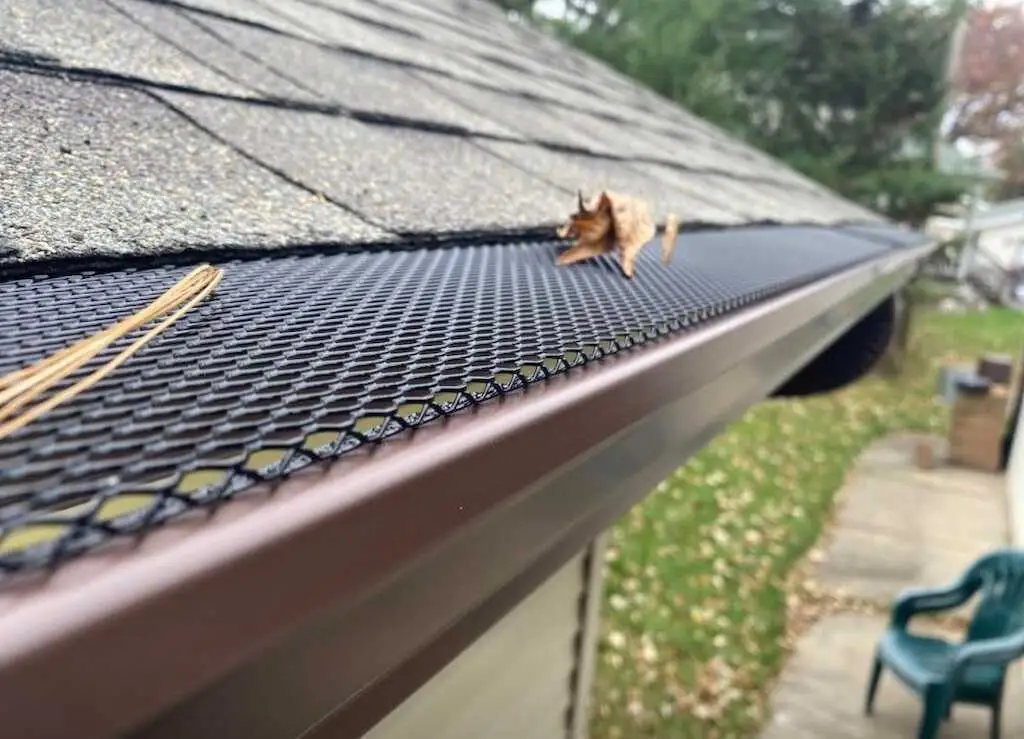
If you’re tired of the constant maintenance, gutter guards can be a game-changer. However, not all guards are created equal. We typically recommend high-quality stainless steel micro-mesh screens. These allow water in but keep even small debris like pine needles out.
For homeowners with older, sectional gutters, upgrading to seamless gutters is another excellent preventive measure. Sectional gutters have joints every 10 or 20 feet; these joints are “catch points” for debris and are prone to leaking. Seamless gutters, custom-fit to your home, eliminate these weak spots.
When it’s time for a change, knowing the Top Signs That It’s Time for Gutter Replacement can save you from an emergency situation during a summer storm.
Frequently Asked Questions about Gutter Damage
How often should I clean my gutters to prevent leaks?
For most homes in Fort Atkinson and surrounding areas, twice a year (spring and fall) is sufficient. However, if your home is heavily shaded by pine trees or large oaks, you may need quarterly cleanings. Pine needles, in particular, are very “efficient” at clogging downspouts quickly.
Can I tell if a ceiling leak is from my gutters or my roof?
It can be tricky, but there are clues. If the leak only happens during heavy rain and is located near the exterior walls or eaves, it’s likely a gutter-related overflow or fascia issue. If the leak is in the middle of a room or happens long after the rain stops (due to water trapped in the attic), it may be a shingle or flashing failure. A professional inspection is the only way to be 100% sure.
Are gutter guards a permanent solution for clogs?
“Permanent” is a strong word. While high-quality guards significantly reduce clogs and maintenance, no system is 100% maintenance-free. You should still have your system inspected annually to ensure no fine silt has built up or that the guards haven’t been damaged by heavy ice or falling branches.
Conclusion
At the end of the day, your gutters are your home’s first line of defense against water damage. While it’s easy to ignore them when the sun is shining, the reality is that clogged gutters cause roof leaks, structural rot, and foundation issues that can cost a fortune to fix.
At Smith Roofing & Exteriors, we’ve built our reputation on being the local experts Fort Atkinson, Lake Mills, and Jefferson homeowners trust. Whether you need a simple repair, a full gutter replacement, or a comprehensive roof inspection to check for damage, our team is here to help with transparent pricing and superior materials.
Don’t wait for the next Wisconsin thunderstorm to find out your gutters are failing. Explore our Category: Gutters for more tips, or contact us today to schedule a professional inspection and keep your home—and your wallet—protected.