Why Gutter Guards Are One of the Smartest Home Investments You Can Make
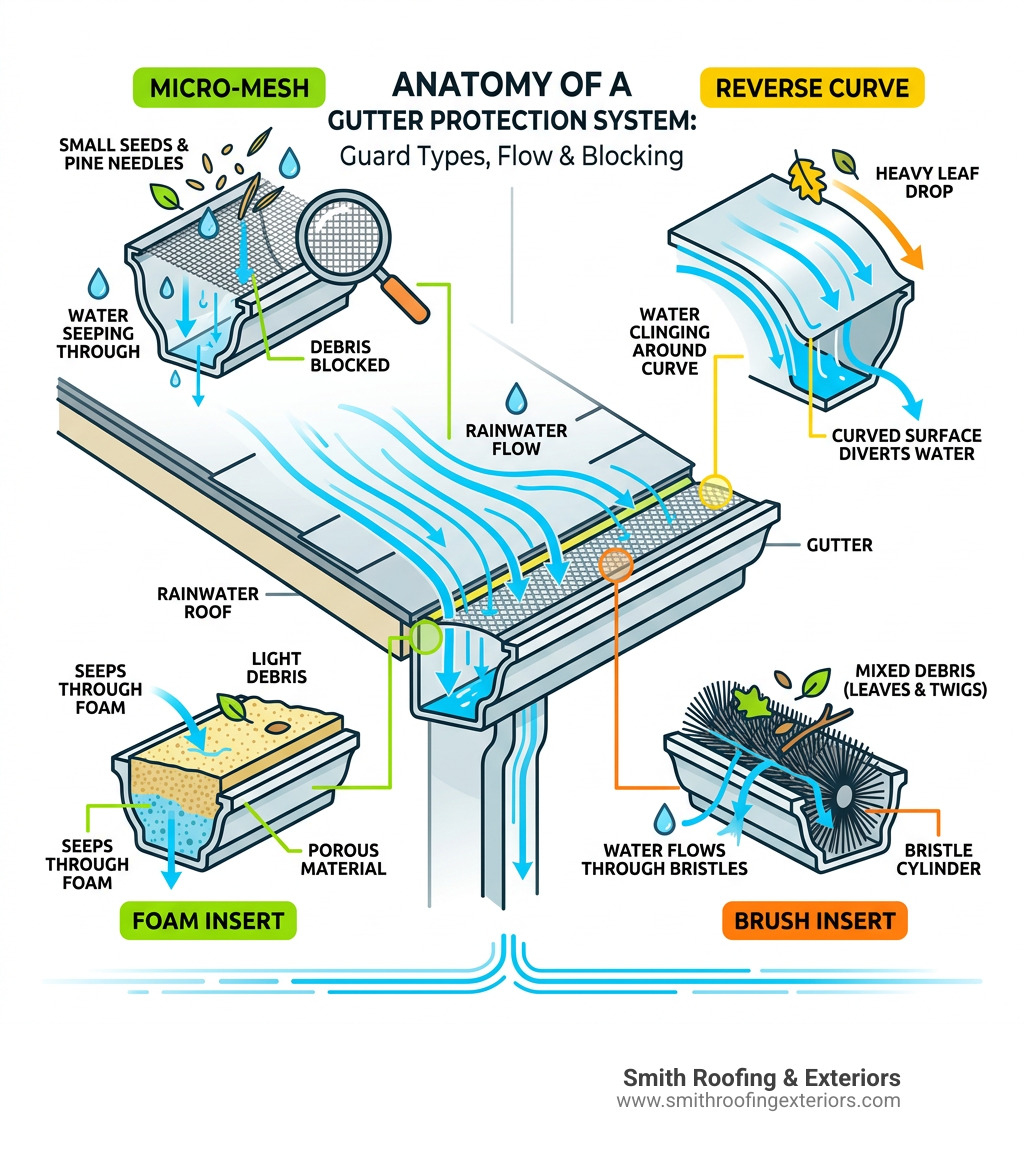
Gutter guards are protective covers or inserts that fit over or inside your gutters to keep debris out while letting rainwater flow through freely.
Here’s a quick overview:
| Type | How It Works | Best For |
|---|---|---|
| Micro-mesh | Fine screen filters water, blocks debris | Pine needles, small seeds |
| Reverse curve | Water clings around a curved hood into gutter | Heavy leaf drop |
| Foam insert | Porous foam sits inside gutter, water seeps through | Light debris |
| Brush insert | Bristle cylinder fills gutter, debris sits on top | Mixed debris |
The core job of any gutter guard is simple: keep your gutters flowing so water moves away from your home — not into your basement, not down your fascia, and not pooling around your foundation.
And the stakes are higher than most homeowners realize. Over 60% of homes deal with basement flooding, often traced back to clogged or failing gutters. Every year, more than 164,000 Americans are injured in ladder-related accidents — many while trying to clean out gutters packed with leaves and debris. In Wisconsin, where heavy rain, snow, and ice put gutters through serious stress, a clogged gutter isn’t just an annoyance. It’s a liability.
I’m Matt Smith, owner of Smith Roofing & Exteriors, and after years of installing and inspecting gutter guards across rural Wisconsin, I’ve seen how the right gutter guard system can protect a home — and how the wrong one (or none at all) can lead to expensive repairs. This guide covers everything you need to make a confident, informed decision.
What are Gutter Guards and How Do They Work?
At their most basic level, gutter guards act as a filtration system for your home’s drainage. Think of them like a coffee filter: they allow the “good stuff” (rainwater) to pass through into the “pot” (your gutter channel), while keeping the “grounds” (leaves, twigs, and helicopter seeds) out.
When rain hits your roof, it gains velocity as it slides down the shingles. Without protection, that water carries everything in its path directly into your gutters. Once there, organic matter settles, rots, and eventually forms a thick sludge that acts like a dam. Gutter guards break this cycle by creating a physical barrier. Depending on the design, they either screen out the debris, block it with bristles, or use physics to let leaves slide off the edge while water “wraps” around a curved surface into the trough.
There are top advantages of installing gutter guards that go beyond just skipping a Saturday on a ladder. These systems are your home’s first line of defense against the elements. By ensuring water always has a clear path to the downspouts, you are actively preventing water from overtopping the gutter and saturating the ground next to your foundation.
Furthermore, they are excellent at pest prevention. Open gutters are essentially “luxury condos” for birds, mice, and even stinging insects. By sealing off the top of the gutter, you remove the nesting ground, keeping your home’s perimeter much quieter and safer.
How Gutter Guards Prevent Water Damage
Water is a homeowner’s greatest enemy, especially in Southeastern Wisconsin. When gutters clog, the water has nowhere to go but “back and over.”
- Fascia Rot: When water overflows the back of the gutter, it soaks the wooden fascia board. Over time, this wood rots, weakens, and can eventually cause the entire gutter system to pull away from your house.
- Soil Erosion: We see this all the time in places like Fort Atkinson and Lake Mills. Heavy rain pouring over the side of a clogged gutter hits the ground with enough force to wash away landscaping and 1.7 billion tons of soil are lost annually to water erosion—much of which is preventable with proper drainage.
- Basement Leaks: If water pools at the base of your home rather than being diverted away, it creates hydrostatic pressure against your basement walls. This is a primary cause of the basement flooding that affects over 60% of homes.
- Structural Integrity: Constant moisture near the foundation can lead to cracks and shifting. By installing gutter guards, you ensure that water is moved at least 5 to 10 feet away from your home’s footprint.
Comparing the Main Types of Gutter Guards
Choosing the right guard depends heavily on the “threat level” of the trees around your property. A home in a new subdivision in Edgerton has different needs than a farmhouse in Jefferson surrounded by century-old oaks.
| Guard Type | Durability | Maintenance | Best Debris Type |
|---|---|---|---|
| Micro-Mesh | High (Stainless Steel) | Low (Self-cleaning) | Pine needles, shingle grit |
| Reverse Curve | High (Aluminum) | Medium (Occasional nose wipe) | Large leaves, maple seeds |
| Foam | Low (Polyurethane) | High (Needs replacement) | Large leaves only |
| Brush | Medium (Polypropylene) | Medium (Shake out) | Sticks, leaves, birds |
When we look at elkhorn/gutters/guards, we often recommend matching the guard to the gutter size. Most residential homes use 5-inch K-style gutters, but larger roofs or steeper pitches often require 6-inch systems to handle the water volume. Most modern guards are adjustable or come in specific widths to fit both. Material matters too—look for UV-stabilized plastics or rustproof metals like aluminum and stainless steel to ensure the system lasts as long as your roof.
Micro-Mesh and Screen Gutter Guards
Micro-mesh is often considered the “gold standard” of gutter protection. These systems use a fine stainless steel mesh supported by an aluminum frame. The holes are so small—often measured in microns—that even tiny pine needles and shingle grit cannot pass through.
The major benefit here is airflow. Because the mesh is porous, wind can get underneath the debris sitting on top, drying it out so it simply blows away. This “self-cleaning” aspect is why we frequently install these for homeowners who are tired of dealing with tiny debris that slips through traditional screens.
Reverse Curve and Surface Tension Systems
These are the solid covers you might see on homes in Burlington. They work on the principle of surface tension (the same reason water sticks to the side of a glass when you pour it). Water follows the curve of the aluminum hood and drops into the gutter, while leaves—which can’t make that tight turn—simply fall off the edge.
Our neighbors looking for burlington/gutters/guards often prefer these for heavy leaf environments. They are incredibly durable and can handle massive amounts of rainfall, though they do require a “nose-forward” installation where the guard extends slightly past the gutter lip to ensure debris clears the trough.
Are Gutter Guards Worth the Investment?
We get asked this in Lake Geneva constantly: “Is it actually worth the money?” The answer is usually found in the math of home maintenance.
Installing gutter guards can extend the lifespan of your gutter drainage system by 2 or 3 times. Without guards, the constant weight of wet debris and the acidic nature of decomposing leaves wear down the metal and the seals. Furthermore, consider the ROI (Return on Investment) regarding your own safety. With over 164,000 ladder injuries annually, the cost of a professional installation is a fraction of a single ER visit.
For those looking at lake-geneva/gutters/guards, these systems also add to the resale value of the home. Prospective buyers love hearing that a home is “low maintenance,” and a high-quality gutter protection system is a visible sign that the current owner has taken care of the property’s bones.
Cost Factors for Gutter Guards
The price of gutter guards isn’t one-size-fits-all. Several variables will dictate your final quote:
- Linear Footage: The total length of your gutter runs.
- Material: Plastic and vinyl are the most affordable but least durable; stainless steel and powder-coated aluminum are premium options.
- Roof Pitch and Height: Two-story homes or very steep roofs require more labor and safety equipment.
- Condition of Existing Gutters: If your gutters are sagging or leaking, they must be repaired before guards can be installed.
- Tree Density: If you have heavy pine or oak coverage, you’ll need a more advanced (and usually more expensive) micro-mesh system.
When we provide quotes for delavan/gutters/guards, we focus on transparent pricing. While DIY kits from big-box stores might cost $1–$3 per foot, they often lack the durability of professional-grade systems, which can range higher but come with warranties and expert fitment.
Performance in Extreme Weather and Maintenance Needs
Wisconsin winters are the ultimate test for any gutter system. Between the heavy snow loads in Fort Atkinson and the freeze-thaw cycles in Delavan, your gutters take a beating.
A common concern is whether gutter guards cause ice dams. In reality, ice dams are usually caused by poor roof ventilation and inadequate attic insulation—heat escaping the house melts the snow on the roof, which then refreezes at the cold gutter edge. While guards don’t “cause” ice dams, certain types (like solid hoods) can sometimes lead to more visible icicles. However, a properly installed system allows for better drainage during those mid-winter thaws, preventing the gutter from being a solid block of ice when the spring rains arrive.
If you’re researching fort-atkinson/gutters/guards, it’s important to ensure your roof is breathing correctly. We always check your ventilation during a gutter consultation to ensure your home is protected year-round.
Cleaning and Long-Term Maintenance
We want to be honest: “maintenance-free” is a bit of a myth. While gutter guards reduce the need for cleaning by 70% to 90%, you should still perform an annual inspection.
- The Brush-Off: Occasionally, a heavy “mat” of wet leaves might sit on top of the guards. A quick sweep with a telescopic brush from the ground is usually all it takes.
- System Flushing: Once every few years, it’s a good idea to run a hose through the downspouts to ensure no fine silt or shingle grit has settled at the bottom.
- Check the Seals: Look for any areas where the guards may have shifted due to heavy snow loads.
For our customers in walworth/gutters/guards, we offer maintenance packages where we handle these checks for you, ensuring your system stays in peak condition for decades.
Frequently Asked Questions about Gutter Protection
Can I install gutter guards myself as a DIY project?
Yes, many “snap-in” or “drop-in” styles are designed for DIYers. However, there are risks. Beyond the obvious ladder safety concerns, many DIY products don’t come with the same warranties as professional systems. If installed incorrectly—such as tucking them under shingles in a way that voids your roof warranty—a DIY project can become very expensive. Professionals have the tools to cut and mitre corners perfectly, ensuring no gaps are left for pests.
Do gutter guards work with pine needles and small seeds?
Standard screens fail miserably with pine needles; they simply get stuck in the holes like a pincushion. For homes with pines or maples (and those pesky “helicopters”), you need a fine micro-mesh or a brush guard. These designs prevent the needles from entering the gutter or clumping together, allowing them to dry and blow away.
Will gutter guards cause ice dams in winter?
As mentioned earlier, ice dams are an insulation and ventilation issue, not a gutter guard issue. In fact, by keeping the gutter clear of debris, guards ensure that when snow melts, the water has a clear path to exit rather than being trapped behind a “debris dam” and freezing into a solid block.
Conclusion
At Smith Roofing & Exteriors, we take pride in being the local experts for Southeastern Wisconsin. Whether you are in Fort Atkinson, Jefferson, or Lake Geneva, we understand the specific challenges our weather poses to your home. We don’t just sell a product; we provide a custom solution tailored to your trees, your roof pitch, and your budget.
If you are tired of the biannual “ladder dance” or worried about the next heavy downpour flooding your basement, it’s time to consider a professional gutter protection system. Our team is ready to help you safeguard your home with transparent pricing and superior materials.