What You Need to Know About Roof Insurance Claims in 2026
Roof insurance claims are formal requests homeowners make to their insurance company to pay for roof damage caused by a covered event — like a storm, hail, wind, or falling tree.
Here’s a quick snapshot of how the process works:
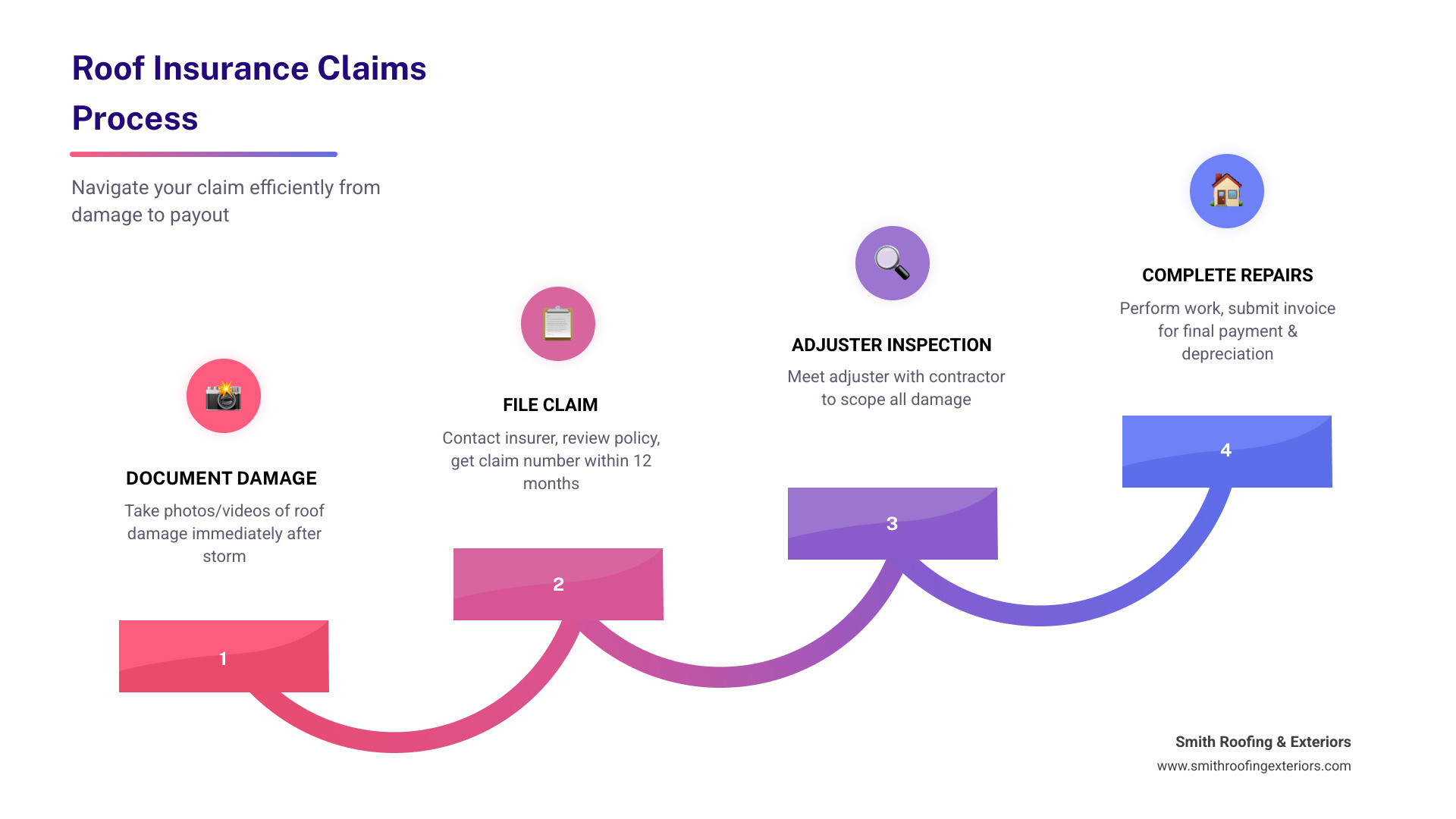
- Document the damage with photos and videos right after the storm
- Contact a licensed roofing contractor for a professional inspection
- Review your policy to confirm coverage, deductible, and deadlines
- File your claim with your insurer and get a claim number
- Meet the adjuster — ideally with your contractor present
- Review the settlement offer and check for recoverable depreciation
- Complete repairs and submit documentation to receive final payment
A few key facts to know upfront:
- The average wind and hail claim paid out $14,747 between 2019 and 2023
- Most claims take 30 to 120 days from filing to final payment
- Insurance covers sudden, accidental damage — not normal wear and tear or neglect
- Many policies pay in two checks: an initial amount, then a second after repairs are complete
- Filing deadlines can be as short as 12 months from the date of damage
Wisconsin homeowners are no strangers to roof damage. Hail, heavy winds, and brutal winters can all leave your roof vulnerable — and navigating the insurance process on top of dealing with the damage can feel overwhelming.
That’s exactly why this guide exists.
I’m Matt Smith, owner of Smith Roofing & Exteriors, and after years of helping Wisconsin homeowners work through roof insurance claims — from the first inspection to the final check — I’ve seen what works, what doesn’t, and what mistakes cost people money. Let’s walk through it together, step by step.
Understanding Your Coverage for Roof Insurance Claims

Before you pick up the phone to call your agent, you need to know what you’re actually paying for. In April 2026, many Wisconsin homeowners are finding that their policies have changed during recent renewals. Insurers are becoming stricter, but the core “covered perils” usually remain the same.
Covered Perils: What Insurance Pays For
Standard homeowners policies (specifically the HO-3 form used by most of us in Southeastern Wisconsin) cover damage that is sudden and accidental. This includes:
- Wind Damage: High gusts that rip off shingles or cause tree limbs to crash onto your home.
- Hail Impact: Hailstones (usually 1 inch or larger) that fracture the fiberglass mat of your shingles.
- Fire and Lightning: Direct strikes or heat damage.
- Falling Objects: That oak tree in your backyard that decided to move into your living room during a storm.
- Weight of Ice and Snow: A major concern for us in Fort Atkinson and Lake Geneva during heavy winters.
RCV vs. ACV: The Big Difference
This is where many homeowners get a nasty surprise. Your settlement depends heavily on which type of coverage you have.
| Feature | Replacement Cost Value (RCV) | Actual Cash Value (ACV) |
|---|---|---|
| Payout Basis | Today’s cost to replace the roof | Depreciated value based on age |
| Out-of-Pocket | Only your deductible | Deductible + years of “wear and tear” |
| Checks Issued | Two (Initial ACV check + Depreciation) | One (Final depreciated amount) |
If your roof is older than 15 to 20 years, some insurers may have automatically switched you from RCV to ACV. Always check your policy for a “Roof Surfacing Payment Schedule,” which limits payouts as the roof ages.
What’s NOT Covered?
Insurance is meant for disasters, not maintenance. They will generally deny claims for:
- Wear and Tear: If your shingles are simply “tired” and losing granules due to age.
- Neglect: If a small leak existed for years and you never fixed it, causing rot.
- Manufacturing Defects: Issues with how the shingles were made (though these might be covered by a manufacturer warranty).
- Cosmetic Damage: Some policies now exclude “cosmetic-only” hail damage that doesn’t affect the roof’s ability to shed water.
To dive deeper into how different materials handle storm impact, check out our guide: Hail No A Guide To Assessing Colorbond Roof Damage And Insurance Payouts.
The 7-Step Guide to Filing Your Claim

Filing roof insurance claims shouldn’t feel like a part-time job. Following a structured process ensures you don’t miss out on the funds you’re entitled to. For a local perspective on handling this in our area, you can also read Navigating Your Insurance Roof Claim In Burlington Like A Pro.
Step 1: Assess and Document the Damage
Safety first! Never climb on a wet or damaged roof. Use binoculars to spot visible signs from the ground. Look for:
- Missing, curled, or cracked shingles.
- Dents on gutters, downspouts, or soft metal vents (these are “collateral damage” that adjusters look for).
- Large piles of shingle granules at the end of your downspouts.
- Water stains on your ceilings or active leaks in the attic.
Take photos and videos of everything. If you have a “breach” (a hole where water is getting in), you are actually required by your policy to perform emergency tarping to prevent further damage. Keep your receipts for these temporary repairs; they are usually reimbursable!
Step 2: Hire a Professional Roofing Contractor
Don’t wait for the insurance company to tell you what’s wrong. Hire a local, licensed, and insured contractor to perform a professional inspection first. We provide a detailed report that acts as evidence for your claim.
Why do you need a contractor early? Because adjusters sometimes miss subtle damage that a trained roofer sees every day. Plus, having an expert on your side helps you avoid the “estimate escape room.” Learn more here: Estimate Escape Room Why Contractors Need Your Insurance Paperwork.
Step 3: Review Your Insurance Policy
Before calling the claims hotline, know your numbers.
- Deductible: Is it a flat $1,000, or is it 1% of your home’s value? On a $400,000 home, a 2% wind/hail deductible is $8,000 out of your pocket!
- Ordinance and Law: This is crucial. It covers the extra cost of bringing your roof up to current Fort Atkinson or Burlington building codes (like adding ice and water shield).
Step 4: Filing Your Roof Insurance Claims Officially
Once you’re sure the damage exceeds your deductible, file your “First Notice of Loss” (FNOL). You can usually do this via your insurer’s app, website, or by calling your agent. You’ll receive a claim number—keep this handy for all future correspondence. Many Wisconsin policies have a 12-month window to file after the storm occurs. For more technical details on the filing process, see this step-by-step guide.
Step 5: The Insurance Adjuster Inspection
The adjuster will visit your home to verify the damage. We strongly recommend having your contractor present during this meeting.
Adjusters use software like Xactimate to calculate costs, but they might not account for local material price hikes or specific roof complexities. We speak their language and ensure they see every dent and fractured shingle. We’ll help them distinguish between “functional damage” (which must be replaced) and “cosmetic damage” (which they might try to skip).
Step 6: Review the Settlement and Recoverable Depreciation
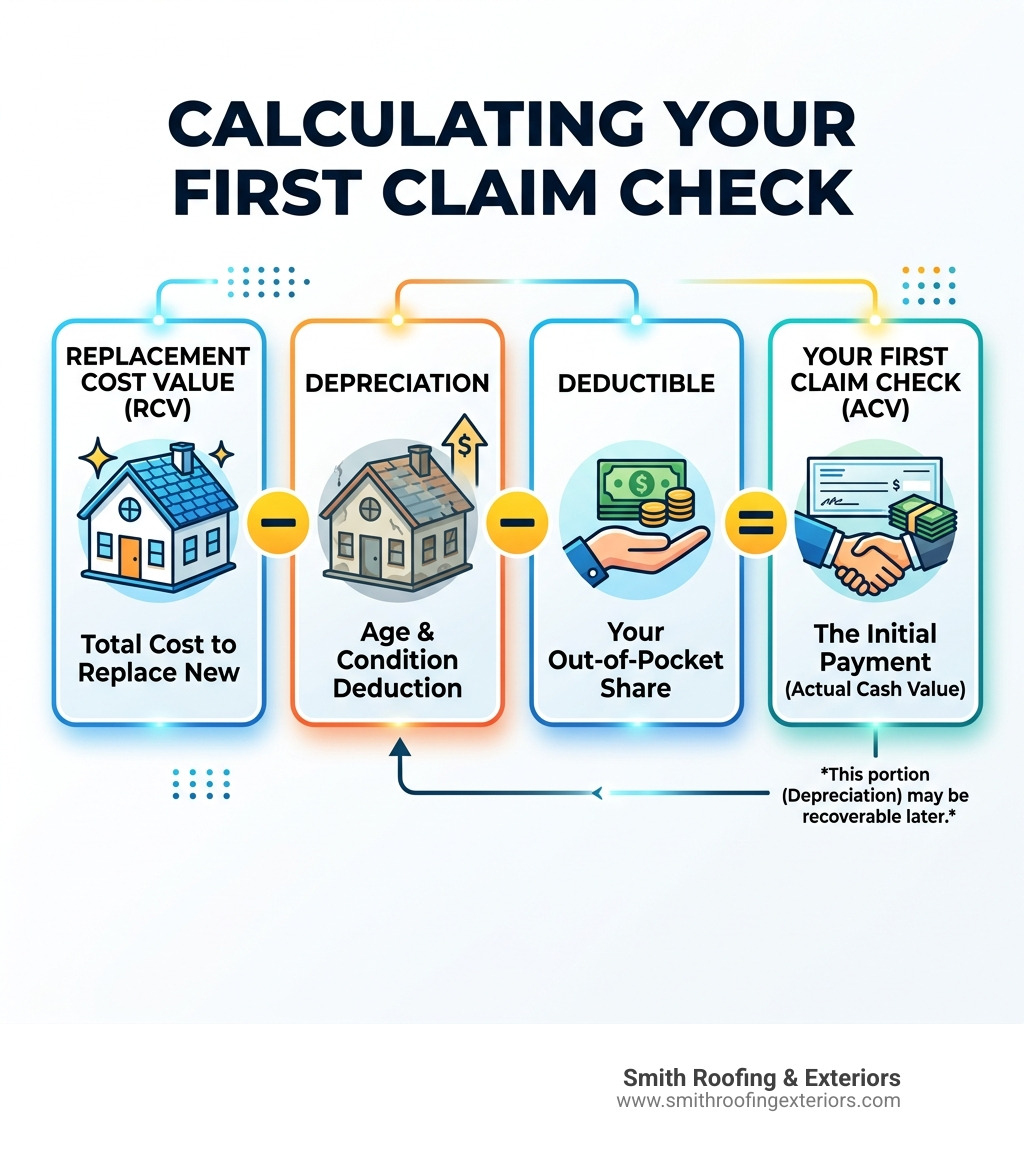
If approved, you’ll receive a “Scope of Loss” and your first check. This check is for the Actual Cash Value (ACV)—the cost to fix the roof minus your deductible and depreciation.
If you have an RCV policy, the “depreciation” is recoverable. This means the insurance company holds onto that portion of the money until the work is finished and you submit a final invoice showing the job is done.
Step 7: Complete Repairs and Close the Claim
Once the work is done, we provide a Certificate of Completion and a final invoice. You send these to your insurer, and they release the final check (the recoverable depreciation). If you have a mortgage, they may need to sign off on the checks as well, which can add a few days to the process.
Deductibles, Settlements, and Denials
Understanding the math behind your settlement is the best way to avoid frustration.
The Math of Recoverable Depreciation
Let’s say your roof replacement costs $20,000.
- Your roof is 10 years old, so the insurer calculates $5,000 in depreciation.
- Your deductible is $1,000.
- First Check: $20,000 – $5,000 (Depreciation) – $1,000 (Deductible) = $14,000.
- Second Check: Once repairs are finished, you get back that $5,000 in depreciation.
Why Claims Get Denied
It happens. The most common reasons for denial in Southeastern Wisconsin include:
- Pre-existing Damage: They claim the damage happened before you bought the policy.
- Lack of Maintenance: They argue the roof failed because you didn’t clean gutters or fix minor issues.
- Below Deductible: The repair cost is $900, but your deductible is $1,000.
- Cosmetic Exclusions: The hail made the roof look ugly but didn’t “break” its function.
If you disagree with a denial, you have options. You can invoke the Appraisal Clause in your policy, which brings in independent appraisers to settle the dispute. You can also file a complaint with the Wisconsin Department of Insurance if you feel you’re being treated unfairly.
Common Mistakes with Roof Insurance Claims
- Hiring “Storm Chasers”: These are contractors who knock on doors after a storm. They often use high-pressure tactics and disappear once they get the first check. Always hire a local company with a physical office in places like Fort Atkinson or Elkhorn.
- Signing an Assignment of Benefits (AOB): This gives the contractor the right to “stand in your shoes” and deal with the insurance company directly. It sounds easy, but it can strip you of your rights and control over the claim.
- Delaying the Filing: Waiting “until next spring” to file for summer hail damage can lead to a denial for “late reporting.”
Frequently Asked Questions about Roof Damage
Will filing a claim raise my insurance premiums?
Not necessarily for a single “Act of God” claim like a hailstorm. However, if an entire ZIP code is hit by a massive storm, insurers often raise rates for the whole area to cover the widespread loss. It’s always best to ask your agent about your specific policy.
How long does the roof claim process typically take?
Most of our clients in Jefferson and Walworth counties see their claims settled within 30 to 60 days. However, if there is a dispute or a massive regional catastrophe, it can stretch to 120 days.
Can I choose my own contractor for the repairs?
Yes. In fact, it is illegal for an insurance company to force you to use a specific contractor. While they may have a “preferred vendor” list, you have the right to hire a local expert you trust.
Conclusion
Dealing with roof insurance claims doesn’t have to be a nightmare. By staying organized, documenting everything, and partnering with a local expert, you can ensure your home is restored to its best condition without unnecessary stress.
At Smith Roofing & Exteriors, we are proud to be the first line of defense for homeowners in Fort Atkinson, Lake Mills, Burlington, and throughout Southeastern Wisconsin. We offer:
- Experienced Local Team: We know Wisconsin weather and local building codes.
- Superior Materials: We only install roofs designed to last.
- 24/7 Emergency Services: If a storm hits at 2 AM, we’re ready to help with tarping and repairs.
- Transparent Pricing: No hidden fees, no “storm chaser” gimmicks.
Don’t let a storm compromise your family’s sanctuary. If you suspect your roof has been damaged, act quickly to protect your investment.
Schedule your professional storm damage assessment today and let us help you navigate your claim with confidence.