Why Drip Edge for Gutters Is the Most Important Detail Most Homeowners Miss
Drip edge for gutters is a small strip of metal flashing installed along your roof’s edge that directs water off the roof and into the gutter — instead of behind it.
Here’s what you need to know at a glance:
- What it does: Channels rainwater from your shingles into the gutter, protecting your fascia board and roof deck
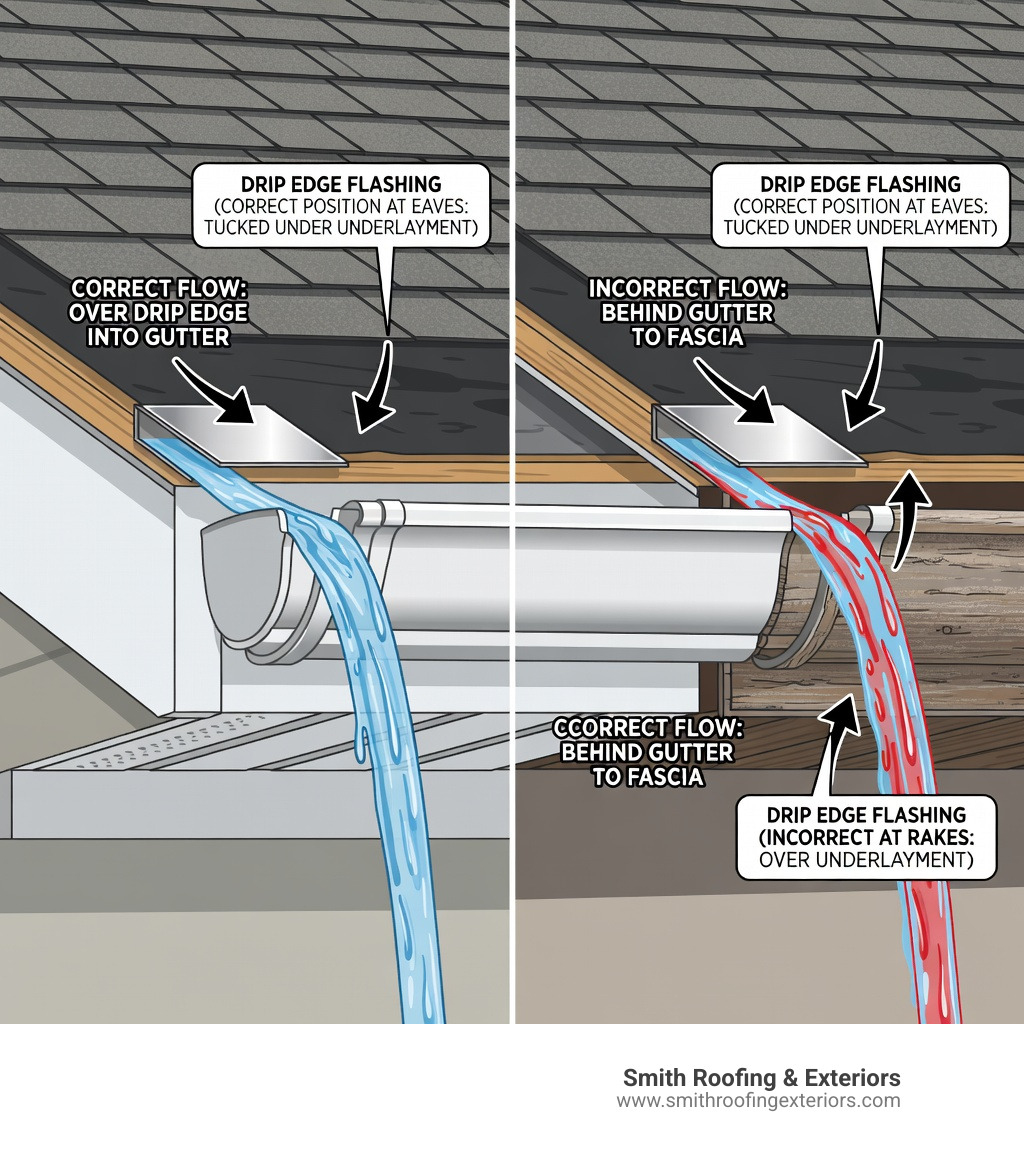
- Where it goes: Under the underlayment at eaves, over it at rakes — and always so the gutter sits behind the drip edge
- Why it matters: Without it, water seeps behind gutters, rots fascia boards, and can damage your home’s foundation
- What it’s made of: Aluminum, galvanized steel, copper, or PVC — typically sold in 10.5-foot lengths
- Code status: Required by most building codes across North America
Most homeowners never think twice about drip edge — until water starts showing up where it shouldn’t. By then, the fascia board is rotting, the gutters are pulling away from the house, and the repair bill is climbing fast. In Wisconsin’s harsh climate, with heavy rain, snow, and freeze-thaw cycles, even a small installation mistake can cause serious damage over a single winter.
I’m Matt Smith, owner of Smith Roofing & Exteriors, and I’ve seen how often drip edge for gutters is either skipped entirely or installed the wrong way — sometimes by well-meaning roofers who just aren’t gutter specialists. In this guide, I’ll walk you through everything you need to know to get it right.
What is a Drip Edge for Gutters and Why is it Essential?

At its core, a drip edge for gutters is an L-shaped or T-shaped piece of metal flashing that bridges the gap between your roof and your gutter system. While it might look like a simple piece of trim, it performs a complex physical task involving water cohesion and surface tension.
Without a drip edge, water doesn’t always just fall straight down. Due to capillary action, water has a tendency to “cling” to the underside of your shingles or the edge of your roof deck. Instead of landing in the gutter, it curls backward, running down the fascia board and even soaking into the roof sheathing.
If you find yourself needing gutter repair services because your gutters are sagging or pulling away, the culprit is often a missing or poorly installed drip edge. When water consistently hits the fascia board (the wooden board behind your gutters), it rots. Eventually, the wood becomes too soft to hold the gutter spikes or brackets, and the whole system fails.
Beyond water management, a drip edge serves as a vital pest deterrent. It seals the “builders gap” between the roof deck and the fascia, preventing squirrels, bats, and wasps from making a home in your attic. For a deeper look at the mechanics, This Old House provides a great overview of installing a roof drip edge.
Materials and Profiles: Drip Edge vs. Gutter Apron
Choosing the right material and shape for your drip edge for gutters is critical for longevity. In Southeastern Wisconsin, we deal with heavy snow loads and high winds, so “cheap” is rarely “cost-effective.”
| Material | Pros | Cons | Best For |
|---|---|---|---|
| Aluminum | Rust-proof, easy to work with, matches most gutter colors. | Can be thin (needs 0.019″ – 0.024″ gauge). | Most residential homes. |
| Galvanized Steel | Extremely strong, withstands high winds and ice. | Can eventually rust if the coating is scratched. | High-wind areas; commercial roofs. |
| Copper | Lifetime durability, beautiful patina. | Very expensive; requires specialized installation. | High-end custom homes. |
| PVC / Vinyl | Inexpensive, won’t rust or dent. | Can become brittle in WI winters; limited color options. | Budget-conscious repairs. |
Understanding Profiles
Not all drip edges are shaped the same. There are three main profiles you’ll encounter:
- Type C (L-Style): A basic 90-degree bend. It is common but often requires a “furring strip” to keep the water far enough away from the fascia.
- Type D (T-Style): Shaped like a “T” with a protruding lip at the bottom. This is the gold standard because it pushes water further away from the house.
- Type F (Gutter Apron): This has a longer “face” (the part that hangs down). It is specifically designed for eaves where gutters are present. If you are considering gutter replacement, we often recommend gutter apron because it covers more of the fascia and ensures every drop of water makes it into the trough.
Most drip edges are sold in 10.5-foot lengths. For maximum durability, we look for hemmed edges, which provide extra rigidity and prevent the metal from cutting the installer or the roofing underlayment.
Professional Installation Standards and Pitch Requirements
Installing a drip edge for gutters isn’t just about nailing metal to wood; it’s about the “layering” of the roof system. If you get the layers wrong, you’re essentially building a funnel for water to enter your home.
The industry standard for installation follows these rules:
- Eaves (Horizontal edges): The drip edge goes on before the underlayment. This ensures that if any water gets under the shingles, it flows over the underlayment and then over the drip edge.
- Rakes (Sloping edges): The drip edge goes on after the underlayment. This protects the underlayment from being lifted by wind-driven rain.
- The Overhang: The metal should extend about 3/4 of an inch beyond the fascia board to ensure water clears the wood entirely.
Nails should be spaced every 12 inches (maximum 16 inches) to prevent the metal from buckling during Wisconsin’s temperature swings. In high-wind areas, we also apply a bead of roofing cement to secure the flange. For those looking for technical specifications, you can consult this DripEdge Install Guide. Additionally, if you are installing gutter guards, the drip edge must be positioned perfectly so the guard can tuck under it without creating a “shelf” for debris.
Correct Positioning of Drip Edge for Gutters
This is the most common mistake we see: the gutter must be tucked behind the drip edge.
Think of it like a waterfall. The drip edge is the ledge, and the gutter is the pool below. If the “ledge” is behind the “pool,” the water just falls into the gap. When we perform a gutter installation in Burlington, we ensure the back of the gutter is slid up underneath the drip edge. This creates a continuous metal path for water to travel from the shingles into the gutter.
How Gutter Pitch Affects Drip Edge for Gutters
Here is where things get tricky. Gutters are not installed level; they are pitched (sloped) at about 1/4 inch per 10 feet toward the downspout to ensure drainage. However, your roofline is usually level.
This creates a widening gap between the drip edge and the gutter as you move toward the downspout. On a long run of 40 feet, the gutter might sit an inch lower than the drip edge at the downspout end.
- The Solution: For long runs, we often use a “gutter apron” or “slip metal” (also called a cheater strip) to bridge that gap.
- The Rule of Thumb: To minimize extreme gaps, we recommend one downspout for every 600 square feet of roof area. This allows us to keep the pitch manageable.
Troubleshooting Common Mistakes and FAQ
If you’re worried about your current setup, look for these “red flags” of a bad drip edge for gutters installation:
- Water leaking behind the gutter: You can see water stains or “tiger stripes” on the fascia board.
- Moss or mold: Green growth on the fascia or the underside of the roof deck.
- Peeling paint: This is a sign that the wood is constantly damp.
- Ceiling leaks: Sometimes water travels so far back it enters the soffit and leaks into your exterior walls.
If you find that your roofers didn’t install the drip edge correctly, you might not have to tear the whole roof off. According to the Contractor Directory, you can replace a drip edge without removing shingles by using a flat pry bar to carefully lift the shingles and remove the existing nails.
Should the gutter go under or over the drip edge?
The gutter should always go under (behind) the drip edge. If the gutter is installed over the drip edge, water will simply run behind the gutter, rot your fascia, and eventually cause your gutters to fall off.
Can you replace drip edge without removing shingles?
Yes! It is a two-person job. One person carefully lifts the first row of shingles with a flat pry bar while the other removes the old nails and slides the new metal into place. It’s tedious but much cheaper than a new roof.
What are the building code requirements for drip edge?
While it used to be optional, the International Residential Code (IRC) and ARMA (Asphalt Roofing Manufacturers Association) now require drip edge for most new roof installations. In Wisconsin, it is considered a best practice for all “conditioned” buildings to prevent ice dam damage.
Conclusion
A drip edge for gutters might be a small component, but it’s the “glue” that holds your roofing and gutter systems together. Without it, you’re just waiting for rot to set in. Whether you’re in Fort Atkinson, Lake Geneva, or Delavan, our team at Smith Roofing & Exteriors is here to make sure your home is protected from the top down.
Don’t wait until you see moss on your fascia or puddles in your basement. If you’re unsure about the state of your roof’s perimeter, give us a call for a professional inspection. We specialize in transparent pricing and superior materials that stand up to Wisconsin weather. Protect your home with professional gutter services and ensure your drip edge is doing its job today!