What Does an Asphalt Shingle Roof Cost Per Square Foot?
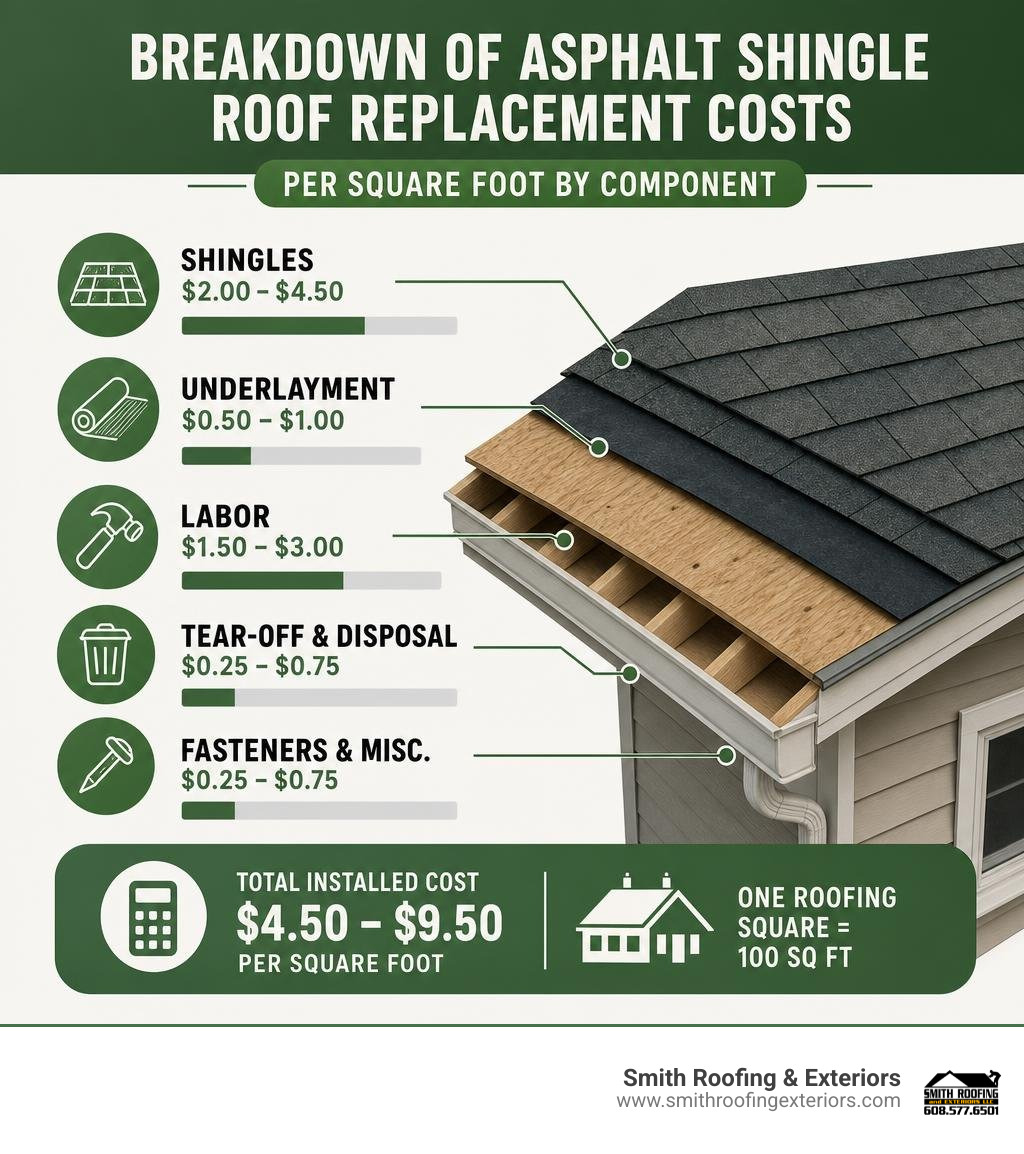
The cost of asphalt shingle roof installation per square foot in 2026 typically falls between $4.50 and $9.50 installed, depending on shingle type, roof complexity, and where you live. Here’s a quick snapshot:
| Shingle Type | Cost Per Square Foot (Installed) |
|---|---|
| 3-Tab Asphalt | $3.50 – $5.50 |
| Architectural (Dimensional) | $5.00 – $8.00 |
| Premium / Luxury | $6.50 – $11.00 |
For a typical 2,000 sq ft home, that translates to a total project cost of roughly $9,000 to $22,000, with most Wisconsin homeowners landing somewhere in the middle.
A few things to know upfront:
- Material costs alone are just 40–60% of that number — labor, tear-off, and materials like underlayment make up the rest.
- One roofing square = 100 square feet. Contractors often quote by the square, so divide by 100 to get your per-square-foot price.
- Regional pricing matters. Midwest markets tend to run slightly below the national average.
I’m Matt Smith, owner of Smith Roofing & Exteriors, and after years of helping Wisconsin homeowners navigate the real cost of asphalt shingle roof replacement per square foot, I know how confusing contractor quotes can be. This guide breaks it all down so you can budget with confidence.
Cost of asphalt shingle roof per square foot word roundup:
The Real Cost of Asphalt Shingle Roof per Square Foot in 2026
When planning a home improvement project of this scale, understanding the baseline metrics is key. In the roofing industry, we talk in terms of “squares,” but as a homeowner, you probably want to know how that translates directly to your wallet on a square-foot basis.
The national average to install a new asphalt shingle roof ranges from $3.40 to $5.95 per square foot for basic replacements, but when you look at all-in costs in 2026—which include local permits, tear-off, and regional labor rates—most homeowners pay between $4.50 and $9.50 per square foot installed.
Understanding the real price of replacing your asphalt shingle roof requires looking past the cheap, raw material prices advertised at retail stores. The total cost is a combination of material quality, local labor wages, overhead, and the unique structural demands of your home. If you compare this to other options on the market, as detailed in this guide on roof cost per square foot in 2026: asphalt, metal, tile, slate | TRB, you will see that asphalt remains the most cost-effective and versatile choice for residential properties in Southeastern Wisconsin.
Average Cost of Asphalt Shingle Roof per Square Foot by Shingle Type
The specific type of asphalt shingle you select is one of the most significant factors in your final estimate. Asphalt shingles generally fall into three categories:
- 3-Tab Asphalt Shingles ($3.43 – $4.65 per sq. ft. installed): These are the traditional, flat, single-layer shingles that have been the industry standard for decades. While they are the most budget-friendly option upfront, they carry a shorter lifespan (typically 15 to 20 years) and are only wind-rated up to 60 mph. In Wisconsin, where we experience heavy snow and strong winds, 3-tab shingles are increasingly phased out in favor of more durable options.
- Architectural (Dimensional) Shingles ($4.11 – $5.57 per sq. ft. installed): Accounting for roughly 75% of the residential roofing market, architectural shingles feature multiple laminated layers of fiberglass and asphalt. This gives them a rich, three-dimensional look that mimics wood shake or slate. They typically offer a 30-year warranty, a Class A fire rating, and wind resistance up to 110–130 mph. They represent the best balance of cost, performance, and aesthetic appeal.
- Premium / Luxury Shingles ($4.39 – $5.95+ per sq. ft. installed): These are thick, heavy-duty shingles designed to replicate natural slate or hand-split wood shakes. They offer maximum durability, impact resistance (often Class 4 rated), and lifespans extending up to 50 years.
To explore how these material tiers affect your budget over time, read our detailed breakdown on the price of protection asphalt shingle costs.
Materials vs. Total Installed Costs
One of the most common points of confusion for homeowners is the difference between retail material pricing and professional installation quotes. If you walk into a major home improvement retailer in the Burlington or Delavan area, you will see individual bundles of architectural shingles (such as GAF Timberline HDZ) priced between $38.97 and $40.97 per bundle.
Since one standard bundle covers 33.33 square feet, you need three bundles to cover one roofing square (100 square feet). This means your raw shingle material cost is roughly $1.17 to $1.23 per square foot (or about $117 to $123 per square). If you buy in bulk (typically 36 bundles or more), you might qualify for a retail discount of around 10%, bringing the cost down to about $35.07 to $36.87 per bundle.
However, the shingles themselves only account for 25% to 35% of a professional contractor’s total quote. The rest of the estimate covers:
- Labor Costs: Professional roofing is highly physical, high-risk work that requires specialized safety equipment, tools, and training. Labor typically accounts for 50% to 60% of the total project cost.
- Accessory Materials: A complete, warrantied roof system requires synthetic underlayment, ice and water shields, starter shingles, ridge caps, drip edges, flashing, and ventilation components.
- Disposal and Equipment: Renting roll-off dumpsters, hauling tons of heavy debris, and utilizing specialized tools like magnetic sweepers and power nailers.
- Contractor Overhead and Warranties: Standard business operations, liability insurance, workers’ compensation, and the cost of providing a solid workmanship warranty.
For a deeper dive into how these individual line items are structured, check out this guide on asphalt shingle roof cost (2026 pricing guide) | RoofCostCalculator.
Key Factors That Drive Your Roofing Estimate Up or Down
No two residential roofs are exactly alike. Even two identical floor plans on the same street in Lake Geneva or Fort Atkinson can receive quotes that differ by thousands of dollars due to structural and accessibility factors.
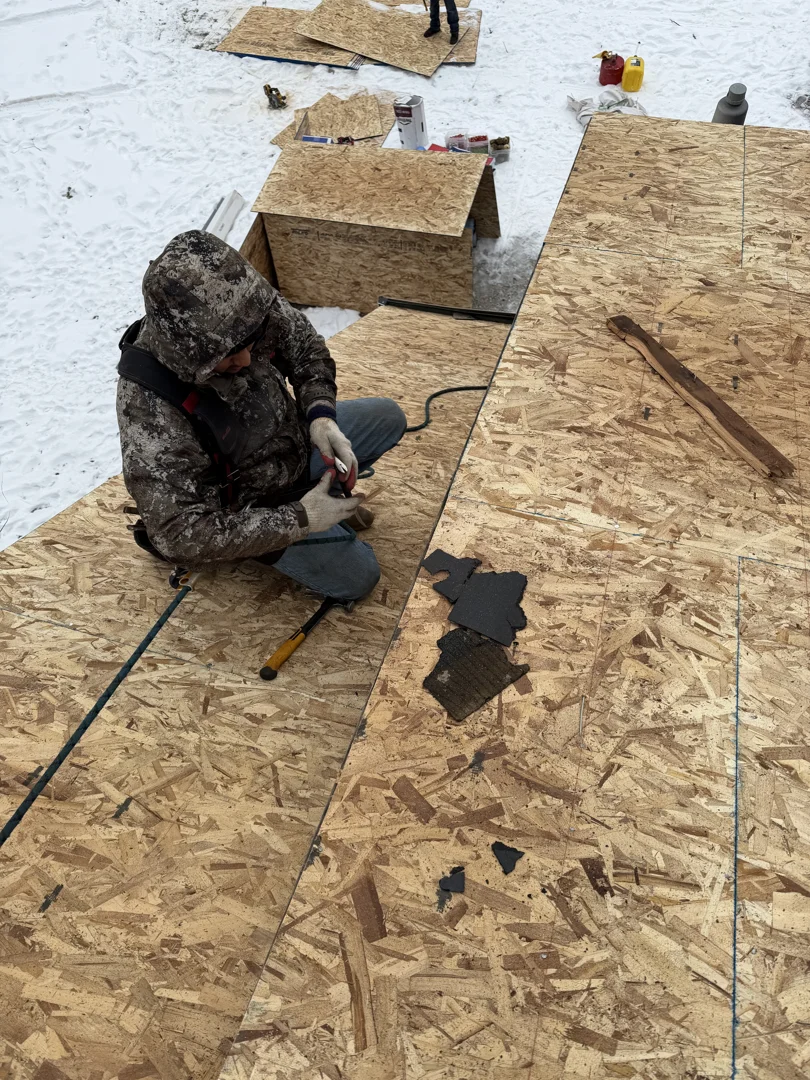
When we evaluate a property to provide an accurate estimate, we look at several physical characteristics of the structure that directly impact labor difficulty and material waste. For a comprehensive look at how these elements interact, read our in depth guide to roof replacement cost.
Roof Size, Pitch, and Architectural Complexity
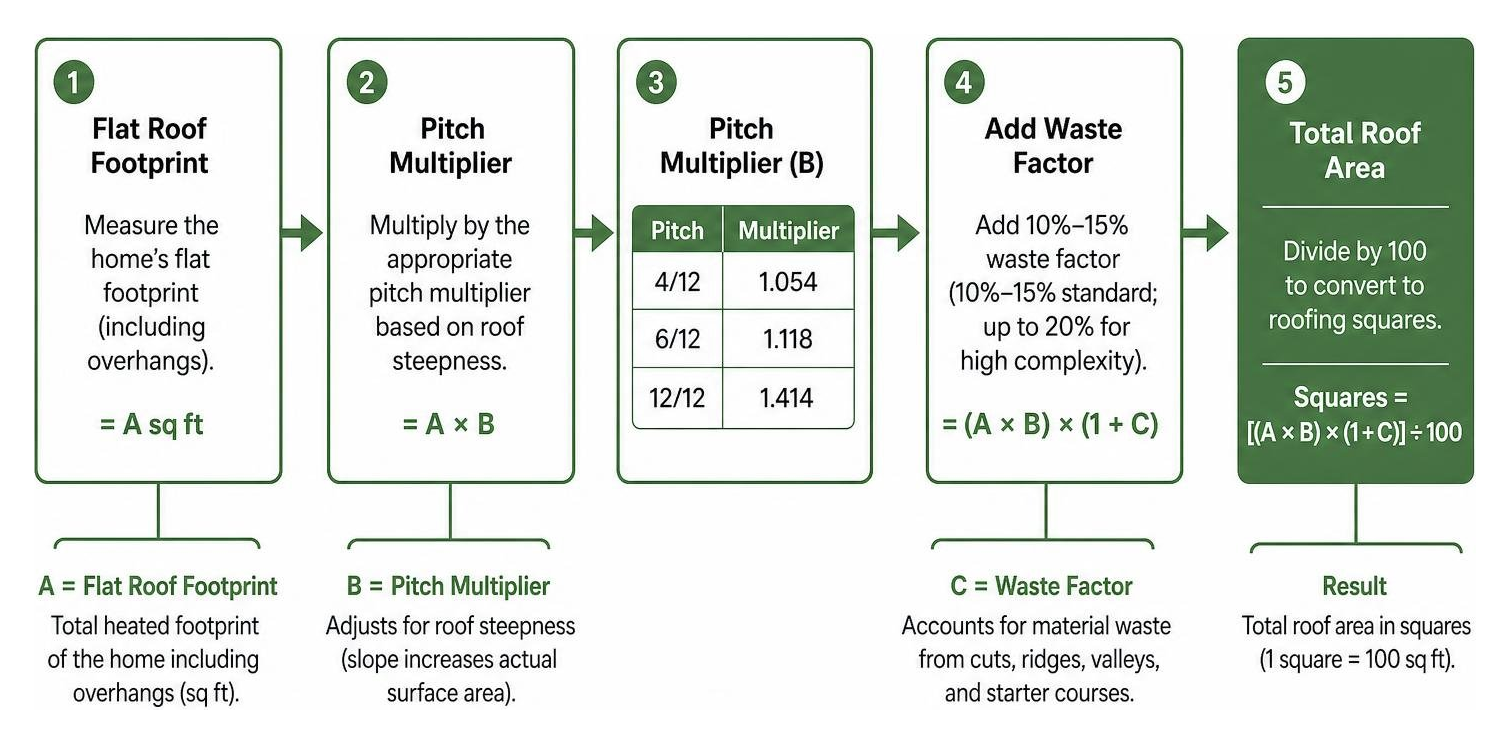
The size of your home’s heated living space does not equal the size of your roof. Many homeowners make the mistake of assuming a 2,000-square-foot house requires exactly 2,000 square feet of roofing. In reality, your roof’s surface area is significantly larger due to overhangs, eaves, and—most importantly—the pitch (steepness) of the roof.
To find the actual roof surface area, we multiply the flat footprint of the home (including overhangs) by a specific pitch multiplier:
- Low Pitch (4/12 pitch): Multiplier of 1.054
- Medium Pitch (6/12 pitch): Multiplier of 1.118
- Steep Pitch (12/12 pitch): Multiplier of 1.414
For example, a home with a flat footprint of 2,000 square feet and a steep 12/12 pitch will actually have a roof surface area of approximately 2,828 square feet before adding a waste factor.
Additionally, we must account for a waste factor of 10% to 15% (and up to 20% for highly complex roofs with multiple valleys, dormers, and hips). This covers the material cut away and discarded during the installation of valleys, ridges, and starter courses.
How Labor Rates Impact the Cost of Asphalt Shingle Roof per Square Foot
Labor rates are heavily influenced by the local economy, contractor insurance requirements, and the complexity of the installation. In mid-tier Midwestern markets, professional roofing labor typically runs between $1.50 and $4.50 per square foot.
This labor rate covers a structured crew consisting of lead roofers (who earn higher specialized wages) and general installation laborers. When evaluating quotes, keep in mind that a contractor’s markup—which typically ranges from 13% to 22%—is built into the final labor and material figures to cover general liability insurance, workers’ compensation, and administrative overhead.
Choosing a contractor based solely on the lowest labor rate can be a major risk. Lower-priced bids often indicate that the company uses temporary subcontractors rather than an in-house team, or lacks proper liability and workers’ compensation insurance. To understand how labor rates and crew efficiency translate into your final bill, you can consult this resource on average cost per square asphalt shingle roof: price range and drivers 2026 – current cost.
Regional Price Swings and Climate Considerations
Geography plays a massive role in construction costs. While national databases provide a broad average, local labor availability, municipal permit fees, and regional climate demands dictate what you will actually pay.
In Southeastern Wisconsin—including communities like Fort Atkinson, Jefferson, Lake Mills, and Edgerton—our climate requires specific roofing standards that may not be necessary in southern states. The International Residential Code (IRC) mandates that homes in cold climates prone to freezing temperatures must have an ice and water barrier installed at the eaves. This self-adhering membrane must extend from the lowest eave edge to a point at least 24 inches inside the exterior wall line to protect against ice damming.
Additionally, heavy winter snow loads mean we must carefully inspect the structural integrity of the wood decking during every replacement. If your roof deck has suffered water damage or sagging from previous winter seasons, it must be replaced to ensure the new shingles have a solid, flat surface to nail into.
Hidden and Additional Costs in a Roof Replacement Quote
When you receive a professional roofing estimate, the “headline” price per square foot often covers the standard material and basic installation labor. However, there are several necessary steps and potential structural discoveries that can add to your final invoice.
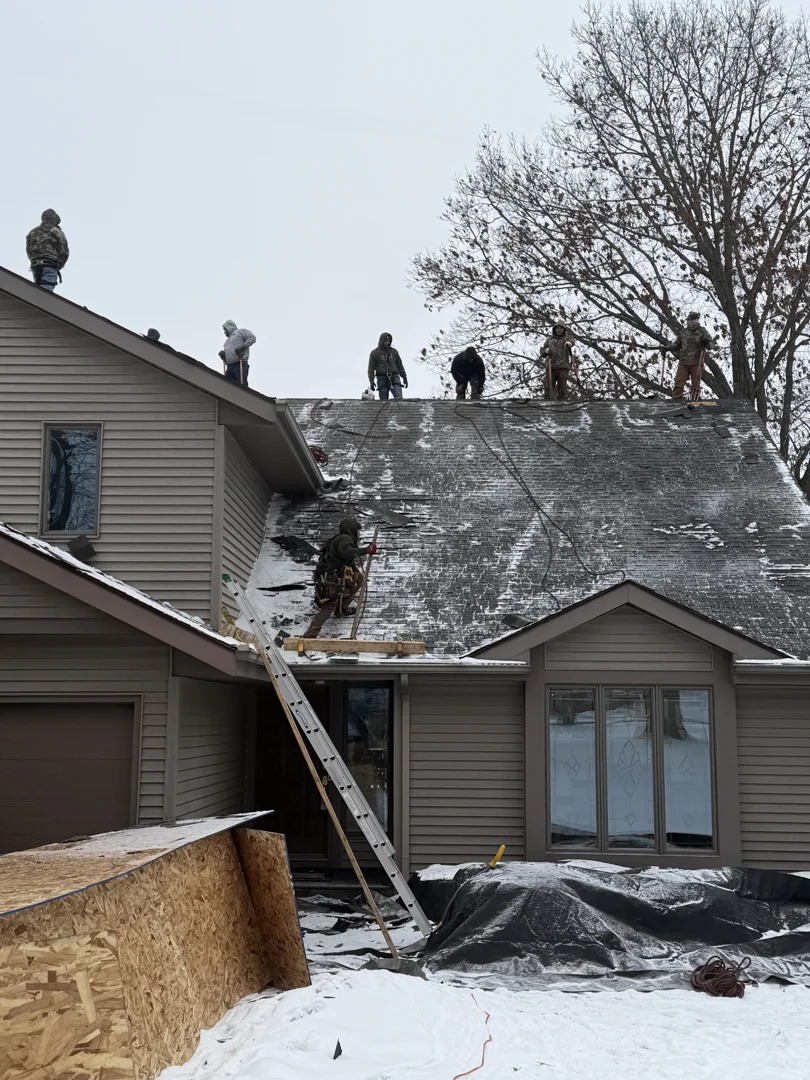
Understanding these hidden expenses beforehand prevents unexpected surprises mid-project. If you are trying to decide whether a complete replacement is necessary or if a minor repair will suffice, refer to our guide on roof repair vs replacement what’s the right move.
To help you budget, here is a breakdown of common additional expenses that may be itemized in your quote or added as a change order if rot is discovered after tear-off:
- Decking Replacement: $2.20 to $3.00 per square foot (or $80 to $135 per 4×8 sheet of plywood/OSB).
- Underlayment Installation: $1.50 to $2.10 per square foot.
- Ice and Water Shield: $1.87 to $2.53 per square foot.
- Fascia Board Replacement: $4.25 to $8.62 per linear foot.
- Soffit Replacement: $2.80 to $5.28 per linear foot.
- Roof Flashing: $9.00 to $11.00 per linear foot.
- Pipe Boot Replacement: $63.00 to $85.00 per boot.
- New Gutters: $5.00 to $14.00 per linear foot.
For a comprehensive overview of how these individual components protect your home, you can review this guide on asphalt shingle roof cost (2026): $9K-$22K average.
Tear-Off and Old Shingle Disposal Fees
Unless you are performing a simple overlay (which we generally advise against), your old roofing materials must be completely removed, loaded into a dumpster, and hauled to a local landfill.
Removing and disposing of a single layer of existing asphalt shingles typically costs between $0.39 and $0.53 per square foot (or $40 to $80 per square). However, if your home has multiple layers of old shingles hidden beneath the surface, the tear-off cost can double. Tearing off two or more layers of old roofing requires significantly more physical labor, generates twice the weight in landfill fees, and slows down the overall project timeline.
A standard 22-square roof replacement generates approximately 4 to 5 tons of heavy waste material. Ensuring that your contractor includes dumpster rental fees, municipal landfill permits, and a thorough yard cleanup with magnetic sweeping tools in their written estimate is crucial to avoiding unexpected bills at the end of the job.
Decking, Underlayment, and Ice Barrier Upgrades
Once the old shingles are removed, the raw wood decking (usually plywood or oriented strand board) is exposed. If we find soft spots, water rot, or delaminated wood, those sections must be replaced immediately. Laying new shingles over rotted wood deck boards will cause the nails to pull out, leading to loose shingles, leaks, and a voided manufacturer warranty.
After ensuring the deck is structurally sound, we install the underlayment and barrier layers:
- Synthetic Underlayment: While older roofs used 15-lb organic felt paper, modern best practices dictate using synthetic underlayment. It is highly tear-resistant, does not absorb moisture, and provides a superior secondary water barrier beneath your shingles.
- Ice and Water Shield: This thick, rubberized asphalt membrane is applied directly to the wood deck along eaves, valleys, and around penetrations (like chimneys and skylights). It self-seals around roofing nails to prevent water from backed-up ice dams from leaking into your home.
- Drip Edge: A metal flashing installed along the edges of your roof to direct water away from the fascia boards and into your gutters, preventing wood rot along the roof’s perimeter.
Frequently Asked Questions about Asphalt Shingle Roofing Costs
How many bundles of shingles do I need for a 2,000 square foot roof?
To calculate the exact number of shingle bundles you need, you must first convert your home’s square footage into roofing squares and account for your roof’s pitch and waste factor.
For a 2,000-square-foot home footprint with a standard 6/12 pitch, the actual roof surface area is approximately 2,236 square feet (2,000 x 1.118 pitch multiplier). To convert this to roofing squares, divide by 100, which gives you 22.36 squares.
Next, you must add a standard 12% waste factor to account for starter courses, hip and ridge caps, and valley cuts:
- 22.36 squares x 1.12 = 25.04 squares needed.
Since there are exactly 3 bundles of standard architectural shingles in a square, you multiply your total squares by 3:
- 25.04 squares x 3 = 75.12 bundles.
Therefore, you should order 76 bundles of shingles to ensure you have enough material to complete the job without running short.
Is it cheaper to overlay shingles instead of doing a full tear-off?
Yes, performing a shingle overlay (installing a second layer of shingles directly over your existing roof) is cheaper upfront because it eliminates the labor and disposal costs associated with tearing off the old roof. Most local building codes in Southeastern Wisconsin allow for up to two layers of asphalt shingles on a residential structure.
However, we strongly advise against this practice for several long-term reasons:
- Hides Decking Damage: An overlay prevents us from inspecting the underlying wood deck for rot, mold, or structural sagging.
- Traps Heat and Moisture: A second layer of shingles traps heat in your attic, which can bake the new shingles from underneath and significantly shorten their lifespan.
- Adds Massive Weight: Shingles are heavy (weighing approximately 2.2 lbs per square foot). Adding a second layer places thousands of pounds of extra stress on your home’s framing.
- Voids Warranties: Many leading shingle manufacturers will void or severely limit their product warranties if the shingles are installed over an existing layer.
What is the “25% rule” in roof replacement?
The “25% rule” is an industry standard and building code guideline used by insurance adjusters and contractors alike. It states that if more than 25% of a roof’s total surface area—or any single major roof slope—is damaged by a storm, wind, or hail, a complete roof replacement is required rather than localized repairs.
This rule is highly beneficial for homeowners dealing with storm damage insurance claims. If a severe windstorm damages a significant portion of one side of your roof, your insurance carrier is typically required to cover the cost of a full roof replacement rather than just patching the damaged section, ensuring your entire home remains uniform and structurally secure.
Conclusion
Replacing your home’s roof is a significant financial investment, but understanding the real factors behind the cost of asphalt shingle roof per square foot empowers you to make informed decisions. By choosing the right shingle tier, understanding how pitch and complexity affect labor, and budgeting for necessary accessory upgrades like ice and water shields, you can ensure your home remains protected for decades to come.
When searching for a contractor, the lowest bid is rarely the best value. Look for an established, local company that uses in-house installation teams, provides transparent, itemized estimates, and offers robust workmanship warranties. To learn more about selecting a trustworthy partner for your project, read our guide on don’t get shingled: a guide to finding reliable asphalt roofing contractors.
At Smith Roofing & Exteriors, we pride ourselves on providing the homeowners of Fort Atkinson, Lake Mills, Jefferson, and the surrounding Southeastern Wisconsin communities with honest, transparent pricing and superior craftsmanship. We never cut corners on essential components like underlayment or ventilation, and we stand behind every roof we install.
Ready for an accurate, transparent quote tailored to your home? Contact Smith Roofing & Exteriors today to schedule a professional roof inspection and receive a detailed, itemized estimate from our experienced local team.