Is HardiePlank Siding Right for Your Home?
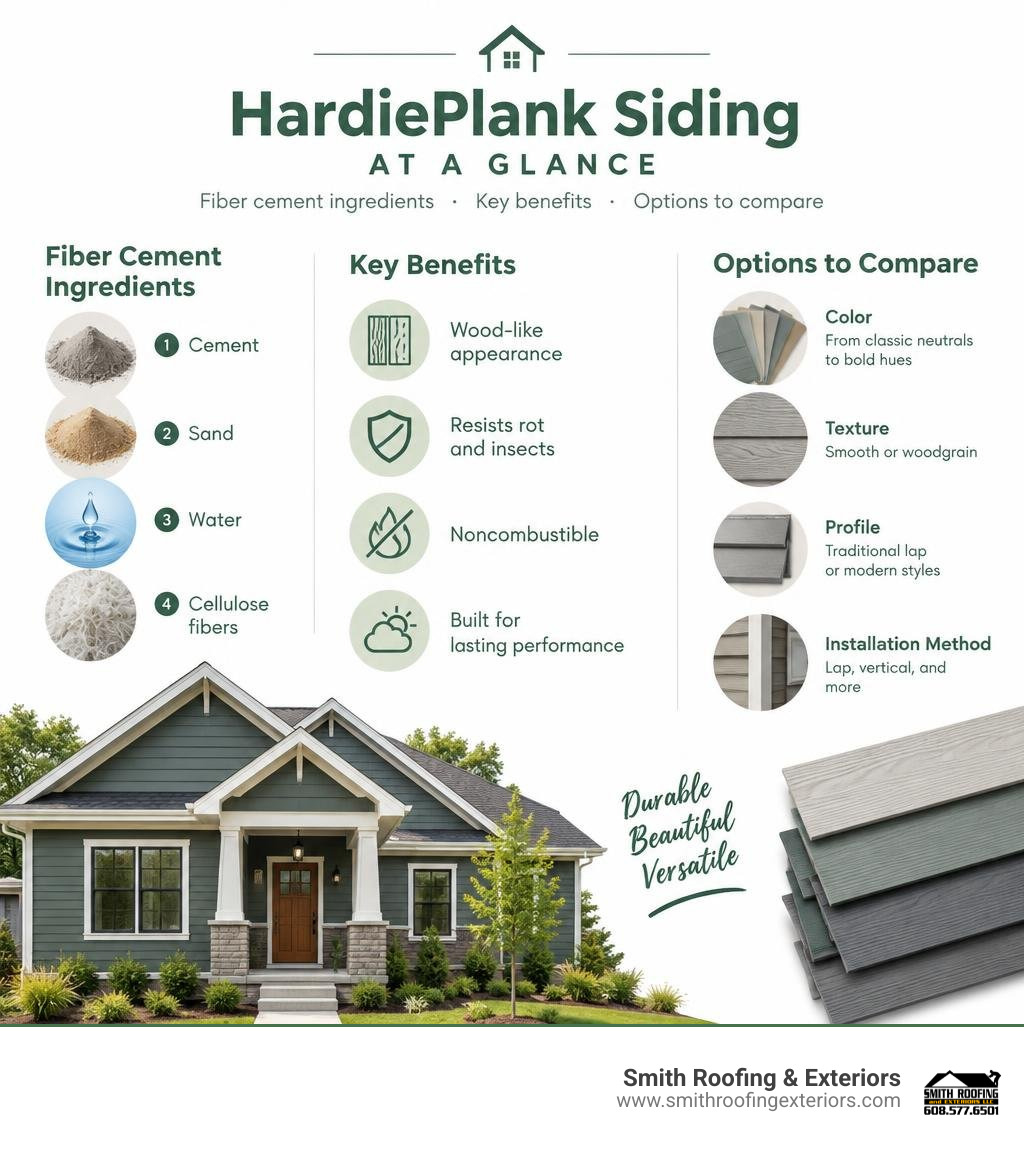
HardiePlank siding is fiber cement lap siding made from cement, sand, water, and cellulose fibers. It gives you a wood-like look without wood’s risk of rot or insect damage. It is also noncombustible. For a home in Wisconsin, the key is to choose the right climate-rated product and have it installed with proper flashing and clearances.
Your choice goes beyond color. Board texture, finish, profile, and installation method all affect how the siding looks and performs. This guide will help you compare those options before you request a quote.
I’m Matt Smith, owner of Smith Roofing & Exteriors. I help homeowners weigh the short- and long-term value of exterior projects, including hardie plank siding, so they can make a choice that fits their home.
Installed on over 5.5 million homes across North America, this siding material has earned its reputation through sheer resilience and high-end curb appeal.
Exploring Hardie Plank Siding Specifications, Profiles, and Material Benefits
Choosing the right cladding requires understanding what makes the material tick. When you look beneath the surface of fiber cement, you see an engineered formulation designed to outlast traditional building materials.
Fiber Cement Composition and Material Advantages
HardiePlank is manufactured from a precise blend of Portland cement, fine silica sand, cellulose fibers, and water. This composite curing process yields a dense, non-combustible substrate that is completely immune to wood-boring pests, woodpeckers, and rot. Unlike organic wood, which expands, rots, and attracts termites, fiber cement stays structurally stable through severe weather.
When evaluating exterior cladding, reviewing a practical guide to comparing siding replacement options can help you weigh durability against upfront investment. While vinyl siding offers a low entry cost, it expands and contracts significantly, can become brittle in freezing temperatures, and easily melts when exposed to intense heat or fire. HardiePlank provides a much lower CO₂ footprint in its product class while offering a lifespan of several decades.
| Feature / Metric | HardiePlank Fiber Cement | Cedar Wood Siding | Standard Vinyl Siding |
|---|---|---|---|
| Material Composition | Portland cement, sand, cellulose fibers | Natural organic timber | Polyvinyl chloride (PVC) |
| Fire Safety Rating | Non-combustible (ASTM E136 / A2-s1, d0) | Combustible (Ignites easily) | Melts and burns under heat |
| Pest & Rot Resistance | Immune to termites, rot, and woodpeckers | Prone to rot, insects, and fungi | Immune to pests; traps hidden moisture |
| Wind Resistance | Rated up to 150 mph | Variable based on nailing | Prone to blow-offs in storms |
| Maintenance Needs | Low (Occasional wash, rare repainting) | High (Staining/painting every 3–5 yrs) | Low (Prone to cracking and warping) |
| Expected Lifespan | Decades (30-year substrate warranty) | 15–30 years (with heavy upkeep) | 20–30 years (fades over time) |
Comparing Hardie Plank Siding Styles, Textures, and ColorPlus Finishes

HardiePlank offers an array of architectural styles that match both historic homes and modern builds:
- Select Cedarmill: Features a deep, natural woodgrain texture that convincingly mimics traditional rough-hewn cedar without any splintering or decay.
- Smooth: A clean, crisp, minimalist finish that works well on contemporary architecture and mid-century renovations.
- Beaded Cedarmill: Inspired by coastal and Southern architectural traditions, this profile incorporates a decorative bead along the bottom edge with a rich woodgrain face.
- Beaded Smooth: Combines the elegant shadow line of a beaded lower edge with an ultra-smooth, modern face.
Beyond surface profiles, James Hardie offers factory-applied finishes. Exploring James Hardie exterior siding solutions gives you access to the Statement Collection, featuring 21 standard colors curated for lasting appeal. These boards use ColorPlus® Technology—a proprietary finish where multi-coat paint is baked onto the boards in a factory-controlled environment.
This process delivers up to 30% better fade resistance against harsh ultraviolet radiation compared to standard field-applied paint. When planning your remodeling budget, calculating the real cost of Hardie panel siding in 2026 ensures you account for the long-term savings of factory-finished fiber cement over frequent exterior repainting.
Hardie Plank Siding vs Hardie VL Plank Dimensions and Profiles
Standard lap planks are engineered for traditional overlapping horizontal runs. Each plank is typically 8.25 inches wide, 12 feet long, and 5/16-inch (8 mm) thick, weighing roughly 16.3 to 21 lbs (about 7.4 kg) while delivering approximately 7 square feet of visible wall coverage depending on the lap exposure.
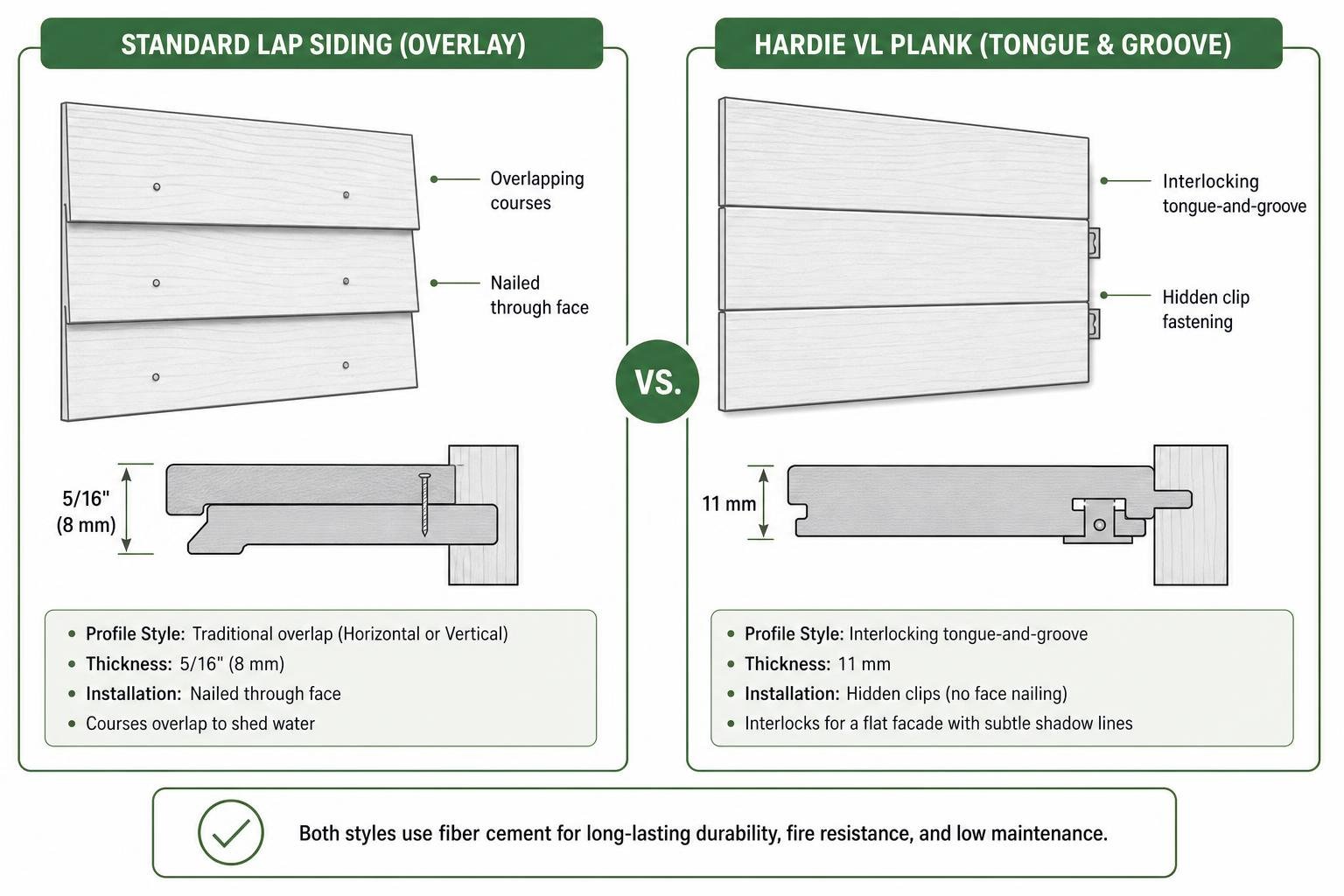
By contrast, products like Hardie VL Plank use an interlocking tongue-and-groove system. Rather than overlapping courses, VL profiles interlock to create a flat facade with subtle shadow lines. The boards are thicker at 11 mm to support the precision-machined edge profile and install with hidden clips rather than blind nailing through the face.
| Specification | Standard HardiePlank Lap | Hardie VL Plank |
|---|---|---|
| Profile Style | Traditional overlap (Horizontal or Vertical) | Interlocking tongue-and-groove |
| Nominal Board Thickness | 8 mm (approx. 5/16 in.) | 11 mm |
| Fastening System | Blind nailing (Face nails in high winds) | Hidden screw and clip system |
| Visual Appearance | Classic stepped lap shadow lines | Flat, flush surface with clean channel joints |
| Available Color Palette | 21 Statement colors + primed | 8 core contemporary shades |
| Installation Speed | Fast clip-less overlap with lap gauges | Interlocking assembly with hidden hardware |
Performance, Climate Engineering, and Installation Standards
Fiber cement delivers outstanding exterior protection, but achieving maximum performance depends on choosing the correct regional formulation and adhering to strict building practices.
Engineered for Climate System, Wind Resistance, and Fire Safety Ratings
James Hardie engineered its product lines around regional weather extremes through the HardieZone® system:
- HZ5® Product Line: Specially engineered for northern climates that face sub-zero temperatures, freezing rain, snow, and severe freeze-thaw cycles. It features low water absorption and specialized edge profiles to shed melting snow.
- HZ10® Product Line: Formulated for southern and coastal zones, resisting high humidity, intense tropical heat, and salt air.
In terms of storm performance, properly fastened fiber cement handles wind loads up to 150 mph.
Fire resistance is another major advantage. The substrate complies fully with ASTM E136 as a non-combustible building material and holds an A2-s1, d0 European fire classification. It will not ignite or act as fuel when exposed to open flames.
These specifications are backed by a 30-year non-prorated, transferable substrate warranty alongside a 15-year limited finish guarantee on ColorPlus coatings. You can verify technical guidelines in the official HardiePlank HZ5 technical specifications.
Best Practices for Fastening, Joint Flashing, and Maintenance Care
Achieving a durable installation requires following proper moisture management and fastening rules:
- Weather-Resistive Barrier & Starter Strip: Install an approved water-resistive barrier across the sheathing. Place a 1.25-inch starter strip along the mudsill to kick out the initial siding course at the correct angle.
- Joint Flashing: Butt joints must never be left unsealed or casually caulked with cheap sealants. Use 6-inch wide joint flashing behind every seam to divert water over the course below. For detailed joint strategies, review our guide on preventing seam issues on siding installations.
- Fastener Placement: Blind-nail boards 3/8-inch from the top edge and drive corrosion-resistant, hot-dipped galvanized or stainless steel nails directly into wall studs spaced up to 24 inches on center. Avoid over-driving nail heads into the fiber cement core.
- Jobsite Safety: When cutting boards on site, use dust-collecting circular saws fitted with specialized polycrystalline diamond-tipped blades to comply with OSHA respirable crystalline silica standards.
- Routine Maintenance: Fiber cement requires minimal upkeep. Inspect joints, trim clearances, and caulking annually. Clean the siding once a year using a low-pressure garden hose, soft-bristle brush, and mild soap. Avoid high-pressure power washers, which can damage factory finishes.
If your exterior ever suffers physical impacts from fallen tree limbs or vehicle bumps, our team provides expert solutions for fixing cracked siding to restore your wall’s moisture barrier and structural integrity.
At Smith Roofing & Exteriors, we deliver exterior remodeling backed by transparent pricing, factory-approved installation practices, and dedicated customer care. Whether you are building a new home or replacing damaged siding, our team is here to help you select and install the right exterior cladding for lasting protection.