What Does Metal Siding Price Actually Cost in 2026?
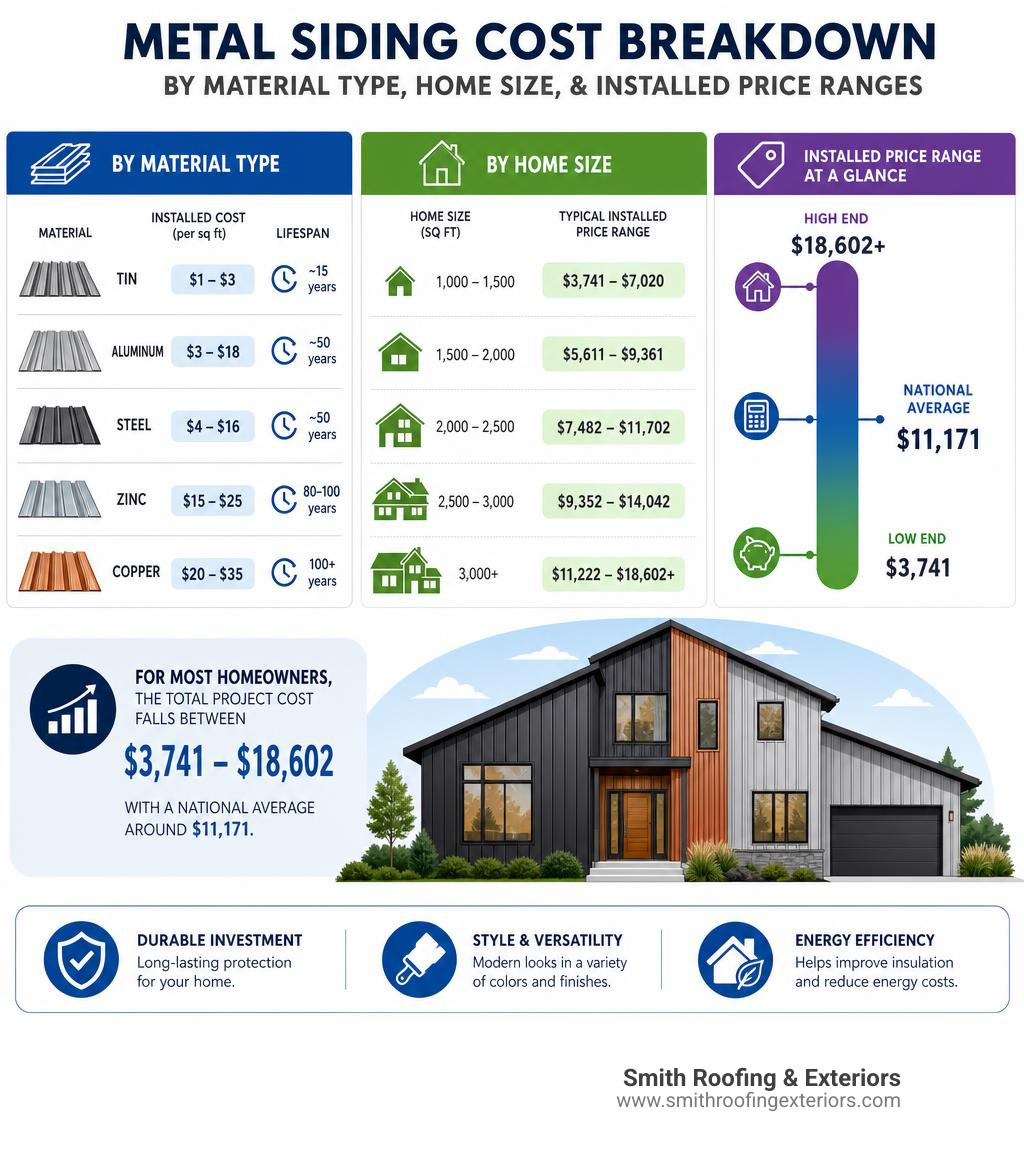
Metal siding price ranges widely depending on the material you choose and the size of your home. Here’s a quick snapshot so you can compare at a glance:
| Metal Type | Installed Cost (per sq ft) | Lifespan |
|---|---|---|
| Tin | $1 – $3 | ~15 years |
| Aluminum | $3 – $18 | ~50 years |
| Steel | $4 – $16 | ~50 years |
| Zinc | $15 – $25 | 80-100 years |
| Copper | $20 – $35 | 100+ years |
For most homeowners, the total project cost falls between $3,741 and $18,602, with a national average around $11,171.
That’s a big range. And if you’re in rural Wisconsin dealing with harsh winters, wind, and ice — the material and installation quality you choose matters a lot more than it might somewhere with a milder climate.
The truth is, metal siding is one of the more complex home improvement investments to price out. Material type, panel style, home size, labor, and a handful of hidden costs all push that number up or down. This guide breaks all of it down so you can budget with confidence — not guesswork.
I’m Matt Smith, owner of Smith Roofing & Exteriors, and I’ve spent years helping Wisconsin homeowners navigate decisions exactly like this — including understanding the real metal siding price before a single panel goes up. Let’s walk through everything you need to know.
Understanding the Average Metal Siding Price in 2026
When you begin researching the metal siding price for a home in Southeastern Wisconsin, you will quickly notice that quotes are presented in two different ways: materials-only and fully installed.
On a national level, the average installed cost of metal siding in May 2026 starts at approximately $8.82 to $14.67 per square foot. However, depending on the premium nature of the metal and the complexity of your home’s architecture, the final cost can range anywhere from $4 to $22 per square foot installed.

For a standard single-family home with 2,000 square feet of exterior wall space, you can generally expect a total investment between $14,000 and $30,000 for standard steel or aluminum. If you choose ultra-premium materials like zinc or copper, that price can easily rise much higher.
To help put these numbers into perspective, we can look at data compiled by industry experts in resources like How Much Does Metal Siding Cost in 2026? | Fixr.com. They highlight that while the upfront cost is higher than basic vinyl, the long-term value, durability, and minimal maintenance requirements of metal make it an incredibly smart investment for modern homeowners.
How Material Selection Shapes Your Metal Siding Price
The specific metal you select is the single largest factor in determining your overall project cost. Each material has its own unique aesthetic, performance characteristics, and lifespan. Here is a detailed comparison of the five primary metal siding materials:
| Material Type | Material Cost (Per Sq. Ft.) | Installed Cost (Per Sq. Ft.) | Average Lifespan | Best Suited For |
|---|---|---|---|---|
| Tin / Galvanized Steel | $0.95 – $3.00 | $5.00 – $10.00 | 15 – 30 Years | Budget-conscious agricultural or accent projects |
| Aluminum | $3.00 – $12.00 | $6.00 – $18.00 | 50 Years | Coastal areas or homeowners wanting lightweight, rust-proof siding |
| Steel (Coated/Painted) | $4.00 – $10.00 | $7.00 – $16.00 | 40 – 70 Years | Standard residential homes needing high impact resistance |
| Zinc | $12.00 – $25.00 | $15.00 – $45.00 | 80 – 100 Years | High-end modern architectural homes; self-healing properties |
| Copper | $19.00 – $35.00 | $20.00 – $50.00 | 100+ Years | Luxury custom homes; develops a beautiful natural patina |
Let’s look at these materials in more detail:
- Steel Siding: This is the heavy-duty workhorse of the residential market. Standard steel siding typically costs $8 to $14 per square foot installed on average. It is highly resistant to hail, flying debris, and extreme temperature swings. If you are shopping for materials directly, you can browse options like Steel Siding at Menards® to get a feel for retail pricing.
- Aluminum Siding: Aluminum is slightly more flexible and completely rust-proof, making it a favorite for damp climates. Aluminum siding costs $6 to $12 per square foot installed on average. Local Midwestern labor and material rates generally align closely with these national averages, though regional demand can cause minor fluctuations.
- Tin Siding: Modern “tin” siding is actually galvanized steel. It is the cheapest option, costing only $1 to $3 per square foot for materials, but it has a shorter lifespan (around 15 to 30 years) and is prone to rusting if the protective zinc coating is scratched.
- Zinc and Copper: These are the luxury, lifetime metals. Zinc ($15 to $25 per square foot installed) and copper ($20 to $35 per square foot installed) require virtually zero maintenance and can easily last over a century. They develop natural patinas over time that protect the metal underneath from corrosion.
Panel Styles and Profiles
Beyond the raw material, the physical shape and style of the panel will influence your metal siding price.
- Corrugated Metal Siding: This classic wavy pattern is the most affordable style. Corrugated metal siding pricing typically ranges from $4 to $8 per square foot for materials alone, with installation bringing the total to $7 to $12 per square foot. It is incredibly strong due to its ribbed design and is highly popular for modern industrial-style homes, barndominiums, and outbuildings.
- Board and Batten: This vertical style mimics traditional wooden siding with wide panels and raised narrow strips (battens). True steel board and batten siding provides a striking, high-contrast look that is perfect for modern farmhouses.
- Steel Log Siding: If you love the look of a rustic log cabin but hate the constant staining, sealing, and wood-rot battles, steel log siding is your answer. Steel log siding costs between $10 and $18 per square foot installed. It features a realistic wood-grain texture and contour-cut foam backing to mimic real logs while offering the fire resistance and durability of steel.
- Vertical Metal Siding Panels: These clean, vertical lines offer excellent water shedding and drainage. They are commonly used on contemporary homes to create a sleek, minimalist aesthetic.
Key Factors That Influence Your Total Installation Cost
When planning your budget, it helps to understand that the price of the metal panels themselves is only one piece of the puzzle.

A professional metal siding installation requires specialized tools, precise calculations, and experienced craftsmanship. According to How Much Does Metal Siding Cost in 2026? (Price Per Square Foot & Installation Guide) | Digital Estimating, hiring a professional contractor accounts for approximately 30% to 60% of the total project cost.
Several key factors dictate where your final price will fall:
- Home Size and Height: A multi-story home requires scaffolding, safety harnesses, and more time to transport materials upward, which increases labor costs.
- Architectural Complexity: Homes with lots of corners, dormers, bay windows, and steep rooflines require custom-cut panels and extra trim, driving up both material waste and labor hours.
- Local Labor Rates: Labor costs vary by region. For example, labor rates in South Central Wisconsin typically range from $3 to $7 per square foot for standard installation, while more complex architectural projects can demand higher specialized labor rates.
Hidden Costs That Can Inflate Your Metal Siding Price
When budgeting, many homeowners forget to account for the preparation and finishing work. These “hidden” costs can catch you off guard if you aren’t prepared:
- Removing Existing Siding: Removing old siding and disposing of it safely adds approximately $1 per square foot to the total project cost (or roughly $1,000 to $2,500 for a standard home). While some contractors can install metal siding directly over old siding using furring strips, we always recommend a clean tear-off if there are signs of underlying damage.
- Substrate Repairs: If we uncover rotted wood sheathing, water damage, or mold once the old siding is removed, those walls must be repaired before the new metal can be installed. Substrate repairs typically cost $2 to $5 per square foot.
- Permits: Most local municipalities in Southeastern Wisconsin require a building permit for siding replacement, which can cost anywhere from $150 to $1,500 depending on your location.
- Trim, Fasteners, and Accessories: You can’t just slap panels on a wall. You need J-channels, starter strips, corner posts, soffits, fascia, and thousands of specialized screws. These accessories typically account for about 10% of your total material budget. To explore local pricing on these materials, you can check out regional suppliers like Burlington, WI – ABC Supply or Siding – Lake Geneva, WI.
To compare these preparation costs with other common siding materials, you can read our guide on how much it costs to reside a house with vinyl siding.
Exposed vs. Concealed Fasteners and Paint Finishes
The way your metal panels are secured to your home plays a massive role in both the final aesthetic and the overall metal siding price.
- Exposed Fasteners: In this system, the panels overlap, and screws are driven directly through the face of the metal. The screw heads remain visible and are sealed with rubber washers. Exposed fastener systems are simpler to install and highly cost-effective, typically running $7 to $12 per square foot installed.
- Concealed Fasteners (Standing Seam): This system uses interlocking joints that hide the screws completely inside the seams. It creates a incredibly clean, modern look and eliminates the risk of leaks around screw holes. However, because it requires highly specialized labor, concealed fastener panels cost about twice as much as exposed fastener options, averaging $10 to $16 per square foot installed.
Additionally, the quality of the paint finish will impact your budget:
- SMP (Silicone Modified Polyester) Paint: This is the standard residential finish. It offers good fade resistance and durability at a budget-friendly price.
- PVDF (Kynar 500) Coating: This premium finish costs 15% to 35% more than SMP paint but offers unmatched color retention, chalking resistance, and UV protection. It typically comes with a 30-to-40-year paint warranty, making it the ideal choice for homes exposed to harsh Wisconsin sun and snow.
Finally, pay attention to the metal’s thickness, known as the “gauge.” In the metal siding industry, a lower number means thicker metal. We highly recommend using 26-gauge or 24-gauge steel for residential applications. Anything thinner (like 29-gauge structural steel) is prone to denting from hail or stray lawnmower rocks and won’t stand up to the elements long-term.
Insulated vs. Non-Insulated Metal Panels
Wisconsin winters are no joke, which is why we always discuss insulation options with our clients.
- Non-Insulated Panels: These are standard metal sheets installed over a house wrap. They are highly durable but offer very little thermal resistance (R-value) on their own.
- Insulated Metal Panels (IMPs): These panels feature a rigid foam core sandwiched between two sheets of metal. While they cost more upfront — typically adding $1,200 to $1,500 or more to the total project cost — they provide an exceptional thermal barrier.
Investing in insulated panels can reduce your heating and cooling costs by 15% to 20%, allowing the siding to pay for itself over time. For a deeper look at how this works, check out our article on how siding replacement improves energy efficiency.
Metal Siding vs. Vinyl: ROI and Long-Term Value
When evaluating the metal siding price, it is natural to compare it to the most popular siding material on the market: vinyl.
Vinyl siding is incredibly popular because of its low upfront cost, typically ranging from $3 to $12 per square foot installed. To learn more about why so many homeowners choose this route, you can read about the top benefits of vinyl siding.
However, while vinyl is cheaper to install today, metal siding offers a far superior return on investment (ROI) over time. Metal siding has one of the highest average ROIs of any remodeling project at 86%.
Here is how the two materials stack up in the long run:
- Durability: Vinyl can crack in extreme cold, warp in intense heat, and melt if exposed to a nearby grill or house fire. Metal siding is non-combustible, insect-proof, and will not warp, rot, or crack.
- Lifespan: A quality vinyl siding job will last 20 to 40 years. Steel and aluminum siding easily last 50 to 70 years, meaning you will likely never have to pay to reside your home again.
- Maintenance: Vinyl requires regular power washing to prevent mold and mildew growth. Metal siding is incredibly low-maintenance; a simple annual rinse with a garden hose is usually all it takes to keep it looking brand new.
When properly installed, steel siding integrates beautifully into local neighborhoods, offering a clean, modern aesthetic that stands the test of time.
Frequently Asked Questions About Metal Siding Costs
How long does metal siding last?
Aluminum and steel siding typically last between 50 and 70 years when properly installed and maintained. Premium metals like zinc and copper can easily exceed 100 years. Because of this extreme durability, the lifetime cost of metal siding is often much lower than other materials that must be replaced every few decades.
Is metal siding fireproof?
While no material is completely “fireproof” under extreme volcanic-level heat, metal siding is non-combustible and highly fire-resistant. It will not ignite, feed a fire, or melt under normal fire conditions. This makes it an incredibly safe option, especially for homes in areas prone to wildfires or dense residential zones.
Does metal siding make a house hotter?
No. This is a common myth! Metal siding actually reflects the sun’s radiant heat away from your home rather than absorbing it like wood or vinyl. When paired with proper insulation and a quality house wrap, metal siding helps keep your home cooler in the summer, reducing your monthly energy bills.
Conclusion
Investing in new siding is a big decision, and understanding the real metal siding price is the first step toward transforming your home. While the upfront cost is higher than vinyl, the unmatched durability, fire resistance, energy efficiency, and high ROI make metal siding an incredibly smart, long-term choice for modern homeowners.
At Smith Roofing & Exteriors, we are proud to serve our neighbors throughout Southeastern Wisconsin, including Fort Atkinson, Lake Mills, Jefferson, Burlington, Delavan, Elkhorn, Lake Geneva, Walworth, and Edgerton. Our experienced local team is dedicated to providing superior materials, transparent pricing, and flawless installations that protect your home for decades to come.
Ready to see what metal siding would cost for your specific home? Upgrade your home with a quality siding replacement company today, and contact us to get a transparent, highly accurate estimate tailored to your budget!