Average Cost to Put Vinyl Siding on House in 2026
The cost to put vinyl siding on a house typically falls between $6,000 and $18,000 for a complete installation, with most homeowners paying around $12,000 on average. Here’s a quick breakdown to help you compare prices at a glance:
| Home Size | Low Estimate | Average | High Estimate |
|---|---|---|---|
| 1,000 sq ft | $2,900 | $7,500 | $12,400 |
| 1,500 sq ft | $4,500 | $11,000 | $16,000 |
| 2,000 sq ft | $6,000 | $12,000 | $18,000 |
| 2,500 sq ft | $7,500 | $15,000 | $24,000 |
Costs include materials and labor. Final price depends on siding style, home complexity, and your region.
Getting a quote for new siding can feel overwhelming — especially when numbers vary wildly from one contractor to the next. One homeowner in an online forum recently shared their shock after receiving a $17,000 quote just for a 900 sq ft house, plus another $9,000 for a two-car garage. Was it too high? Maybe. But the truth is, siding costs depend on a lot more than just square footage.
Material grade, labor rates, old siding removal, trim work, and regional pricing all play a role. In Wisconsin’s harsh climate — with heavy snow, freeze-thaw cycles, and summer storms — choosing the right siding and installer matters even more.
I’m Matt Smith, owner of Smith Roofing & Exteriors, and I’ve helped hundreds of Wisconsin homeowners navigate the real cost to put vinyl siding on a house — from small ranch homes to large two-story properties — so I’ll walk you through exactly what drives the price and how to make sure you’re getting fair value.
When we look at the current market, the spend $11,000 on vinyl siding figure is a solid benchmark for a standard American home. However, “average” can be a tricky word in the home improvement industry. In Fort Atkinson, Lake Mills, and across Southeastern Wisconsin, we see a wide range of project scopes that shift these numbers.
To give you a clearer picture of what to expect for your specific property, we’ve broken down the total estimated costs by home size. These figures include both professional labor and mid-grade materials.
| House Size (Living Space) | Estimated Exterior Wall Area | Total Project Cost Range |
|---|---|---|
| 1,000 sq ft | 1,200 sq ft | $4,500 – $10,500 |
| 1,500 sq ft | 1,800 sq ft | $7,000 – $14,500 |
| 2,000 sq ft | 2,400 sq ft | $9,500 – $19,000 |
| 2,500 sq ft | 3,000 sq ft | $12,000 – $25,000 |
It is important to remember that these are vinyl siding installation services estimates. A ranch-style home is generally cheaper to side than a two-story home of the same square footage because it requires less scaffolding and specialized equipment. National averages suggest a range of $3 to $12 per square foot installed, but for the high-quality materials we use to withstand Wisconsin winters, most homeowners find themselves in the $7.50 to $10.00 per square foot range.
Understanding the Cost to Put Vinyl Siding on House Per Square Foot
One of the most common points of confusion for homeowners is the difference between “floor square footage” and “wall square footage.” When you tell a contractor your house is 1,500 square feet, you’re usually talking about the living space inside. However, we price siding based on the exterior wall surface area.
In the industry, we often use the term “square.” One siding square equals 100 square feet of wall surface.
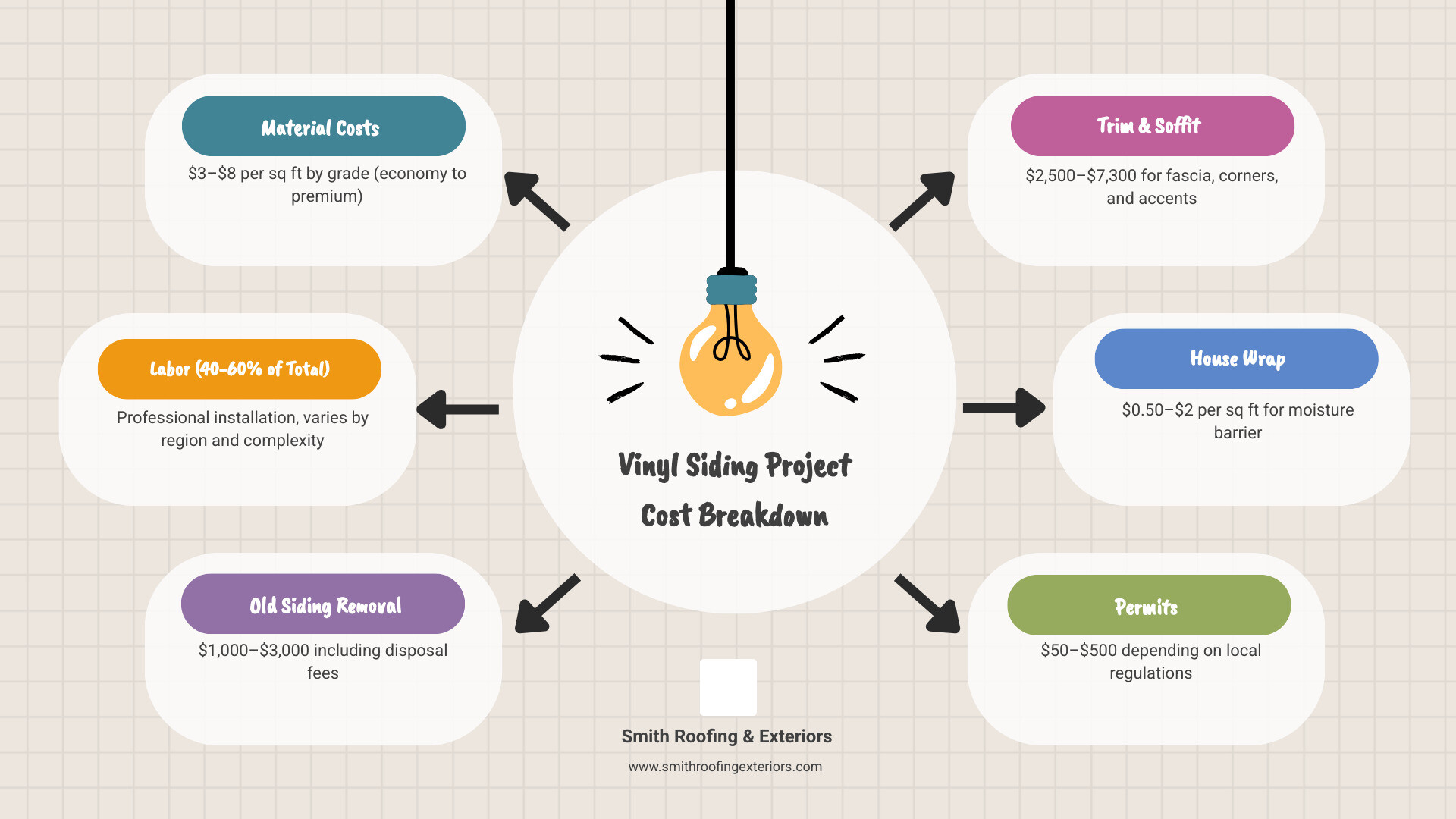
- Material Costs: Usually range from $2 to $6 per square foot depending on the grade.
- Labor Costs: Typically range from $2 to $5 per square foot (or about 40% to 60% of the total bill).
If you are looking for Vinyl Siding Replacement in Watertown WI, you’ll find that the split between labor and materials is fairly consistent, though premium grades will obviously push the material side of the ledger higher.
How Material Quality Impacts the Cost to Put Vinyl Siding on House
Not all vinyl is created equal. The thickness of the PVC (polyvinyl chloride) is the primary indicator of quality and cost. Thicker siding is more rigid, resists “oil canning” (wavy appearance), and stands up better to hail or a stray baseball.
- Builder’s Grade (.040 mm): The thinnest and cheapest option. It’s okay for a quick flip, but we rarely recommend it for Wisconsin homes because it can crack during our deep-freeze cycles.
- Standard Residential (.042 – .048 mm): The “sweet spot” for most homeowners. It offers a great balance of durability and price.
- Premium Reinforced (.050 – .055 mm): This high-end siding often features advanced color retention technology to prevent fading from UV exposure.
Choosing a higher grade is one of the Top 14 Benefits of a Vinyl Siding Installation because it significantly extends the lifespan of your exterior, often lasting 40 years or more with minimal maintenance.
Key Factors Influencing Your Total Installation Quote

If you’ve ever wondered why your neighbor’s quote was thousands less than yours for a similar-sized house, the answer usually lies in the “complexity factor.” A simple box-shaped house is a dream to side. However, most homes in our area have unique architectural features that add time and material waste to the project.
- Architectural Complexity: Every corner, nook, and cranny requires specialized trim (J-channels and corner posts).
- Number of Stories: Working on a second or third story requires scaffolding and increases safety risks, which naturally raises labor costs.
- Gables and Dormers: These require intricate cuts and more waste material.
- Window and Door Counts: Each opening must be flashed and trimmed correctly to prevent water intrusion.
We always emphasize the importance of Troubleshooting Common Vinyl Siding Installation Mistakes, such as improper flashing around windows, which can lead to thousands of dollars in structural rot down the road.
Labor Rates and Regional Pricing Trends
Labor is a huge variable in the cost to put vinyl siding on a house. In Southeastern Wisconsin, labor rates are influenced by the local cost of living and the availability of skilled crews.
For an Elkhorn Siding Replacement, you might see labor costs ranging from $3.50 to $5.25 per square foot. It’s also worth noting that demand spikes in late spring and summer. If you can schedule your project for the late fall or early winter (as long as the weather permits), some contractors offer “off-season” discounts of 10% to 20% to keep their crews busy.
Additional Expenses: Removal, Trim, and Repairs
The “siding” part of the quote is often just the beginning. To do the job right, there are several “extras” that are actually essentials:
- Old Siding Tear-Off: Expect to pay $1,000 to $3,000 for the removal and disposal of your old siding. This is a labor-intensive process, but it allows us to inspect the “bones” of your house.
- Structural Rot Repair: If we find rot in the plywood sheathing once the old siding is off, it must be replaced. Repairs can range from $500 to $5,000+ depending on the damage.
- House Wrap: This moisture barrier is vital. It costs about $0.50 to $2.00 per square foot but protects your home from mold and water damage.
- Soffit and Fascia: Many homeowners choose to replace these at the same time so everything matches. Our Fort Atkinson WI Soffit Fascia Gutter Replacement services ensure your entire roofline is protected and beautiful.
Comparing Vinyl Siding Styles and Material Alternatives
Vinyl has come a long way from the plastic-looking strips of the 1970s. Today, you can choose styles that mimic expensive wood or stone.
- Traditional Lap (Clapboard): The classic horizontal look. Most affordable at $2–$6 per sq ft for materials.
- Dutch Lap: Features a decorative groove that creates deep shadow lines. Very popular in Wisconsin.
- Board and Batten: Vertical siding that offers a modern farmhouse aesthetic. Slightly more expensive at $3.50–$9 per sq ft.
- Vinyl Shake: Mimics cedar shingles. Often used as an accent in gables. Costs $6–$10 per sq ft.
According to the 2019 Remodeling Impact Report, vinyl siding remains one of the most cost-effective ways to improve a home’s exterior while maintaining a high resale value.
Vinyl vs. Fiber Cement and Engineered Wood
While vinyl is our focus here, it’s helpful to know how it stacks up against the competition.
- Fiber Cement: Often known by the brand name Hardie Board. It’s incredibly durable and fire-resistant but costs significantly more ($10–$15 per sq ft installed) and requires periodic painting.
- Engineered Wood: We often perform LP Smartside Siding Installation in Milton WI. It offers the beauty of real wood with better resistance to rot and termites, sitting in a middle price bracket between vinyl and fiber cement.
Vinyl wins on upfront cost and maintenance—you never have to paint it, just a quick power wash once a year is usually enough.
The Value of Insulated Vinyl Siding
If you want to maximize your energy savings, insulated vinyl is the way to go. It features a rigid foam backing that is glued to the siding panel.
- Energy Efficiency: It adds an R-value of 2.0 to 4.0 to your walls, which helps eliminate “thermal bridging” (heat escaping through the wooden studs of your home).
- Durability: The foam backing makes the panels much stiffer and more resistant to impact.
- Noise Reduction: It acts as a sound barrier against street noise.
We’ve seen How a Siding Replacement Can Make a Difference in Energy Efficiency firsthand; homeowners often report lower utility bills and a much quieter indoor environment.
Maximizing Your Investment: ROI and Savings Tips
Why Vinyl Siding Installation Is a Smart Investment for Homeowners comes down to the Return on Investment (ROI). Nationally, you can expect to recoup 63% to 80% of the project cost in added home value.
To keep your costs on the lower end:
- Get Multiple Quotes: Always get at least three detailed bids.
- Choose Mid-Grade: Don’t go for the cheapest, but you don’t always need the “Ultra-Premium” line either.
- Bundle Your Projects: If you need new gutters or a roof, doing them at the same time can often save on total labor and mobilization fees.
- Stick to Standard Colors: Custom or very dark colors can sometimes carry a premium price tag.
Professional Installation vs. DIY Risks
We get it—the “labor” portion of the quote is tempting to try and save. However, siding is harder than it looks. Vinyl needs to “float” on the wall to allow for expansion and contraction. If you nail it too tight, it will warp and buckle the first time the sun hits it.
When you Upgrade Your Home with a Quality Siding Replacement Company, you aren’t just paying for someone to hammer nails. You’re paying for:
- Warranty Protection: Most manufacturers void the warranty if the product isn’t installed by a pro.
- Specialized Tools: Brakes for bending aluminum trim, high-reach ladders, and scaffolding.
- Permit Compliance: We handle the paperwork with the local building department.
- Safety: Falls from ladders are a leading cause of home injury.
Frequently Asked Questions about Vinyl Siding Costs
Is a $17,000 quote for a 900 sq ft house reasonable?
On the surface, $17,000 for a 900 sq ft house sounds high—that’s nearly $19 per square foot. However, the context matters. Was that “best quality” CertainTeed siding? Did it include a full tear-off of three layers of old wood? Did it include all-new soffits, fascia, and premium window wraps? If it was a “full-service” package with premium insulated materials, it might be in the ballpark, but we’d always recommend getting a second opinion to see if a mid-range option fits your budget better.
How do I accurately estimate my siding needs?
To get a rough idea:
- Measure the height and width of each wall.
- Multiply them to get the square footage.
- Add them all together.
- Subtract the area of large windows and doors.
- Add 10% for “waste factor” (the pieces we have to cut off). Divide the final number by 100 to find out how many “squares” of siding you need.
Does new vinyl siding really increase home value?
Absolutely. Real estate experts agree that “curb appeal” is the number one factor in getting buyers through the front door. Low-maintenance exteriors are a huge selling point for modern buyers who don’t want to spend their weekends painting a house.
Conclusion
At Smith Roofing & Exteriors, we take pride in being Fort Atkinson’s local experts. We don’t believe in “mystery pricing” or high-pressure sales. Whether you’re in Burlington, Delavan, or Lake Geneva, our team provides transparent quotes and uses only superior materials to ensure your home is protected for decades.
If you’re ready to transform your home’s exterior and want an honest look at the cost to put vinyl siding on a house, we’re here to help. From minor repairs to full-scale replacements, we offer the precision and expertise your property deserves—and we’re available 24/7 for emergency interventions if a storm catches you off guard.
Get a professional vinyl siding estimate today and let’s give your home the facelift it deserves!