Why Getting Your Hardie Board Seams Right Matters More Than You Think
Hardie board seams are one of the most critical — and most mishandled — parts of any fiber cement siding installation.
Here’s a quick summary of what you need to know:
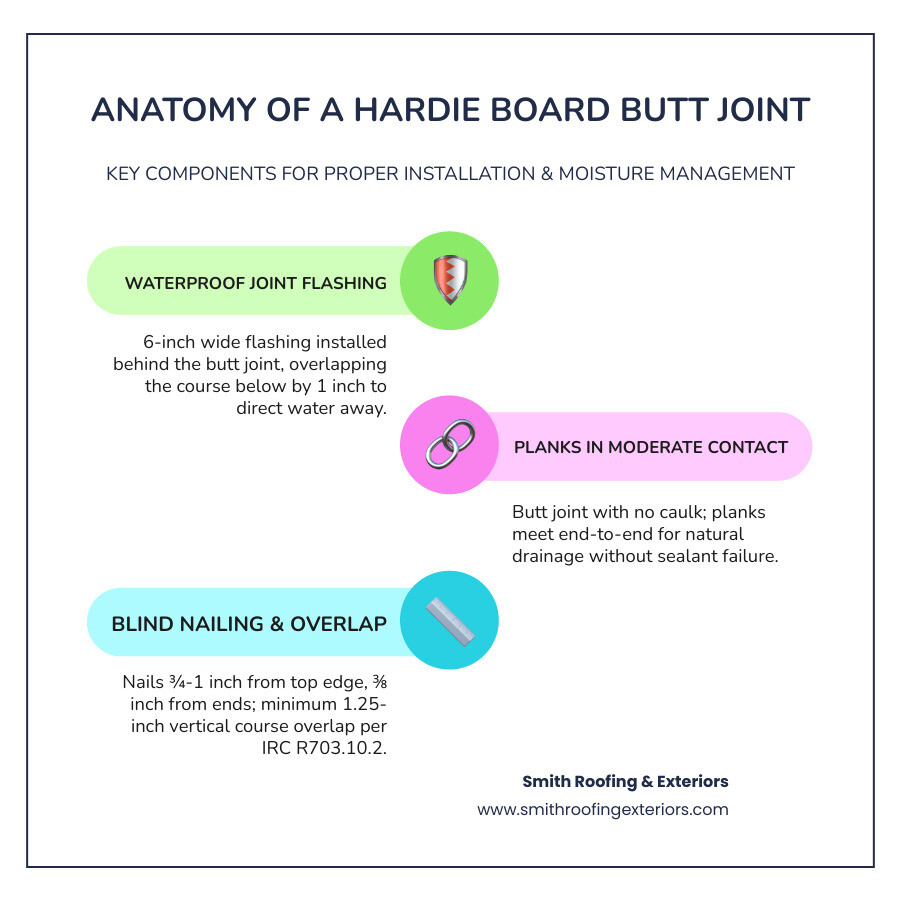
- Use joint flashing, not caulk, at butt joints — James Hardie recommends 6-inch-wide flashing that overlaps the course below by 1 inch
- Stagger butt joints by at least two stud bays (16-inch o.c. framing) or one stud bay (24-inch o.c. framing)
- Minimum 1¼-inch vertical overlap is required by IRC R703.10.2
- Blind nail fasteners ¾ to 1 inch from the top edge and no closer than ⅜ inch from plank ends
- Never caulk horizontal overlaps — it blocks natural drainage and causes problems over time
- ColorPlus® products need special care at seams; caulk weathers differently than the factory finish
Get any of these wrong and you’re looking at water damage, warranty issues, and costly repairs — especially in a Wisconsin winter where moisture and freeze-thaw cycles are relentless.
I’m Matt Smith, owner of Smith Roofing & Exteriors, and I’ve seen how improperly treated Hardie board seams lead to expensive callbacks and water infiltration problems that could have been avoided with the right technique from the start. Let’s walk through everything you need to know to get it done right.
Understanding the Basics of Hardie Board Seams
When we talk about hardie board seams, we are primarily referring to “butt joints”—the vertical point where two pieces of siding meet end-to-end. Because James Hardie siding is a fiber cement product, it doesn’t expand and contract as drastically as wood or vinyl, but it still requires precise handling to maintain a weather-tight seal.
The International Residential Code (IRC R703.10.2) is very specific about how these joints should be treated. To meet code and maintain your warranty, you must ensure a minimum vertical overlap of 1 1/4 inches between courses. However, the real magic happens behind the scenes with moisture management. Every seam is a potential entry point for water, which is why a high-quality water-resistive barrier (WRB) like HardieWrap is essential.
Following the HardiePlank Installation Guide isn’t just a suggestion; it’s the difference between a siding job that lasts 50 years and one that fails in five.
Proper Alignment for Hardie Board Seams
One of the biggest mistakes we see in Southeastern Wisconsin is butt joints that don’t land on studs. For maximum stability and wind resistance, every seam should land directly over a stud center. This allows for secure fastening and prevents the planks from rattling or pulling away.
When joining two planks, we always aim for “moderate contact.” You don’t want to wedge them together so tightly they buckle, but you shouldn’t leave a gaping hole either. We also prioritize using factory ends at the joints whenever possible. Factory ends are smoother and more square than field cuts, leading to a much cleaner look. If you do have to use a field-cut edge at a seam, it must be sealed with primer or a color-matched edge coater. Understanding the importance of siding replacement often starts with realizing how much damage a poorly aligned seam can cause to your home’s structure.
Code Compliance and Seam Integrity
In places like Fort Atkinson and Lake Geneva, local building codes strictly follow the IRC requirements for lap siding. This includes maintaining that 1 1/4-inch vertical overlap to create a natural “shedding” effect for water. By treating the siding as a series of drainage planes, we ensure that gravity does the work of pulling moisture down and away from the wall.
If seams aren’t handled with integrity, water can get trapped behind the boards, leading to rot in your sheathing. This is why our siding installation services focus so heavily on the technical details of the “envelope”—the layers of protection that keep your home dry.
Why Joint Flashing Beats Caulking for Butt Joints
For years, the industry standard was to pump caulk into every vertical seam. James Hardie has moved away from this, and for good reason. According to the Technical Bulletin on Joint Flashing, joint flashing is the superior method for moisture management.
Joint flashing is a simple, durable piece of waterproof material (like painted coil stock) placed behind the seam. It acts as a secondary gutter. If water manages to get through the butt joint, the flashing catches it and directs it out over the course below. This eliminates the need for caulk, which eventually dries out, cracks, and fails. It also looks much better; a flashed joint remains a tight, clean line, whereas a caulked joint often looks like a messy, discolored smear after a few seasons.
The Risks of Caulking Hardie Board Seams
Caulking hardie board seams might look okay on day one, but it rarely stays that way. In our Wisconsin climate, the constant freeze-thaw cycle causes materials to move. Caulk is an elastomeric material, but it has limits. Once it loses its bond, it actually traps moisture behind the siding rather than letting it drain.
Furthermore, James Hardie notes that caulk and their siding finishes (especially ColorPlus® Technology) weather at different rates. Over time, the caulk may fade or turn yellow, highlighting the very seams you were trying to hide. Avoiding these common installation mistakes is the best way to ensure your home stays beautiful and protected.
Flashing Specifications for Maximum Protection
To do flashing right, we follow the 6-1 rule:
- 6-inch width: The flashing should be at least 6 inches wide to provide ample coverage behind the seam.
- 1-inch overlap: The flashing must overlap the siding course below it by at least 1 inch.
We use non-reactive materials like painted aluminum coil stock or specialized house wrap scraps. It’s a small detail that provides a permanent water-shedding solution without the maintenance headaches of H-jointers or sealants.
Proper Staggering and Overlap Requirements
You never want your hardie board seams to line up vertically across different rows. This creates a “zipper” effect that is both structurally weak and visually unappealing. Proper staggering is essential for distributing the weight of the siding and ensuring wind loads are handled correctly.
Best Practices for Staggering Hardie Board Seams
The general rule of thumb is the “two-stud bay rule.” For standard 16-inch on-center (o.c.) framing, your butt joints should be spaced at least 32 inches apart from the joints in the courses above and below.
We often use a “progressive stagger” or “random stagger” pattern. Progressive staggering is highly efficient because you can use the cutoff piece from the end of one row to start the next row. This minimizes waste and ensures that your home is improving curb appeal and efficiency simultaneously.
Minimum Overlap for Weather Resistance
As mentioned, the IRC requires a 1 1/4-inch minimum overlap. This isn’t just a random number—it’s calculated to prevent wind-driven rain from being blown up and under the planks. In high-wind areas, this overlap is critical for the structural performance of the siding. When we perform a professional installation, we often snap chalk lines every few courses to ensure this overlap remains consistent and the siding stays perfectly level across the entire wall.
Fastening and Nailing Near Seams
How you nail your siding is just as important as where the seams are located. James Hardie has very specific Fastening Tips for HardiePlank to prevent the boards from cracking or blowing off during a storm.
We prefer blind nailing. This involves driving the fastener into the top of the plank so that the next course of siding covers the nail head. It’s the cleanest look possible. However, in some high-wind zones or specific building codes, face nailing (where the nail is visible at the bottom of the board) might be required. Regardless of the method, we always use corrosion-resistant, galvanized, or stainless steel fasteners to prevent “bleeding” or rust streaks.
Nailing Guidelines for Hardie Board Seams
Precision is key when nailing near hardie board seams. Here are the non-negotiables:
- The 3/8-inch rule: Never place a nail closer than 3/8 of an inch from the end of a plank. Nailing too close to the edge will cause the fiber cement to blow out or crack.
- The 3/4-inch margin: For blind nailing, fasteners should be installed between 3/4 inch and 1 inch from the top edge of the plank.
- Flush driving: Nails should be driven snug and flush against the siding. They should not be countersunk (driven too deep), as this reduces the holding power of the fastener.
Avoiding Common Nailing Errors
One of the most frequent errors is “high nailing”—placing the nail too far up the board where it doesn’t actually catch the stud or provide enough leverage. This leads to loose planks and rattling. On the flip side, over-driving nails can damage the board’s integrity. Ensuring proper fastening is a smart investment for homeowners because it protects the long-term value and safety of the property.
Special Considerations for ColorPlus and Trim
If you’ve chosen James Hardie ColorPlus® Technology, you’re getting a beautiful, factory-applied finish that’s baked on for durability. However, this finish requires a bit of extra “TLC” during installation, especially at the seams.
Managing ColorPlus Hardie Board Seams
With ColorPlus products, James Hardie strongly advises against caulking butt joints. Since the siding is already finished, you don’t want to mess with the aesthetics using a sealant that will age differently. Instead, we use the recommended joint flashing and ensure all field-cut edges are treated with a James Hardie touch-up kit or edge coater. This maintains the advantages of quality siding and keeps the warranty fully intact. We also leave the protective laminate sheets on the boards until they are fully installed to prevent scuffs and scratches.
Clearance and Trim Gaps
Where siding meets trim (like around windows or at corners), the rules change slightly. Unlike butt joints, which should be in moderate contact, you must leave a 1/8-inch gap between the siding and the trim. This gap is then filled with a high-quality, permanently flexible sealant.
Additionally, we ensure proper clearances:
- 2 inches from paths, steps, or decks.
- 6 inches from the finished grade (the ground).
- 1/4 inch above horizontal flashing (and this gap should never be caulked).
Frequently Asked Questions about Hardie Board Seams
Why does James Hardie recommend flashing over caulk?
James Hardie recommends flashing because it is a “set it and forget it” solution. Caulk is a maintenance item—it shrinks, cracks, and requires re-application every few years. Flashing provides a permanent, gravity-fed drainage path that directs water out of the wall system without relying on a chemical bond that can fail over time.
How far apart should butt joints be staggered?
The spacing depends on your wall framing. If your studs are 16 inches apart (standard), you need to stagger joints by at least two stud bays, or 32 inches. If your studs are 24 inches apart, a one-bay stagger (24 inches) is the minimum requirement. This ensures that no two joints are too close to each other, maintaining the structural strength of the siding “wall.”
Can I install HardiePlank without a starter strip?
Absolutely not. A 1 1/4-inch starter strip is essential. It does two things: it kicks the first course of siding out at the correct angle so that every subsequent row laps correctly, and it creates a “drip edge” that allows moisture to fall away from the foundation rather than running behind the bottom board.
Conclusion
Installing James Hardie siding is an investment in your home’s future, but that investment only pays off if the technical details—especially the hardie board seams—are handled with precision. From Fort Atkinson to Elkhorn and Burlington, the team at Smith Roofing & Exteriors is dedicated to providing the professional craftsmanship your home deserves.
We understand the local climate and the strict manufacturer requirements needed to keep your warranty valid and your home dry. Whether you are in Jefferson or Delavan, don’t settle for “good enough” when it comes to your home’s exterior envelope. Transform your home with expert siding installation and rest easy knowing your seams are a dream, not a nightmare. Give us a call today for a transparent estimate and local expertise you can trust.