How Much Does Hardie Panel Siding Cost in 2026?

Hardie panel siding cost typically falls between $6.50 and $16.00 per square foot installed, depending on your home size, finish choice, and whether old siding needs to come down first. Here’s a quick snapshot for Wisconsin homeowners budgeting a project:
| Home Size | Estimated Total Installed Cost |
|---|---|
| 1,000 sq ft | $6,500 – $16,000 |
| 1,500 sq ft | $9,750 – $24,000 |
| 2,000 sq ft | $13,000 – $32,000 |
| 2,500 sq ft | $16,250 – $40,000 |
| 3,000 sq ft | $19,500 – $48,000 |
Note: Ranges reflect primed to factory-finished panels, single-story to multi-story homes, with and without old siding removal.
If you’re planning a siding project in rural Wisconsin, you already know harsh winters and wet springs don’t forgive weak exteriors. Hardie panel siding — a large-format fiber cement product — has become one of the most popular choices for homeowners who want lasting protection without constant upkeep.
But the pricing can feel confusing. Material costs, labor, tear-off, trim, and finish upgrades all stack up fast. This guide breaks down every cost clearly so you can budget with confidence.
I’m Matt Smith, owner of Smith Roofing & Exteriors, and I’ve helped countless Wisconsin homeowners navigate hardie panel siding cost — from first estimate to final installation. I’ll walk you through exactly what drives the price and how to make sure you’re getting real value for your investment.
Learn more about hardie panel siding cost:
What Hardie Panel Siding Is and How It Compares to Other Hardie Styles
Hardie panel siding is a vertical fiber cement siding product made from cement, sand, and cellulose fibers. Instead of narrow horizontal planks, it uses large sheets or panels. That gives homes a clean, modern look and also works well for farmhouse-style board and batten designs.
Compared with other Hardie styles:
- Hardie lap siding uses long horizontal planks
- Hardie shingle siding mimics cedar shakes
- Hardie panel siding uses large vertical sheets, often paired with battens or trim strips
In simple terms, lap siding looks classic, shingles look cottage-style, and panels look more architectural. None of them are “wrong” – they just create different curb appeal.

How hardie panel siding cost differs from lap-style projects
Panel projects are priced differently than lap-style jobs because the installation method changes.
Hardie panel can sometimes reduce the number of visible seams because each sheet covers more area. But that does not always mean lower labor cost. Large panels are heavy, require precise layout, and often need battens, trim details, and careful flashing around windows and doors.
That means:
- Material pricing may be slightly higher than basic lap products
- Board and batten layouts often add trim and labor
- Tall walls can be efficient to cover with panels
- Complex homes with many openings can erase that efficiency quickly
In many Wisconsin projects, standard Hardie lap is the budget-friendly option, while panel siding lands a bit higher depending on the design.
Common panel styles, textures, and finishes
Hardie panel is available in several looks, including:
- Smooth
- Cedarmill
- Sierra 8
You will also choose between:
- Primed panels, which must be painted after installation
- Factory-finished panels, which cost more up front but reduce immediate finishing work
Retail pricing for individual panels in 2026 shows why finish and size matter. Common 4×8 primed smooth or textured panels often land around the mid-$50 range per sheet, while 4×10 panels can push into the $70 to $95 range depending on texture and supplier. Add battens, trim boards, fasteners, sealants, and housewrap, and the real material cost rises beyond the panel alone.
Hardie Panel Siding Cost Per Square Foot in 2026
For most homeowners in Fort Atkinson and across Southeastern Wisconsin, hardie panel siding cost breaks into two buckets:
- Materials only
- Fully installed cost
A fair working range in 2026 is:
| Project Scope | Cost Per Sq Ft |
|---|---|
| Materials only | $2.50 – $6.50 |
| Installed, primed | $6.50 – $12.00 |
| Installed, factory-finished | $8.00 – $16.00 |
These ranges line up with broader fiber cement data showing installed costs commonly between $6 and $14 per square foot, with labor often accounting for about 45% to 50% of the total.
hardie panel siding cost for materials only
Materials-only estimates usually include more than just panels. A complete package may include:
- 4×8 or 4×10 Hardie panels
- Battens or trim strips
- Outside corner trim
- Starter and termination details
- Fasteners
- Flashing
- Housewrap or moisture barrier
- Caulk and sealants
- Waste factor, usually 5% to 10%
If you are shopping sheet prices, a panel might look surprisingly reasonable by itself. But siding projects are a lot like ordering fries and then discovering you also somehow bought the combo, dessert, and upgraded drink.
For panel-only product pricing, many 4×8 primed panels translate to roughly $1.70 to $4.00 per square foot before accessories. Once you add trims and project waste, materials-only often climbs to the $2.50 to $6.50 per square foot range.
hardie panel siding cost installed
Installed cost is where most budgets move from “not bad” to “okay, let’s talk numbers.”
Typical installed pricing for Hardie products in 2026 falls around $6.50 to $14.00 per square foot nationally, and panel styles often sit toward the middle or upper-middle of that range depending on finish and design. In Wisconsin, several variables push the total:
- One-story homes are easier and cheaper than two-story homes
- Scaffolding and access issues raise labor cost
- Board and batten layouts increase trim work
- Primed products require painting
- Tear-off and disposal add cost
Labor alone commonly runs about $3 to $10 per square foot for fiber cement installation. For simpler ranch homes in our area, panel installs may stay near the lower half of the range. Taller or more detailed homes move upward fast.
Typical total costs by home size
Here is a practical planning table for Wisconsin homeowners considering Hardie panel siding:
| Home Size | Typical Cost Range |
|---|---|
| 1,000 sq ft | $6,500 – $16,000 |
| 1,500 sq ft | $9,750 – $24,000 |
| 2,000 sq ft | $13,000 – $32,000 |
| 2,500 sq ft | $16,250 – $40,000 |
| 3,000 sq ft | $19,500 – $48,000 |
Simple ranch homes usually cost less per square foot than two-story homes because crews can work faster and safer with less staging. A two-story home with dormers, gables, and lots of trim can add 10% to 30% or more compared with a basic layout.
For another national pricing reference, see this 2026 Hardie board siding cost guide.
What Changes the Final Price of a Hardie Panel Siding Project
The final estimate depends on much more than square footage. Two homes with the same wall area can have very different project totals.
The biggest cost drivers are:
- Home size
- Number of stories
- Wall height
- Layout complexity
- Existing siding removal
- Hidden sheathing or moisture damage
- Trim detail level
- Finish selection
- Labor rates
- Seasonal scheduling
Removal, repairs, and prep work
Removing old siding is one of the most common add-ons. Research shows tear-off and disposal often add about $1,000 to $2,500 on average, though more difficult projects can cost more.
Prep work may also include:
- Removing old siding and trim
- Dumpster and disposal fees
- Replacing rotten sheathing
- Installing housewrap
- Upgrading flashing
- Resealing penetrations
- Recaulking around windows and doors
This is also where hidden damage shows up. Once old siding comes off, we may find rot, water staining, or framing issues that were impossible to see before. That is why we recommend leaving a 5% to 10% budget cushion.
Design choices that raise or lower cost
Some design choices are beautiful. Some are budget-friendly. Some are both, which is the dream.
Choices that usually raise price:
- Board and batten detailing
- Factory-finished ColorPlus-style finishes
- Custom colors
- Accent walls
- Extra corner boards and trim
- Lots of windows and doors
- Dormers and bump-outs
Choices that can help control price:
- Simpler panel layouts
- Standard colors
- Fewer decorative trim transitions
- Combining panel siding with less expensive accent areas only where needed
If you are comparing smooth vs textured panels, the price difference is usually modest compared with the labor and trim decisions.
DIY vs professional installation and warranty impact
Could a homeowner install Hardie panel siding? In theory, yes. In practice, we do not recommend it.
Fiber cement is heavy, brittle at the edges, and creates silica dust during cutting. It also requires correct fastening, flashing, spacing, and moisture control. Improper installation can lead to cracking, moisture issues, and warranty problems.
Professional installation matters because:
- The material is heavy and harder to handle than vinyl
- Specialized cutting tools are needed
- Silica dust safety matters
- Weather barrier details must be done correctly
- Manufacturer installation requirements affect warranty coverage
If you are comparing residing costs more broadly, our guide on how much it costs to reside a house with Hardie board is a good next read.
Hardie Panel Siding Cost vs Other Siding Materials
If you are deciding between Hardie panel and another siding type, cost should be viewed in two ways:
- Upfront installation cost
- Long-term ownership cost
Upfront price comparison and long-term ownership cost
Here is a simple 2026 comparison:
| Siding Type | Installed Cost Per Sq Ft | Typical Lifespan |
|---|---|---|
| Vinyl siding | $3.50 – $7.00 | 20 – 40 years |
| Hardie / fiber cement panel | $6.50 – $16.00 | 30 – 50+ years |
| Engineered wood | $7.00 – $12.00 | 20 – 30+ years |
| Wood siding | $8.00 – $14.00+ | 20 – 40+ years |
| Stucco | $7.00 – $12.00 | 30 – 50+ years |
Vinyl is usually cheaper up front. Hardie costs more initially but generally lasts longer, resists fire better, and holds up well in harsh weather. Over a few decades, repainting and replacement cycles can make cheap siding less cheap than it first looked.
For homeowners comparing options, our articles on vinyl siding advantages and why vinyl siding installation can be a smart investment can help frame the tradeoffs.
Pros and cons of choosing Hardie panel siding
Pros:
- Strong curb appeal, especially for modern and farmhouse homes
- Resists rot and insect damage
- Noncombustible material
- Handles Wisconsin weather well
- Lower maintenance than wood
- Long service life
Cons:
- Higher upfront cost than vinyl
- Heavier and more labor-intensive to install
- Can chip or crack if mishandled
- Primed versions need painting
- Repairs are usually more involved than vinyl panel replacement
Hardie panel is often a great fit for homeowners who care about appearance, durability, and long-term value more than lowest initial price.
Lifespan, maintenance, and expected ROI
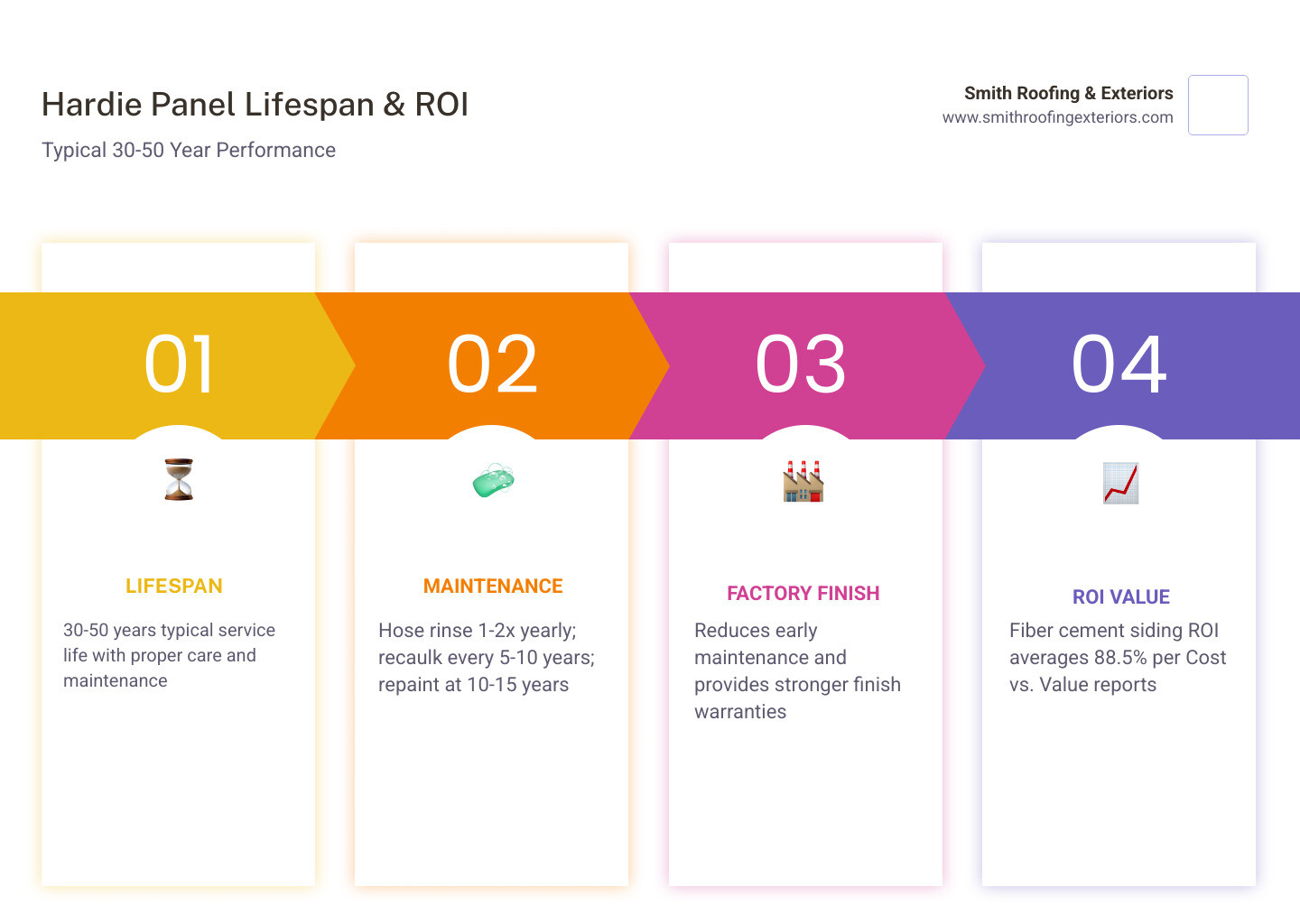
Most research places Hardie board lifespan at about 30 to 50 years, and some sources suggest it can last even longer with proper care. Typical maintenance includes:
- Rinsing with a garden hose once or twice a year
- Cleaning dirt with a soft brush if needed
- Keeping bushes and mulch away from siding
- Inspecting caulked joints every year
- Recaulking as needed, often every 5 to 10 years
- Repainting primed or field-painted products when finish wear appears, often around 10 to 15 years
Factory-finished options reduce early maintenance and usually carry stronger finish warranties than field-applied paint.
As for return on investment, fiber cement siding continues to perform well. One widely cited Cost vs. Value report placed fiber cement siding ROI at 88.5%. That does not mean every homeowner gets a check at the door for exactly that amount, of course, but it does show strong resale value compared with many exterior projects.
You can also read more on Hardie board cost data from Angi and our own piece on how siding replacement can improve energy efficiency.
How to Estimate Your Hardie Panel Project and Avoid Budget Surprises
A good estimate starts with actual wall area, not just home square footage. The size of your house and the size of your exterior walls are not always the same thing.
What a complete quote should include
A professional siding quote should spell out:
- Panel material type and finish
- Trim and batten details
- Labor
- Tear-off and disposal
- Housewrap or moisture barrier
- Flashing details
- Caulking and sealants
- Painting, if using primed panels
- Permit costs, if required
- Cleanup
- Workmanship warranty
- Manufacturer warranty information
If a quote is one line long and mysteriously low, that is not “efficient.” That is a future headache wearing a discount sticker.
Cost-saving tips without cutting quality
Here are smart ways to control cost:
- Choose standard colors instead of custom finishes
- Keep the layout simple
- Consider factory-finished panels if you plan to stay long-term
- Bundle siding with related exterior work when timing makes sense
- Schedule in slower seasons when possible
- Get multiple detailed estimates
Factory-finished siding often costs more up front, but it can save thousands compared with primed siding that needs painting soon after installation and repainting earlier in the ownership cycle.
When to replace siding instead of patching
Sometimes repair makes sense. Sometimes it is just putting a bandage on a wall.
It may be time to replace siding if you see:
- Repeated moisture problems
- Soft or rotted wall sections
- Cracking or loose panels
- Fading and finish failure across large areas
- Higher maintenance costs year after year
- Interior signs of water intrusion
If that sounds familiar, these resources may help:
- 5 signs it’s time to install new siding on your home
- top benefits of upgrading your home with siding replacement
Frequently Asked Questions About Hardie Panel Siding Cost
Is Hardie panel siding more expensive than standard lap siding?
Usually, yes. Standard lap siding is often the lower-cost Hardie style. Panel siding can cost more because the sheets are larger, layout precision matters more, and many designs include battens or extra trim. On a simple home, the difference may be modest. On a board and batten design, it can be more noticeable.
Can Hardie panel siding be installed over existing siding?
In most cases, we recommend full tear-off instead of installing over old siding. Removing the existing material lets us inspect sheathing, install the right moisture barrier, and avoid trapping hidden water damage. It is also the safer route for long-term performance and warranty protection.
Does factory-finished Hardie panel cost more up front but save money later?
Yes. Factory-finished panels usually cost more initially, often by about $1.50 to $2.50 per square foot compared with primed products once the finish premium is included. But they avoid immediate painting, offer strong fade resistance, and can reduce maintenance costs over the first 10 to 15 years.
Conclusion
For most homeowners in Fort Atkinson and across Southeastern Wisconsin, hardie panel siding cost is best thought of as a value decision, not just a price tag. You are paying for a durable fiber cement exterior, strong curb appeal, and a product that can last for decades when installed correctly.
The key is getting a quote that includes the full picture: materials, labor, trim, tear-off, prep, and warranty-backed installation. That is where transparent pricing really matters.
At Smith Roofing & Exteriors, we help homeowners make sense of siding numbers without the fluff, the guesswork, or the mysterious “miscellaneous” line item that somehow costs as much as a used fishing boat. If you are planning a siding project in Fort Atkinson, Lake Mills, Jefferson, Burlington, Delavan, Elkhorn, Lake Geneva, Walworth, Edgerton, or nearby Southeastern Wisconsin communities, we are here to help.
For your next step, visit Upgrade Your Home with a Quality Siding Replacement Company.