Essential Tools and Materials to Attach Siding to House
Attaching siding to a house is one of the most impactful upgrades you can make to protect your home and boost curb appeal — especially in Wisconsin, where harsh winters and wet springs put your exterior to the test year after year.
Here is a quick overview of how to attach siding to a house:
- Prepare the surface — inspect sheathing, install house wrap, and add flashing around all openings
- Install starter strips — snap a level chalk line and fasten your starter strip along the base of the wall
- Set corner posts and J-channels — secure these accessories first so panels have a clean edge to slide into
- Attach siding panels — work from the bottom up, overlapping each course and leaving expansion gaps
- Nail correctly — center nails in slots, space them 12–16 inches apart, and never drive them tight
- Finish with trim — install soffit, fascia, and finish trim to seal the top and edges
Vinyl siding is the most popular choice today, installed on more than 50% of new homes across the country. It is durable, low-maintenance, and relatively easy to install when you follow the right steps. But even small mistakes — like nailing too tight or skipping flashing — can lead to buckling, water damage, or costly callbacks down the road.
I’m Matt Smith, owner of Smith Roofing & Exteriors, and I’ve helped countless Wisconsin homeowners attach siding to a house the right way, from straightforward re-sides to complex installs around storm damage. This guide walks you through everything I’ve learned in the field, step by step.
Attach siding to house word guide:
Before you even think about climbing a ladder in Fort Atkinson or Lake Mills, you need the right gear. Attaching siding to a house isn’t just about a hammer and nails; it requires precision tools to ensure the final product looks like it was done by a pro.

The Siding Toolkit
- Hammer and Level: You’ll need a standard claw hammer for manual nailing and a 4-foot level to ensure your courses stay straight.
- Chalk Line: Essential for snapping that first perfectly level line for your starter strip.
- Fine-Tooth Saw: A circular saw with a plywood blade installed in reverse is a classic pro trick for cutting vinyl without shattering the edges.
- Tin Snips and Utility Knife: Used for detail cuts around windows and trimming panels to length.
- Tape Measure: As the old saying goes, measure twice, cut once (and then measure again just to be sure).
Fasteners and Accessories
When you attach siding to house structures, your choice of nail is non-negotiable. You must use galvanized, stainless steel, or aluminum roofing nails to prevent rust streaks from ruining your new facade. According to industry standards, nails should have at least a 3/8-inch head and be 1-3/4 inches long to ensure they penetrate at least 3/4 of an inch into a nailable base like wood sheathing.
You will also need specific trim pieces:
- Starter Strips: The foundation that locks in the first row of siding.
- J-Channels: These hide the cut ends of siding around windows and doors.
- Corner Posts: Available in inside and outside varieties to seal the corners of the home.
For those considering other materials, you can find A Step-by-Step Guide to Installing a Wood Siding to see how wood requirements differ, particularly regarding moisture content and stainless steel ring-shank nails.
Surface Preparation and Material Planning
You wouldn’t paint a dirty car, and you shouldn’t attach siding to house walls that aren’t ready for it. Preparation is the “unsexy” part of the job that determines whether your siding lasts 30 years or starts sagging by next summer.
Start by removing old shutters, downspouts, and lighting fixtures. If you’re working on an older home in Jefferson or Elkhorn, check for 5 Signs It’s Time to Install New Siding on Your Home, such as rot or mold on the existing sheathing. Any soft wood must be replaced before the new siding goes on.
The Weather Barrier and Furring
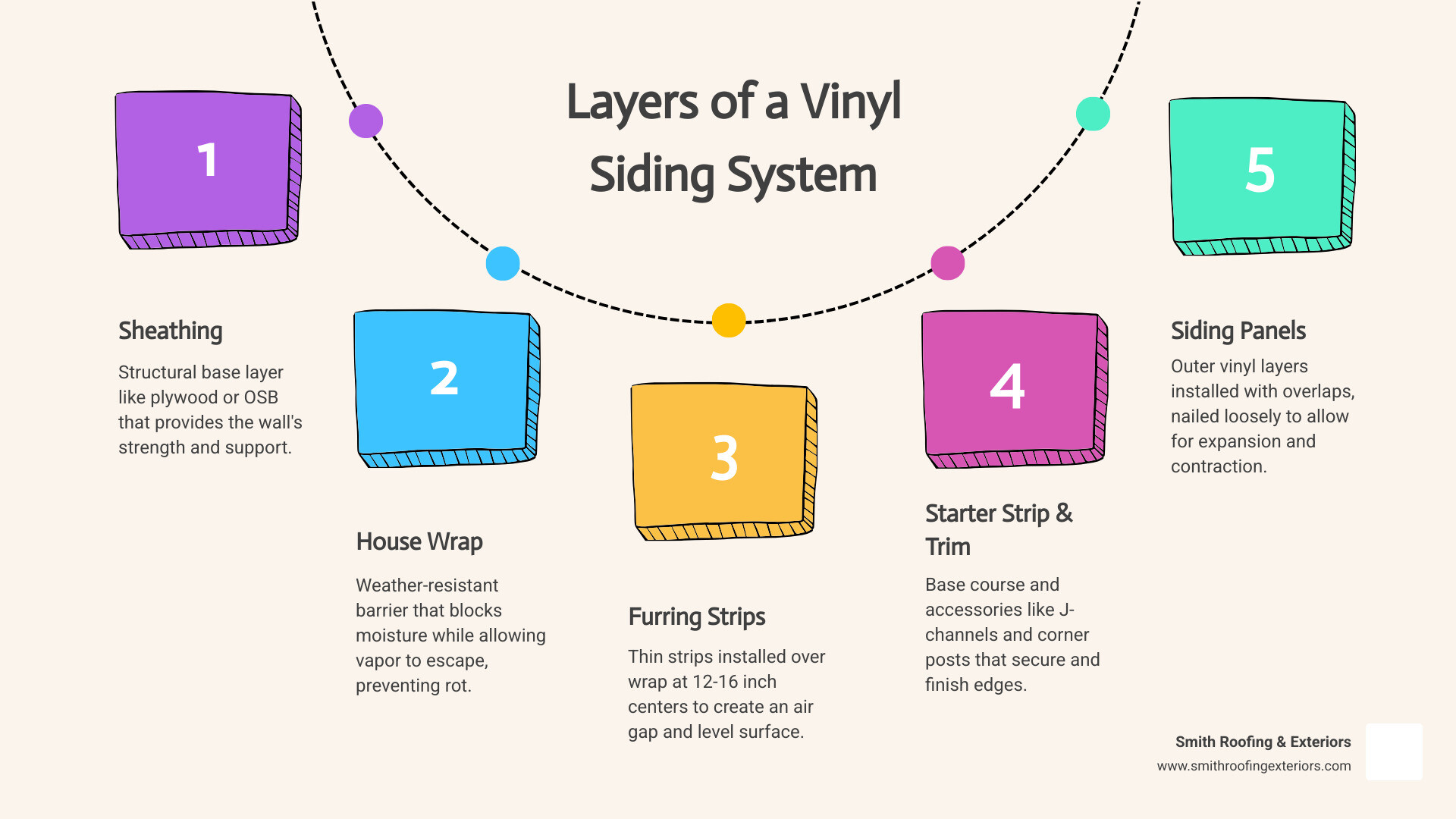
Vinyl siding is not watertight. It is designed to shed the bulk of the rain, but some moisture will always get behind it. This is why a high-quality house wrap or weather-resistant barrier (WRB) is mandatory. Lap the wrap “shingle-style” (top over bottom) so water flows down and away from the structure.
If your walls are uneven—common in many historic Wisconsin homes—you may need to install vertical furring strips on 12-inch to 16-inch centers. This creates a flat plane for the siding and provides an air gap that helps the wall “breathe,” preventing rot.
Calculating Materials to Attach Siding to House
Don’t get caught halfway through a wall on a Sunday afternoon without enough panels. To calculate your needs:
- Measure the square footage of all walls.
- Subtract the area of large windows and doors.
- Add 10-15% for waste, cutting, and the inevitable “oops” moments.
When your materials arrive, store them properly. Do not stack vinyl siding more than five cartons high, and keep them on a flat surface to prevent warping before they even touch the wall.
| Material Feature | Vinyl Siding | Composite Siding |
|---|---|---|
| Expansion Gap | 1/4″ to 3/8″ | 1/8″ to 3/8″ |
| Nailing Rule | Loose (1/32″ gap) | Varies by brand |
| Waste Factor | 10% | 15% (due to weight/breakage) |
| Maintenance | Low (wash only) | Low to Moderate |
Step-by-Step Guide to Attaching Siding Panels
Now for the fun part: actually attaching siding to a house. The key to a professional look is starting level and staying level.
The Foundation: Starter Strips and Corners
Find the lowest corner of the house and snap a level chalk line around the entire perimeter. Fasten your starter strip along this line, but leave a 1/4-inch gap where strips meet to allow for expansion. Next, install your corner posts. These should hang about 1/4 inch below the bottom of the starter strip and extend up to the eave.
For a deeper dive into these initial steps, check out How to Install Vinyl Siding | Polymeric Exteriors or see our local projects for Siding Installation in Lake Geneva.
Installing the Panels
Lock the first panel into the starter strip and slide it into the corner post. When you attach siding to house walls, you must leave room for the material to grow and shrink. In temperatures above 40°F, leave a 1/4-inch gap at all openings and corner posts. If it’s colder, increase that gap to 3/8 of an inch.
When overlapping panels, overlap them by about 1 inch. To make the seams less visible, always lap them away from the highest traffic areas—like the front walkway or the driveway.
Best Practices to Attach Siding to House Obstacles
Windows and doors require extra care. Install J-channels around all four sides of the opening. To ensure water drains correctly, we recommend cutting “rain tabs” in the side J-channels and folding them into the bottom channel.
Always leave at least 1/2 inch of clearance between the siding and any obstructions like mounting blocks for lights or utility vents. This prevents the panels from binding and buckling when the Wisconsin sun hits them. If you’re in the area, our team specializes in Siding Installation in Burlington and can handle these tricky details for you.
Professional Nailing Techniques and Finishing
If you take only one thing away from this guide, let it be this: Do not nail vinyl siding tight. Vinyl expands and contracts significantly with temperature changes. If you pin it to the wall, it will warp, buckle, and look like a wavy mess within a year.
The Nailing Rules
- Center the Nail: Always place the nail in the center of the pre-punched slot.
- Leave a Gap: Leave about 1/32 of an inch (roughly the thickness of a dime) between the nail head and the siding. The panel should be able to slide back and forth easily.
- Drive Straight: Crooked nails pull the siding hem and cause distortion.
- Spacing: Space nails every 12 to 16 inches.
If you’ve already started and notice some “waves,” read our guide on Troubleshooting Common Vinyl Siding Installation Mistakes to see how to fix it.
Finishing the Top
When you reach the top of the wall or the underside of a window, you’ll likely need to “rip” (cut) the panel to width. Since you’ve cut off the nailing hem, use a snap-lock punch to create raised tabs along the cut edge. These tabs lock into a piece of utility trim (finish trim) installed at the top of the wall.
Finally, install your soffit and fascia. For eave areas wider than 16 inches, you may need intermediate nailing supports to keep the soffit from sagging. Finish the corners of your fascia with a custom-cut corner cap for a clean, professional look.
Frequently Asked Questions about Siding Installation
How do I cut vinyl siding without chipping it?
In the cold Wisconsin winters, vinyl becomes brittle. To avoid chipping, use a circular saw with a fine-tooth blade installed backward. This “grinds” through the vinyl rather than “biting” it. For smaller cuts, use sharp tin snips, but try to use the center of the blades rather than the tips for a smoother finish. Always leave a 3/8-inch gap if you are cutting in freezing temperatures.
What is the best way to handle expansion and contraction?
Expansion is the #1 reason for siding failure. Always leave a 1/4-inch gap at all J-channels and corner posts (3/8-inch in cold weather). Most importantly, ensure the panels can move freely. If you can’t slide a panel 1/2 inch left or right with your hand after nailing, it’s too tight.
Can I install new siding over old wood siding?
Yes, but with caveats. You must inspect the old wood for rot or insect damage first. If the wood is sound, you can install a moisture barrier and then attach siding to house walls using furring strips to create a flat surface. That this will add thickness to your walls, which might require window and door trim extensions. For a breakdown of what this might run you, see our article on the Cost to Reside a House with Vinyl Siding.
Conclusion
Attaching siding to a house is a big project, but it’s one of the most rewarding ways to protect your investment. By following these professional steps—preparing the surface, allowing for expansion, and mastering the “loose nail” technique—you can achieve a result that looks great and stands up to the elements for decades.
At Smith Roofing & Exteriors, we take pride in providing local craftsmanship to our neighbors in Fort Atkinson, Delavan, Walworth, and throughout Southeastern Wisconsin. Whether you’re looking for a DIY consultation or a full professional installation, our team is here to help with transparent pricing and superior materials.
Ready to transform your home’s exterior? Check out More info about vinyl siding services or give us a call to get started on your next project!