Your Attic Is Costing You Money — Here’s How to Fix It

The best energy efficient roof vents for most Wisconsin homeowners:
| Vent Type | Best For | Operating Cost |
|---|---|---|
| Solar-powered attic fan | Hot summers, no wiring | $0/year |
| Variable-speed ECM power vent | Large attics, max control | Low |
| Ridge vent (passive) | Balanced year-round airflow | $0/year |
| Turbine vent | Wind-exposed rural roofs | $0/year |
| Soffit + ridge combo | Whole-system efficiency | $0/year |
Energy efficient roof vents are one of the most overlooked upgrades a Wisconsin homeowner can make — yet they directly affect your heating bills, cooling costs, roof lifespan, and even your risk of ice dams every winter.
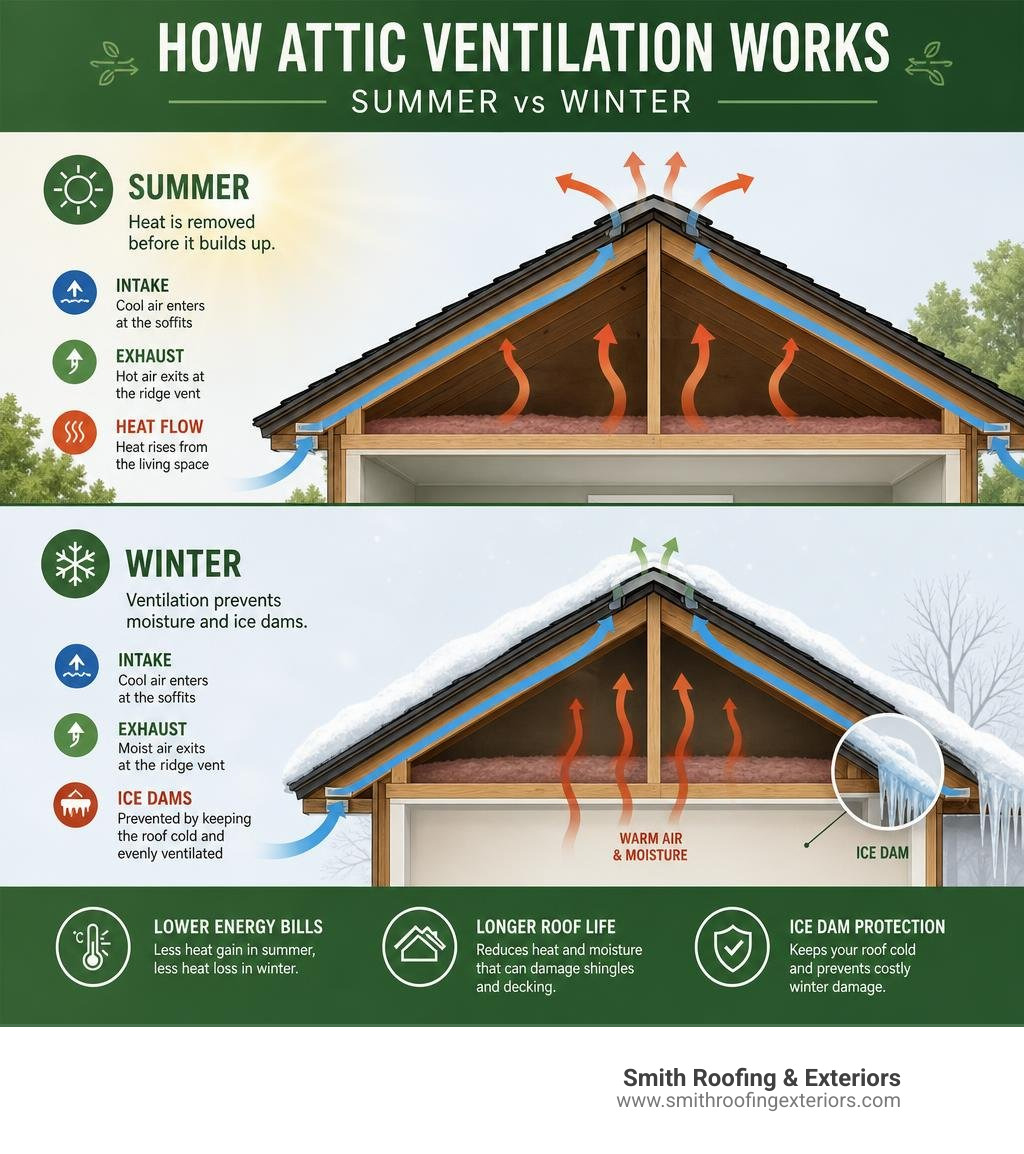
Here’s the problem most homeowners don’t realize: a poorly ventilated attic can reach temperatures well above 150°F in summer. That heat pushes down into your living space, forcing your air conditioner to work harder. In winter, warm air trapped in the attic melts snow on your roof — which then refreezes at the eaves and creates damaging ice dams.
The right vents change all of that.
This guide reviews the top-rated options on the market right now — from zero-electricity passive vents to smart solar-powered fans — so you can choose what actually works for your home and climate.
I’m Matt Smith, owner of Smith Roofing & Exteriors, and I’ve spent years helping homeowners across Wisconsin select and install energy efficient roof vents that hold up against our harsh freeze-thaw seasons. Let’s walk through exactly what’s worth your money.
Energy efficient roof vents definitions:
Why Upgrading to Energy Efficient Roof Vents Matters
When we think about saving money on our energy bills, we usually focus on replacing windows, upgrading the HVAC system, or switching to LED lightbulbs. But your attic is the thermal gateway of your home. Without proper ventilation, it becomes a giant radiator in the summer and a moisture-trapping chamber in the winter.
Upgrading to high-performing, energy efficient roof vents is one of the most cost-effective ways to manage this thermal gateway. In the heat of a Southeastern Wisconsin summer, radiant heat from the sun beats down on your shingles, warming your roof deck and elevating attic temperatures. If that super-heated air has nowhere to go, it transfers directly through your attic insulation and into your bedrooms.
By installing high-quality vents, you create a continuous path for this heat to escape. This drastically reduces your HVAC load, meaning your air conditioner doesn’t have to run constantly to maintain a comfortable temperature.
Furthermore, proper ventilation plays a massive role in moisture control. Everyday household activities like showering, cooking, and washing dishes release moisture that rises into your attic. If this moisture gets trapped, it condenses against the cold roof sheathing, leading to mold, wood rot, and ruined insulation. Understanding The Role of Roofing in Energy Efficiency helps us see how a healthy attic environment protects your entire structural investment.
How Proper Ventilation Lowers Utility Bills
To understand how proper ventilation lowers your utility bills, we have to look at the physics of heat transfer. Heat moves in three ways: conduction, convection, and radiation. During summer, your shingles absorb radiant heat from the sun and conduct it into your attic space.
Once inside, that heat is trapped. Without ventilation, convective currents can’t form to carry the hot air away. This forces your ceiling insulation to work overtime. Over the course of a hot afternoon in Fort Atkinson or Lake Mills, even high-R-value insulation will eventually saturate with heat and radiate it down into your living spaces.
By installing a balanced intake and exhaust system, you harness natural convection. Cool air is drawn in through your eave or soffit vents, and hot air is pushed out through your roof vents. This natural cycle keeps attic temperatures close to the outdoor temperature. Studies show that installing photovoltaic (solar) attic ventilator fans can reduce peak summer attic air temperatures by over 20°F. This results in a measured space-cooling reduction of approximately 6%, saving homeowners about 460 kWh of electricity annually.
For more detailed information on how these airflow patterns work, check out The Complete Guide to Roof Ventilation.
Preventing Ice Dams and Moisture Damage
In places like Jefferson, Walworth, and Edgerton, our winters can be brutal. While we often focus on summer heat, winter ventilation is just as critical for preventing roof damage.
When warm, conditioned air leaks from your home into your attic, it raises the attic temperature. If the attic is too warm, it melts the snow on your roof. This melted snow runs down the slope until it reaches the cold eaves, where it refreezes. This cycle creates ice dams—thick ridges of ice that prevent melting water from draining. The trapped water backs up under your shingles, causing leaks, stained drywall, and ruined gutters.
Proper attic ventilation keeps your roof deck uniformly cold, preventing the snow from melting prematurely. Coupled with regular winter maintenance, a balanced ventilation system protects your shingles from early deterioration. To learn more about how to safeguard your home against winter weather, read our guide on Why Regular Roof Maintenance Is Crucial for Homeowners.
Passive vs. Powered Attic Ventilation: Which is Best?
When planning a ventilation upgrade, you will choose between two primary methodologies: passive (natural) ventilation and active (powered) ventilation.
- Passive Ventilation: This system relies completely on natural forces—specifically, wind pressure and thermal buoyancy (the physical principle that warm air naturally rises). Common passive vents include ridge vents, soffit vents, gable vents, and turbine vents. Because they have no mechanical parts, they consume exactly zero electricity, operate silently, and require almost no maintenance.
- Powered Ventilation: These systems use motorized fans to actively pull air out of the attic. They can be powered by your home’s electrical grid, solar panels, or a hybrid of both. Powered vents are highly effective at moving large volumes of air quickly, making them popular for complex roof shapes where natural airflow is restricted.
So, which is best? For most standard roofs in Southeastern Wisconsin, a balanced passive system is the gold standard. It is reliable, costs nothing to run, and works around the clock. However, powered systems can be highly beneficial in specific scenarios, such as homes with limited soffit space or complicated hip roofs with multiple ridge levels.
The Risks of Improperly Configured Powered Fans
While powered attic fans sound like an easy fix for a hot attic, they come with substantial risks if your home is not properly prepared.
The biggest risk is negative pressure. If your attic floor is not perfectly air-sealed, a powerful attic fan can draw conditioned air from your living spaces up through recessed lighting, attic hatches, and wall bypasses. This means you are paying to cool your home, only for your attic fan to suck that expensive air straight out through the roof!
Furthermore, if your attic lacks sufficient intake vents (like soffit vents), a powered fan can create a vacuum. This vacuum can pull air backward through gas appliance flues (such as your water heater or furnace chimney), drawing carbon monoxide into your living spaces.
Before installing any powered ventilation system, it is vital to perform thorough air sealing and ensure your bathroom exhausts are properly routed. Make sure you don’t make common mistakes by reading Don’t Blow It: The Ultimate Guide to Bathroom Roof Ventilation.
Top-Rated Energy Efficient Roof Vents Reviewed
To help you find the right fit for your home, we have reviewed the top-performing energy efficient roof vents available in 2026, categorized by their technology.
| Product Name | Vent Type | CFM Rating | Key Feature | Source Link |
|---|---|---|---|---|
| HE15 High Efficiency | Variable-Speed Electric | Up to 1500 CFM | Smart ECM motor saves up to 74% energy | Air Vent HE15 |
| 10-Watt Solar 9010TR | Solar Powered | Up to 800 CFM | Tilting panel for maximum sun exposure | Air Vent 9010TR |
| SolarCool SC8 | Solar Powered | Up to 800 CFM | Low-profile dome with zero running cost | Air Vent SC8 |
| Maxx Air 433 CFM | Solar Powered | 433 CFM | Durable steel dome, 25 ft panel cord | Maxx Air 433 |
| Airstract® Terminal | Passive / Natural | High Capacity | 100% rain rejection, zero electricity | Passivent Airstract |
High-Efficiency Variable-Speed Electric Vents
If you need the raw power of an electric vent but want to avoid high utility bills, a variable-speed unit with an Electronically Commutated Motor (ECM) is the way to go.
The High Efficiency Roof-Mount – Air Vent, Inc. (HE15) is a prime example of this technology. Unlike traditional power vents that run at full blast or not at all, the HE15 features a smart, variable-speed ECM motor. Built-in temperature and humidity sensors monitor your attic’s conditions in real-time. Under moderate conditions, the fan runs at a whisper-quiet, low speed, ramping up to its maximum 1500 CFM only when temperatures peak.
This smart operation saves homeowners up to 74% in energy consumption compared to standard power fans, translating to an average of $60 in annual electricity savings. It also features automatic shut-offs if attic temperatures drop too low or in the event of a home fire.
Eco-Friendly Solar-Powered Energy Efficient Roof Vents
For homeowners looking to completely eliminate operating costs, solar-powered vents are an exceptional alternative. They run entirely on free solar energy, meaning they require zero electrical wiring during installation.
The 10-Watt Solar – 9010TR – Air Vent, Inc. is designed for attics up to 1,200 square feet. It features a high-efficiency 24-volt DC motor that delivers up to 800 CFM under direct sunlight. Its standout feature is a solar panel that tilts and rotates on a bracket, allowing installers to position it for maximum sun exposure without separate mounting.
If you prefer a more subtle look, the 10-Watt Solar – SC8 – Air Vent, Inc. offers the same solar-powered efficiency and 800 CFM capacity but in a low-profile, sleek dome design that blends seamlessly with your roofline.
For rugged durability, the Maxx Air 433 CFM Steel Solar Powered Roof Mount Power Attic Ventilator – USFanco is a heavy-duty option. Built with a tough steel dome that resists wind and hail, this unit includes a 15-watt solar panel with a 25-foot cord. This allows you to mount the fan on a shaded part of your roof while placing the solar panel in direct sunlight. It covers attics up to 1,500 square feet and operates without adding a dime to your electric bill.
High-Performance Passive Energy Efficient Roof Vents
Passive vents remain the ultimate choice for zero-maintenance longevity. If you want a highly engineered passive system that outperforms standard ridge vents, look to advanced commercial-grade terminals.
The Airstract® Roof Ventilation Terminal – Passivent is a premium natural ventilation solution designed to harness wind, convection, and thermal buoyancy. It features patented double-bank louvers that provide Class A 100% certified rain rejection, ensuring your attic stays dry even in wind-driven storms. Because it has no mechanical parts, it requires no annual servicing and comes with a 15-year no-leak guarantee. It’s an excellent choice for modern, green-focused residential builds or flat-roof applications.
Sizing and Balancing Your Attic Ventilation System
The secret to an energy-efficient attic isn’t just buying the most expensive vent—it’s achieving balance. A ventilation system requires a balanced ratio of intake vents (which let fresh air in) and exhaust vents (which let hot, moist air out).

A general building guideline is the 1:150 rule, which states you need one square foot of net free ventilating area (NFA) for every 150 square feet of attic floor space. Under certain building codes, if you have an airtight vapor barrier and balanced ventilation, this ratio can be reduced to 1:300.
To keep the system balanced:
- 50% of your ventilation should be Intake: Typically installed at the lowest point of your roof, such as soffit or eave vents.
- 50% of your ventilation should be Exhaust: Installed at the highest point of your roof, such as ridge vents, box vents, or powered fans.
If you have plenty of exhaust vents but no soffit vents, your roof vents won’t work properly. Instead of drawing fresh air from outside, they will pull air from your home or fail to move air altogether.
The Critical Role of Attic Air Sealing and Insulation
Ventilation does not work in a vacuum; it must be paired with proper insulation and air sealing to achieve true energy efficiency.
In Southeastern Wisconsin, we recommend insulating your attic floor to an R-value of R-49 or higher. However, before laying down new fiberglass or blown-in cellulose, you must seal all air leaks. Air sealing blocks the pathways where warm, conditioned air escapes from your living room into the attic.
Once your ceiling is airtight, your insulation acts as a reliable thermal barrier, and your roof vents can do their job—regulating the attic’s temperature without stealing your heated or cooled indoor air. To find out how to coordinate these upgrades during your next roofing project, read How a Roofing Contractor Can Extend the Life of Your Roof Through Simple Maintenance.
Frequently Asked Questions about Attic Ventilation
Do powered attic fans actually save money on electricity?
Yes, but only if your attic floor is thoroughly air-sealed and you have plenty of intake (soffit) vents. If your attic is not sealed, a powered fan will pull air-conditioned air from your home, which increases your utility bills. If you want to avoid this risk entirely, solar-powered vents are the best alternative because they cost nothing to run.
How do I calculate how many roof vents my home needs?
First, calculate your attic’s square footage (length x width). Divide that number by 150 to get the total square feet of Net Free Area (NFA) you need.
For example, a 1,500 sq. ft. attic requires 10 square feet of NFA. To keep things balanced, you would install 5 square feet of intake vents (soffits) and 5 square feet of exhaust vents (ridge or roof vents).
Can I mix different types of exhaust vents on the same roof?
No! We strongly advise against mixing different types of exhaust vents (for example, combining a ridge vent with a powered attic fan).
Doing so can “short-circuit” the system. Instead of drawing cool air up from your soffits, the powered fan may pull air from the nearby ridge vent. This leaves the rest of your attic completely unventilated and traps heat and moisture where you least want it.
Conclusion
Upgrading to energy efficient roof vents is one of the smartest investments you can make for your home’s comfort, efficiency, and structural health. Whether you choose a smart, variable-speed electric vent, a zero-cost solar fan, or a reliable passive ridge-and-soffit system, getting the installation right is what matters most.
At Smith Roofing & Exteriors, we specialize in designing balanced ventilation systems tailored to our Southeastern Wisconsin climate. From Fort Atkinson and Lake Mills to Jefferson, Burlington, and Lake Geneva, our local team is here to help you lower your energy bills and extend the life of your roof.
Ready to make your home more comfortable and energy-efficient? Contact us today for a professional attic ventilation assessment, and learn more about how we can help by reading The Role of Roofing in Energy Efficiency.