Average Labor Cost to Shingle a Roof in 2026
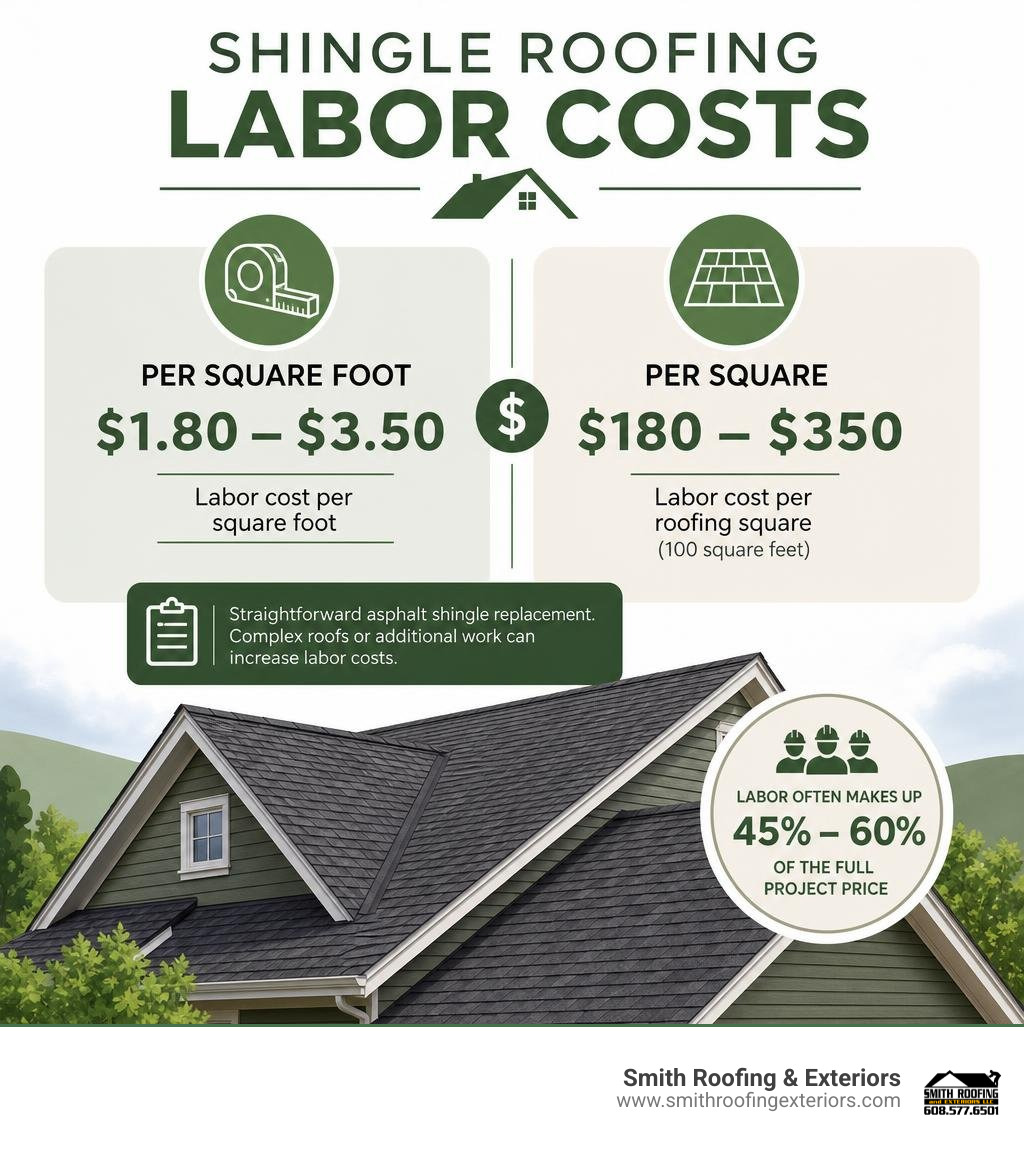
The average labor cost to shingle a roof is about $1.80 to $3.50 per square foot, or $180 to $350 per roofing square (100 square feet), for a straightforward asphalt shingle replacement. A steep roof, multiple stories, tear-off, or many valleys and dormers can raise labor to $350 to $450 per square before materials.
For a typical replacement, labor often makes up 45% to 60% of the full project price. The key is to compare quotes with the same scope: tear-off, disposal, deck repairs, underlayment, flashing, ice-and-water shield, and cleanup can change the real labor cost fast. This matters especially in rural Wisconsin, where snow, ice dams, wind exposure, and short roofing seasons can add both safety steps and required weather protection.
I’m Matt Smith, owner of Smith Roofing & Exteriors, and I work directly with homeowners to explain the average labor cost to shingle a roof in clear, itemized terms. In this guide, I’ll show you what drives labor pricing so you can compare estimates without guessing.
Related content about average labor cost to shingle a roof:
- asphalt shingles roof replacement cost
- cost of asphalt shingle roof per square foot
- roof replacement cost
Understanding the Average Labor Cost to Shingle a Roof
When contractors evaluate a project, we calculate pricing using surface area rather than simple floor plans. In the roofing trade, 100 square feet of roof surface is defined as one “roofing square.” Because roof slopes and overhangs extend beyond the exterior walls of a house, a 2,000-square-foot home footprint often requires 22 to 26 roofing squares of surface coverage.
A reliable baseline for budgeting is the industry standard 60/40 rule: roughly 60% of your total roofing bill covers direct labor, crew mobilization, safety equipment, and overhead, while the remaining 40% pays for the physical materials. Direct physical installation of shingles usually runs between $150 and $400 per square across standard residential builds.
Hourly rates for roof work fall into distinct tiers based on crew specialization:
- Lead roofers and specialized installers: bill out at approximately $130 per hour for critical tasks like flashing, valley weaving, and complex penetrations.
- General roof laborers: average roughly $35 per hour, handling material staging, continuous clean-up, and physical tear-off.
- Blended crew rates: across standard Midwestern projects, an entire multi-person crew typically averages $60 per worker hour.
For a broader breakdown of how these square-based numbers add up on an actual home, check out our roof replacement cost guide: what’s the price per square? and explore external asphalt shingle installation benchmarks for national context.
Key Factors Driving Roofing Labor Pricing
Every roof presents unique architectural challenges. Two identical floor plans sitting across the street from one another in Southeastern Wisconsin can require significantly different labor investments based on structural layout, roof accessibility, and site geometry.
Key factors that shift labor hours include:
- Structural complexity: Every ridge, valley, hip, dormer, and chimney requires hand-cutting, flashing, and extra underlayment. A simple gable roof installs quickly, whereas a cut-up roof with multiple gables slows down crew progress.
- Accessibility and site barriers: Landscaping, narrow side yards, overhead power lines, and multi-tier decks limit where equipment can park. If crews cannot place dump trailers near the eaves, manual haul-away increases total labor hours.
- Calculated waste factor: Complex roofs generate higher material waste (15% to 20% compared to 10% on basic roofs), demanding extra cutting, measuring, and fastening labor.
- Seasonal climate demand: Roofing in Wisconsin is compressed by winter conditions. Shingles require temperatures of 40°F and rising for adhesive strips to seal down correctly. High demand during temperate months drives full crew schedules.
- Local building codes: Mandated ice-and-water barriers along eaves and valleys ensure homes withstand heavy freeze-thaw cycles and ice damming.
How Roof Pitch and Stories Impact the Average Labor Cost to Shingle a Roof
Roof slope (pitch) indicates how many inches the roof rises vertically for every 12 inches of horizontal run. Pitch is the single largest structural factor affecting installation speed and safety requirements.

- Walkable slopes (4/12 to 6/12 pitch): Installers can walk comfortably across the decking with standard footing, allowing high production rates at the base labor tier of $180 to $250 per square.
- Moderate slopes (7/12 to 8/12 pitch): Movement slows as roofers require toe-boards and specialized footwear, bumping installation labor up by $20 to $75 per square.
- Steep slopes (9/12 to 11/12 pitch): Crews must install roof jacks, staging planks, and full OSHA-compliant harness tie-offs. Labor rates climb to $250 to $325 per square.
- Extreme vertical pitches (12/12 and higher): Workers cannot stand without permanent rigging and staging platforms. Labor charges jump to $350 to $450 per square.
Height adds another variable. Two-story and three-story homes require longer ladder setups, aerial lifts, and extra time hoisting bundles, adding $30 to $60 per square compared to a single-story ranch.
How Material Selection Shapes the Average Labor Cost to Shingle a Roof
The specific shingle profile you choose alters handling difficulty, bundle count, and fastening requirements.
- 3-Tab shingles: These traditional, single-layer shingles are lightweight but require precise manual alignment along the keyways. They represent a declining segment of modern installations.
- Architectural (laminated) shingles: Now standard on over 75% of residential roofs, these multi-layer shingles feature an offset design that installs quickly and securely, offering high wind ratings (up to 130 mph).
- Premium designer / Luxury shingles: Heavyweight luxury options (such as imitation slate or thick wood-shake patterns) weigh between 450 and 530 lbs per square—more than double the weight of standard shingles. They ship in four bundles per square rather than three, requiring significantly more muscle and time to stage and fasten.
- Class 4 impact-resistant shingles: These shingles feature reinforced polymer backing. While they require specific high-tensile nails and precise fastening schedules, they often qualify homeowners for substantial annual insurance premium discounts.
To learn more about how material upgrades align with long-term roofing investments, review the real price of replacing your asphalt shingle roof.
Step-by-Step Breakdown of Roofing Labor Tasks
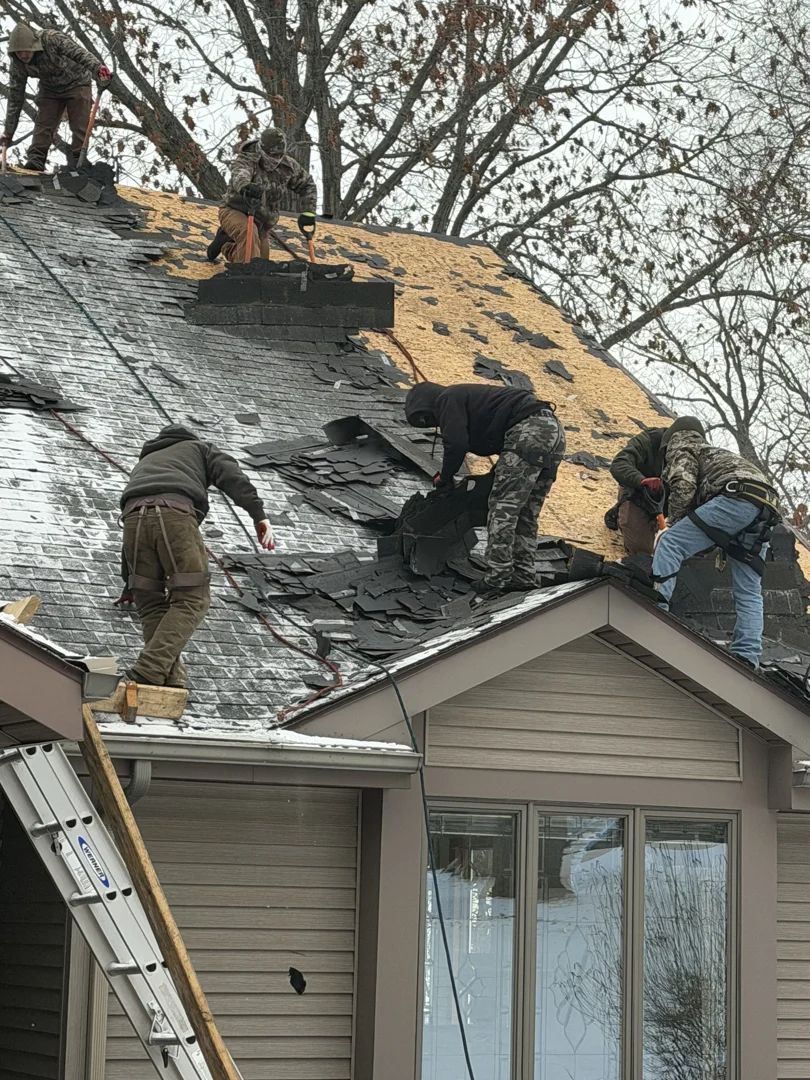
A high-performing roof system requires a methodical, multi-stage installation. Direct labor encompasses far more than simply driving nails through shingles.
- Mobilization and property protection: Tarping shrubbery, placing plywood over HVAC units, and setting up catch-all debris netting around the perimeter.
- Tear-off and deck inspection: Stripping existing shingles and felt paper down to the bare wooden substrate to check for moisture damage or rot.
- Decking preparation: Renailing loose sheathing and replacing damaged plywood or oriented strand board (OSB).
- Underlayment and drip edge installation: Fastening corrosion-resistant metal drip edges along eaves and rakes, followed by self-adhering ice-and-water barrier and synthetic underlayment.
- Flashing and penetration sealing: Installing new step flashing against siding, counter-flashing chimneys, and fitting rubber boot collars around plumbing vents.
- Starter strip and field shingle application: Nailing starter courses along edges and nailing field shingles per manufacturer pattern specifications.
- Ridge cap and ventilation: Installing continuous intake and exhaust ridge vents and capping hips and ridges with specialized cap shingles.
- Ground magnet sweep and haul-away: Running rolling magnetic sweeps across lawns, driveways, and landscaping to collect loose nails before loading trailers for disposal.
| Labor Task | Average Time (24-Sq Roof) | Typical Cost Per Square | Core Responsibility |
|---|---|---|---|
| Site Prep & Property Protection | 1 to 2 hours | $15 – $25 | Tarping, setting catch-nets, protecting siding/plants |
| Tear-Off & Substrate Inspection | 4 to 6 hours | $50 – $150 | Stripping old layers, pulling old nails, checking deck |
| Flashing, Drip Edge & Underlayment | 3 to 4 hours | $35 – $65 | Installing ice barrier, synthetic felt, wall metal |
| Shingle Fastening & Ridge Capping | 6 to 10 hours | $150 – $250 | Laying courses, nailing per specs, ridge venting |
| Continuous Cleanup & Disposal | 2 to 3 hours | $20 – $40 | Magnet sweeps, hauling debris to dumpsters |
For deeper market analysis on complete project allocations, reference the 2026 residential roofing cost data.
Regional Labor Rates and Crew Economics
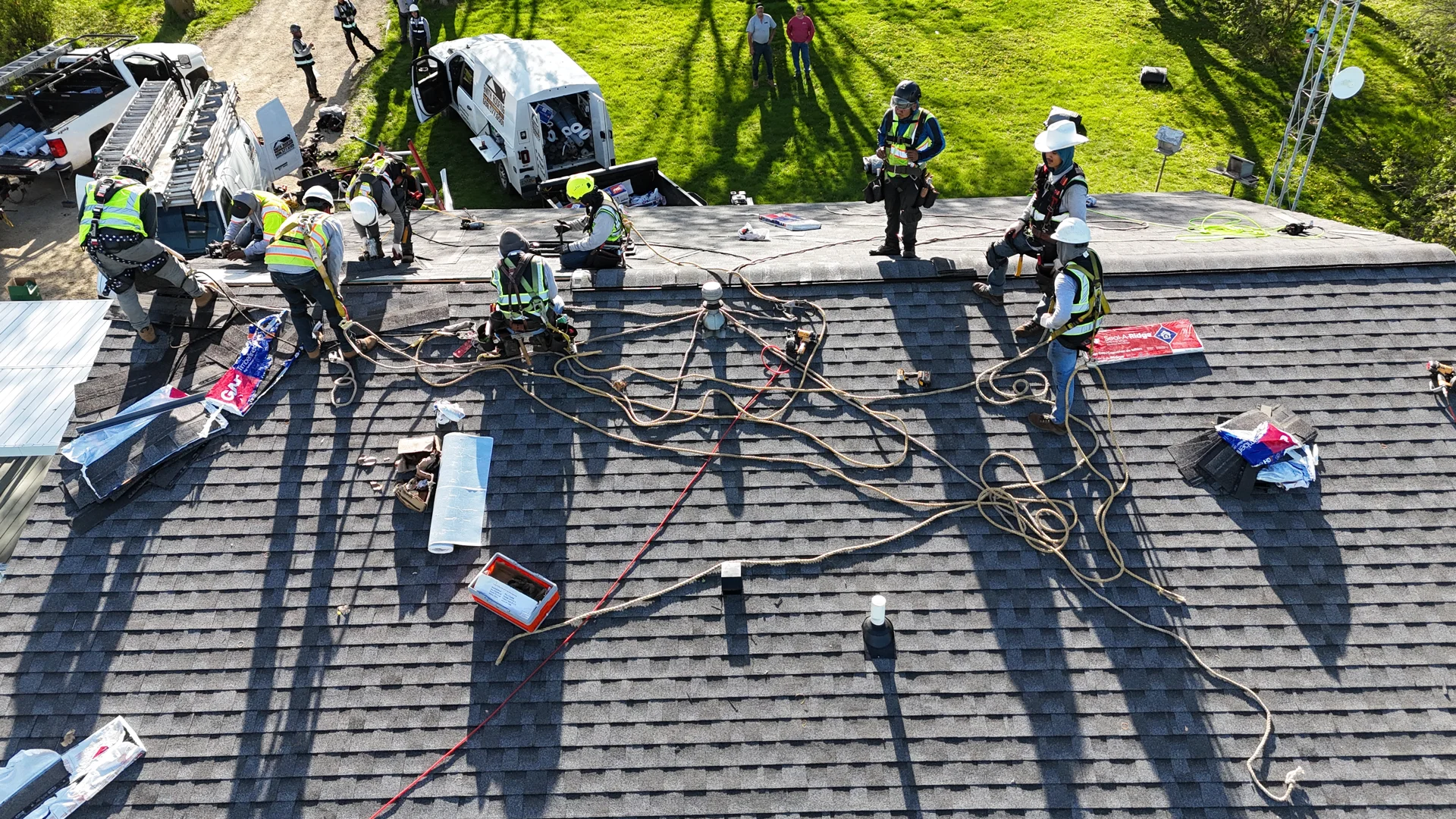
Roofing labor rates reflect local living costs, commercial insurance regulations, and weather-driven seasonality. In lower-cost southern regions, four-person crews frequently bill between $1,400 and $1,800 per day. In contrast, Midwestern suburban markets typically bill between $2,000 and $2,600 per day.
A standard residential roofing crew consists of 3 to 5 workers:
- One on-site crew lead/supervisor overseeing layout and flashing integration.
- Two to three seasoned shingle installers.
- One ground technician handling staging, continuous site cleanup, and equipment maintenance.
On a standard walkable roof, an experienced four-person crew installs 20 to 30 squares per day. A typical 24-square home is stripped, dried-in, reshingled, and cleaned up in 1 to 2 working days.
A substantial portion of labor billing covers mandatory overhead, including workers’ compensation insurance premiums (roofing carries high risk ratings) and general commercial liability. To understand how contractors assemble these numbers into a balanced proposal, see the art of estimation: how roofing contractors calculate costs.
Hidden Labor Adders and Quote Comparison Strategies
When comparing contractor bids, examining the line-item scope helps you identify missing items before work begins. Quotes that appear unusually low often omit essential preparation steps.
Common labor adders that can arise during construction include:
- Deck rot repair: Rotted or delaminated roof decking cannot hold nails securely. Replacing damaged sheathing runs $70 to $150 per 4×8 plywood sheet ($2.00 to $3.00 per sq ft) for materials and labor.
- Flashing replacement: Reusing old, corroded step flashing or rusted chimney counter-flashing is a common corner-cutting tactic. New custom-bent flashing requires $9.00 to $11.00 per linear foot.
- Plumbing pipe boots: Installing fresh neoprene or silicone pipe boots costs $63 to $85 each to protect roof penetrations from premature leaks.
- Permit and municipal inspection fees: Building permits generally range from $100 to $600 depending on your local township or city hall.
To protect your home and your budget:
- Ensure the estimate explicitly itemizes tear-off, brand-specific underlayment, drip edge, ridge caps, and cleanup.
- Ask for a stated per-sheet rate for unexpected wood decking replacement.
- Confirm that the contractor uses trained in-house personnel rather than unvetted third-party labor pools.
Before committing to a contract, read through everything you need to know before hiring a roof installation company.
Frequently Asked Questions About Roofing Labor Costs
What is the average pure labor cost per square to install asphalt shingles?
Pure installation labor for asphalt shingles on a standard, walkable roof (4/12 to 6/12 pitch) runs between $150 and $250 per square ($1.50 to $2.50 per square foot). If the project involves safety harness staging for steep slopes or multi-story access, pure labor rates rise to $250 to $400 per square.
How much does shingle tear-off and disposal add to labor costs?
Tearing off a single layer of old asphalt shingles and hauling the debris to an approved disposal facility adds $50 to $150 per square ($0.50 to $1.50 per square foot) to your total labor bill. A standard residential tear-off generates 3 to 5 tons of heavy waste. If your roof has two or more existing layers, tear-off costs increase accordingly.
Can I reduce roofing labor costs by installing new shingles over old ones?
While an overlay saves upfront tear-off labor, it is generally poor practice. Installing new shingles over old ones prevents the crew from inspecting the wooden deck for hidden rot, voids top-tier manufacturer warranties, traps excess attic heat, and doubles future removal costs. Performing a complete tear-off provides the best long-term value and roof performance.
Conclusion
Understanding roofing labor costs gives you the clarity needed to make confident decisions about your home’s exterior. Quality installation by experienced professionals protects your property against severe seasonal weather, ice dams, and high winds while keeping manufacturer warranties fully intact.
At Smith Roofing & Exteriors, we serve homeowners across Fort Atkinson, Lake Mills, Jefferson, Burlington, Delavan, Elkhorn, Lake Geneva, Walworth, Edgerton, and surrounding Southeastern Wisconsin communities with transparent pricing and exceptional craftsmanship. If you are planning an upcoming project or need an honest assessment of your current roof, contact our local team today for an itemized estimate.