What Hail Actually Does to a Flat Roof (And Why It Matters)
hail damage flat roof problems are more common — and more serious — than most property owners realize. Here’s a quick overview of what to know:
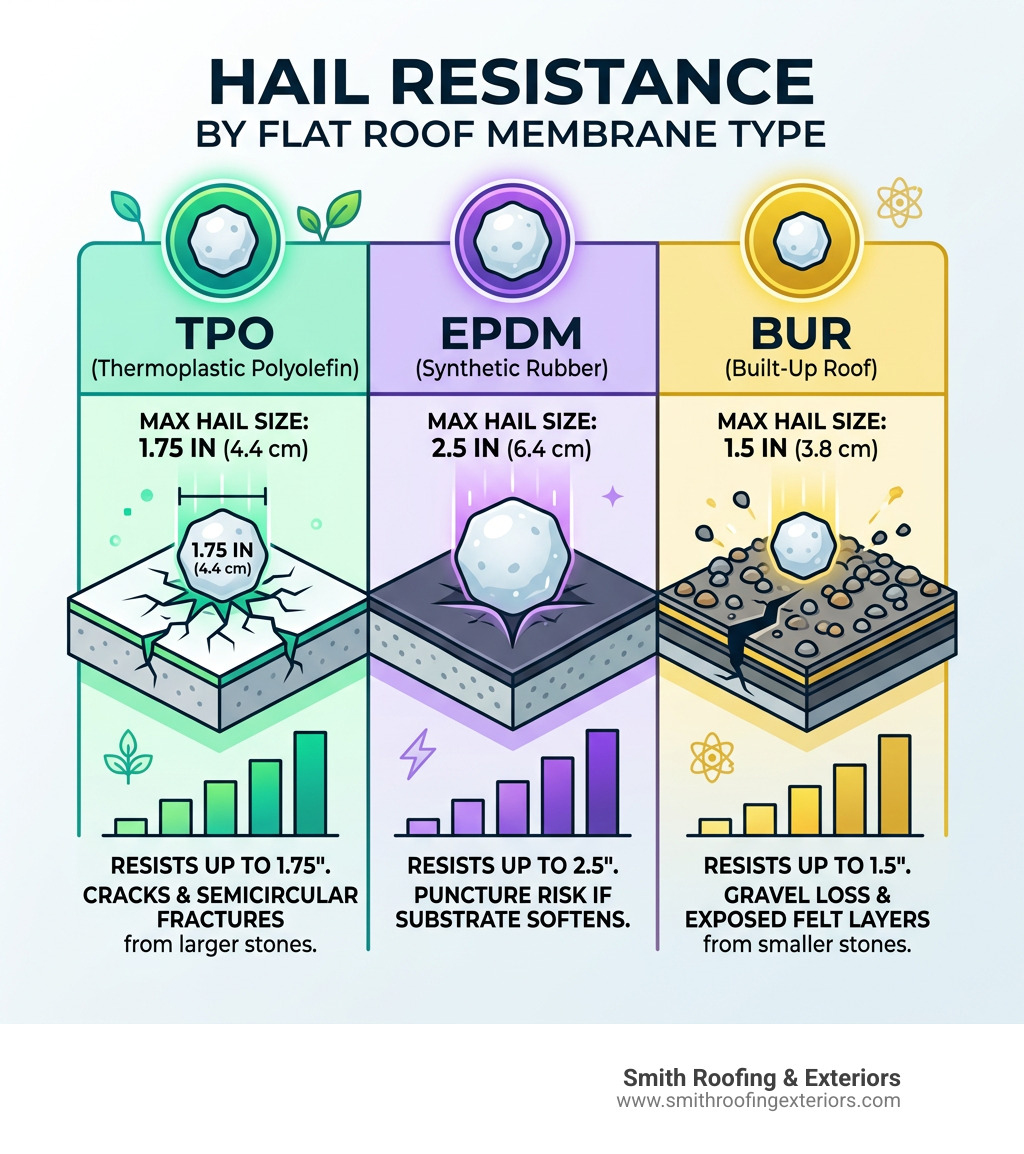
- TPO/PVC membranes withstand hail up to 1.75 inches; larger stones cause cracks and semicircular fractures
- EPDM membranes resist up to 2.5 inches, but can puncture if the substrate beneath softens
- BUR (gravel) roofs can lose protective gravel from stones as small as 1 inch, exposing vulnerable felt layers
- Hidden damage — including insulation bruising and delamination — is common and often invisible from the surface
- Hail damage accounts for 70% of all property losses from severe storms every year
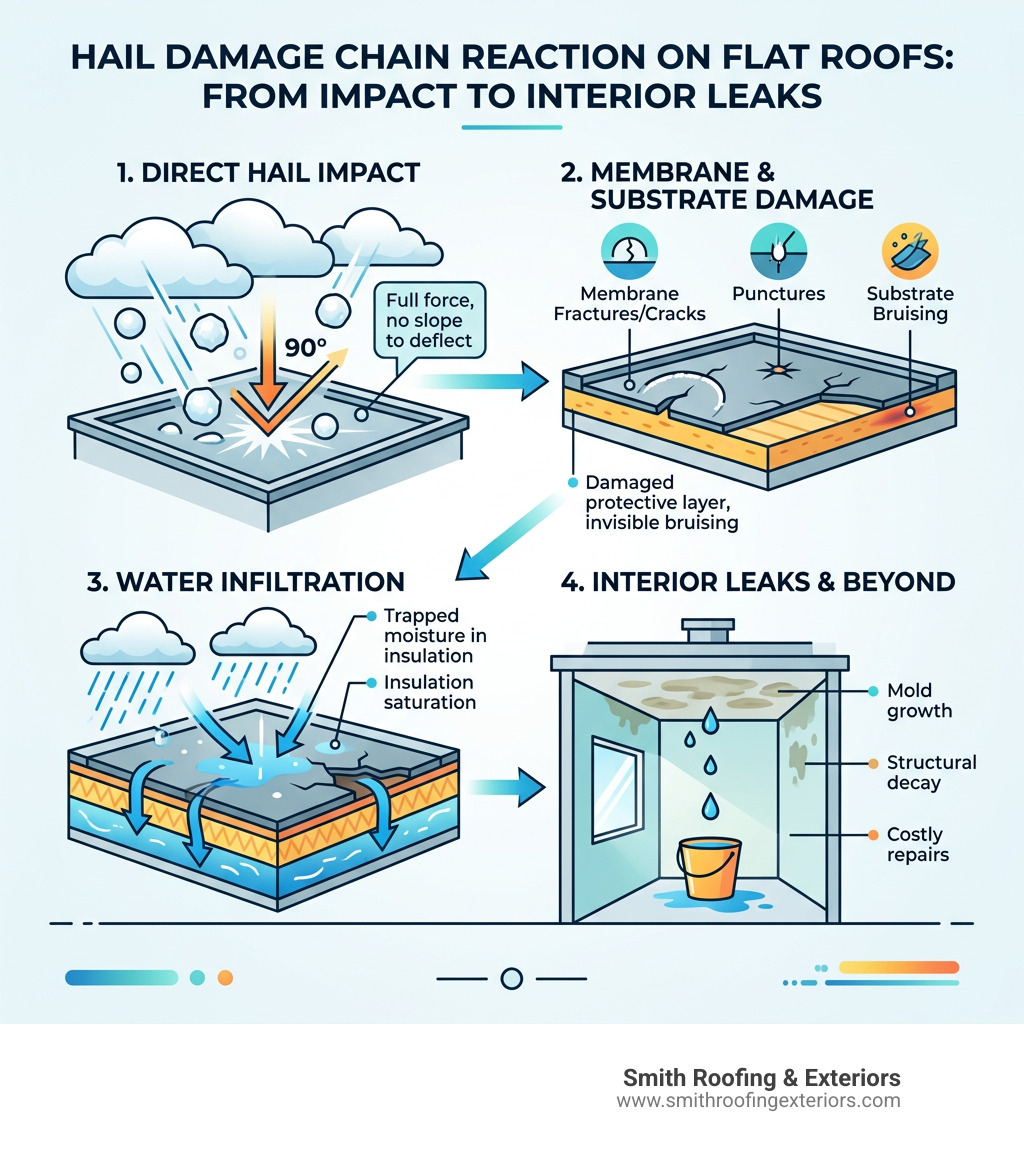
Unlike sloped roofs, flat roofs take every hailstone as a direct, 90-degree hit. There’s no slope to deflect the impact. That means more force on the membrane, more risk of punctures, and — because water doesn’t drain as easily — a greater chance that even small breaches turn into big leaks.
Wisconsin storms can be brutal. After a bad hailstorm, it’s easy to assume your roof is fine if you don’t see obvious holes. But the real damage is often hiding just below the surface, quietly growing into a much costlier problem.
I’m Matt Smith, owner of Smith Roofing & Exteriors, and I’ve spent years helping Wisconsin homeowners and business owners assess and recover from hail damage flat roof situations after severe storms. In this guide, I’ll walk you through exactly how to check your flat roof safely and what to do next.
Why Flat Roofs Are Uniquely Vulnerable to Hail Damage
When you think of a hailstorm, you probably imagine hailstones bouncing off a sloped shingle roof like a pinball machine. On a sloped roof, the angle of the surface often deflects the stone, glancing the blow and reducing the total energy transferred to the building. However, flat roofs don’t have that luxury.
On a commercial flat roof, every single hailstone is a direct, 90-degree strike. Imagine the difference between someone throwing a baseball at a wall at an angle versus throwing it straight down onto the floor. The straight-down hit carries the full force of the impact. This direct impact vulnerability makes flat roofs significantly more susceptible to punctures, fractures, and underlying structural bruising.
Furthermore, flat roofs are designed to manage water differently. While they aren’t perfectly “flat” (they have a slight pitch to internal drains or scuppers), any small indentation caused by hail can create a “micro-pond.” When water pools in these tiny craters, it puts constant pressure on the membrane. If the hail has created even a microscopic fracture, that standing water will eventually find its way into your insulation and decking.
The risks are high, and the statistics back it up. Nationally, hail damage contributes to roughly 70% of all property losses caused by severe storms annually. While states like Texas lead the nation in sheer numbers, our region in Southeast Wisconsin—from Fort Atkinson to Lake Geneva—sees its fair share of “sky-rocks” that can compromise a commercial investment in minutes. For a deeper dive into how these systems differ, check out our guide on flat-vs-sloped-commercial-roofing-which-is-best.
Identifying Membrane-Specific Damage Patterns
Identifying hail damage flat roof issues isn’t always as simple as looking for a hole. Depending on the material—whether it’s TPO, PVC, EPDM, or a Built-Up Roof (BUR)—the damage manifests in very different ways. A “trained eye” is often necessary because what looks like a simple scuff mark could actually be a catastrophic failure of the membrane’s reinforcement.
If you are wondering what hail damage looks like on a flat roof, you have to look closer than just the surface. Material degradation, UV exposure, and the age of the roof all play a role in how the membrane reacts to impact. Older roofs become brittle as plasticizers leach out over time, making them far more likely to shatter under the stress of a storm.
Signs of Hail Damage Flat Roof Issues on TPO and PVC
TPO (Thermoplastic Polyolefin) and PVC (Polyvinyl Chloride) are popular “single-ply” membranes known for their reflective properties. When hail hits these surfaces, it often leaves behind a very specific signature: the semicircular crack.
These cracks often look like a tiny “frown” or a crescent moon on the surface. While the top layer might look okay to a casual observer, the impact often shatters the internal reinforcement fabric (the “scrim”) inside the membrane. Once that scrim is broken, the membrane loses its structural integrity.
- The Threshold: Generally, TPO and PVC can withstand hailstones up to 1.75 inches in diameter. Anything larger than a golf ball is almost guaranteed to cause functional damage.
- Aging Vulnerability: As these roofs age in the Wisconsin sun, the chemicals that keep them flexible begin to evaporate. An older TPO roof might fail when hit by 1-inch hail that a brand-new roof would have easily shrugged off.
- Hidden Fractures: Sometimes the surface doesn’t crack, but the underside does. This is why a professional inspection is so critical—we check for the “bruise” that indicates a future leak.
EPDM and Built-Up Roofing (BUR) Indicators
EPDM, or “rubber roofing,” is much more flexible than TPO. Because of this elasticity, it is often rated to withstand hailstones up to 2.5 inches in diameter. However, EPDM is only as strong as what lies beneath it. If the hailstones are large enough to dent the rigid insulation board (the substrate) under the rubber, the membrane can be stretched to its breaking point or punctured by the sudden compression.
Built-Up Roofing (BUR), often called “tar and gravel” roofs, uses layers of bitumen and felt topped with a layer of gravel. These roofs are naturally more hail-resistant because the gravel acts as a shock absorber. However, they aren’t invincible.
- Gravel Displacement: High-velocity hail can strip the gravel away from the bitumen, exposing the underlying felt to UV rays and water.
- Exposed Felt: Once the gravel is gone, the “armor” is pierced. Even 1.5-inch stones can loosen enough gravel to leave the roof vulnerable to rapid deterioration.
Choosing between these systems is a big decision for any building owner. You can learn more about the pros and cons in our article on metal-vs-rubber-choosing-the-right-commercial-roofing-system.
Step-by-Step Guide: How to Safely Inspect Your Flat Roof
We always recommend leaving roof inspections to the pros—especially after a storm when surfaces might be slippery or structurally compromised. However, if you choose to take a look yourself, safety must be your absolute priority.
- Ground-Level Scouting: Before grabbing a ladder, walk the perimeter. Look for “collateral damage.” If your gutters are dented, your siding is dinged, or your window screens are torn, there is a 100% chance your roof took a beating too.
- Check the AC Units: The thin metal fins on HVAC units are very soft. If you see “combing” or dents in these fins, it’s a clear indicator of the hail’s size and intensity.
- Ladder Safety: If you must go up, ensure your ladder is rated for your weight, placed on level ground, and extends at least three feet above the roof edge. Never go up alone.
- The Binocular Method: You can often spot large tears or displaced gravel on a BUR roof using high-powered binoculars from a safe distance or a higher vantage point.
- Look at the Vents and Flashing: Metal components like roof vents, chimney caps, and flashing will show dents much more clearly than a rubber membrane. If the metal is dented, the membrane underneath likely suffered an impact that needs closer inspection.
If you spot active leaks or major punctures during your walk-through, don’t wait. Check our guide on emergency-roof-repair-after-a-storm-what-to-do for immediate mitigation steps.
Hidden Risks: Beyond the Surface Membrane
One of the most dangerous things about a hail damage flat roof is that the worst damage is often invisible. This is what we call “hidden functional damage.”
When a large hailstone hits a flat roof, the energy travels through the membrane and into the rigid insulation boards (often polyisocyanurate or “ISO” board) underneath. Even if the membrane doesn’t pop like a balloon, the impact can crush the cells of the insulation.
This creates several long-term problems:
- Delamination: The membrane is usually glued to the insulation. When the insulation facer is crushed or bruised, the membrane can pull away (delaminate). This leads to air pockets, reduced wind uplift resistance, and eventual tearing.
- Loss of Thermal Efficiency: Crushed insulation doesn’t insulate as well. You might notice your energy bills creeping up in the months following a storm.
- The “Apple Bruise” Effect: Just like an apple looks fine on the outside but turns brown inside after being dropped, your roof decking can begin to rot from trapped moisture that entered through micro-fractures you couldn’t see.
Ignoring these hidden risks can lead to mold growth and structural decay that might void your manufacturer’s warranty.
Navigating the Insurance Claim Process for a Hail Damage Flat Roof
Dealing with insurance adjusters can feel like a full-time job. The most important thing to understand is the difference between functional damage and cosmetic damage.
Insurance companies are generally only required to pay for functional damage—damage that affects the roof’s ability to shed water or shortens its expected lifespan. If a hailstone leaves a tiny dent in a metal flashing that doesn’t leak, they may call it “cosmetic” and deny the claim. However, on a flat roof, almost any impact that compromises the membrane or the insulation facer is functional because it invites water pooling and delamination.
Because hail damage accounts for 70% of storm-related property losses, adjusters are often under pressure to minimize payouts. This is why having an independent contractor report is vital. We provide a detailed assessment that often uncovers damage adjusters miss, ensuring you get the coverage you actually paid for in your policy.
Documenting Hail Damage Flat Roof Evidence for Adjusters
To win an insurance claim, you need a mountain of evidence. Don’t just take one photo of the roof and call it a day.
- The “Test Square”: Adjusters often look at a 10′ x 10′ area and count the number of hits. We do the same, marking impacts with chalk to make them visible in photos.
- Photo Documentation: Take photos of the hail next to a ruler or a common object (like a quarter) to prove the size. Take photos of the collateral damage (gutters, AC units, vents).
- Date and Time Stamps: Ensure your digital photos have metadata that proves they were taken immediately following the storm.
- Professional Reports: A signed document from a local expert carries weight. If you’re in the Jefferson County area, visit our fort-atkinson/roofing/commercial/storm-damage page to see how we help document these claims.
Repair vs. Replacement: Making the Right Choice
When is it time to patch, and when is it time to pull the trigger on a full replacement? We generally follow the 25% Rule. If more than 25% of the roof surface is damaged, or if there are more than 8–10 hits per “square” (a 100 sq. ft. area), a full replacement is usually the most cost-effective long-term solution.
Other factors to consider:
- Roof Age: If your TPO roof is 15 years old and takes a hit, patching it is like putting a Band-Aid on a broken leg. The surrounding material is likely too brittle to hold a new weld.
- Maintenance History: A well-maintained roof might survive a storm with minor repairs. A neglected roof with existing ponding issues will likely need to be replaced.
- Upgrading for the Future: If you do replace your roof, consider impact-rated materials. Class 4 shingles or high-density cover boards under your membrane can significantly reduce future damage. For help deciding, read our guide on choosing-the-right-commercial-roofing-system-for-your-building.
Whether you need a quick fix in Lake Mills, a major repair in Jefferson, or are looking for roofers near Delavan, we have the local expertise to guide you.
Frequently Asked Questions about Flat Roof Hail Damage
What size hail causes damage to flat roof membranes?
TPO and PVC typically withstand up to 1.75 inches, while EPDM can resist up to 2.5 inches; however, stones as small as 1 inch can displace gravel on BUR systems. Even smaller “pea-sized” hail can cause significant wear over time by scouring the protective granules off modified bitumen roofs.
Can hidden hail damage cause leaks months later?
Yes; hail can create micro-fractures or bruise the underlying insulation, leading to delamination and eventual water intrusion that isn’t immediately visible. This is why we see a spike in “mystery leaks” in the autumn following a spring hailstorm. The freeze-thaw cycle in Wisconsin expands those tiny cracks until they become major problems.
Does insurance cover cosmetic hail damage on flat roofs?
Most policies require “functional damage” that affects the roof’s lifespan or shedding ability; cosmetic dents that don’t puncture the membrane may be excluded. However, “cosmetic” is a subjective term. What an adjuster calls a dent, we might identify as a structural fracture of the membrane’s reinforcement.
For more general information on the inspection and claim process, the Ultimate Hail Damage on Roof : Inspection & Claim Guide is an excellent external resource.
Conclusion
A hailstorm is a stressful event for any property owner, but a hail damage flat roof doesn’t have to be the end of the world. The key is acting fast. The longer you wait, the more likely it is that secondary damage—like mold, rot, and saturated insulation—will set in, potentially complicating your insurance claim or voiding your warranty.
At Smith Roofing & Exteriors, we are your neighbors. Based right here in Fort Atkinson, we serve the entire Southeast Wisconsin region, including Lake Mills, Jefferson, Delavan, and Lake Geneva. Our experienced team uses superior materials and provides transparent pricing to ensure your commercial or residential flat roof is restored to peak condition.
We offer 24/7 emergency services because we know storms don’t stick to a 9-to-5 schedule. If you suspect your building has been hit, don’t leave it to chance.
Schedule a professional flat roof inspection with Smith Roofing & Exteriors today and let us handle the heavy lifting—from the initial climb to the final insurance negotiation.