What You Need to Know About Hail Roof Damage Insurance
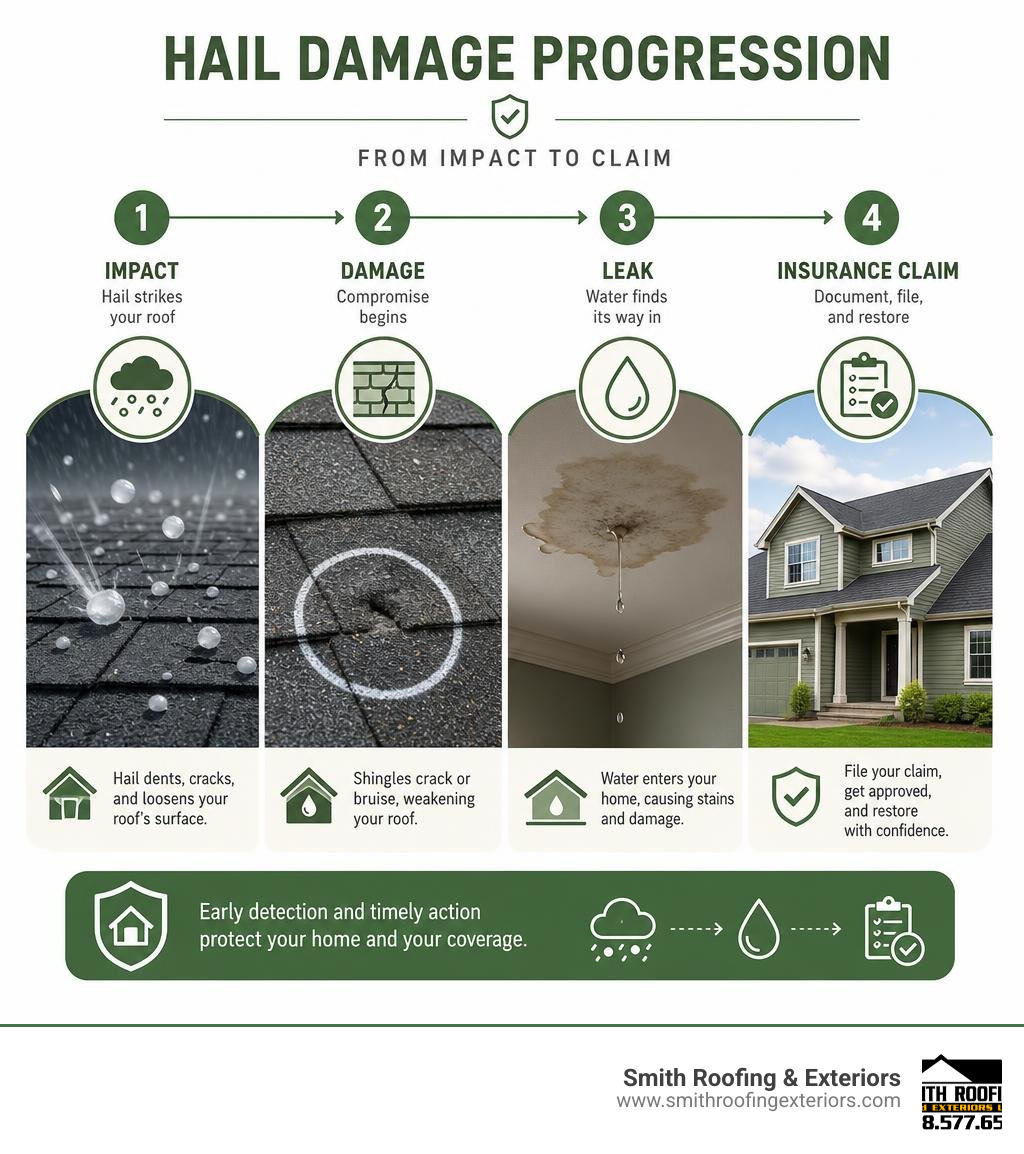
Hail roof damage insurance is one of the most commonly filed — and most commonly disputed — homeowner claims in the United States. If a storm just rolled through your neighborhood and you’re wondering whether your roof is covered, here’s the short answer:
Yes, hail damage is typically covered under a standard homeowners insurance policy — but the payout depends on your policy type, your deductible, your roof’s age, and how well you document the damage.
Quick-answer snapshot:
| Question | Short Answer |
|---|---|
| Is hail damage covered? | Usually yes, under standard homeowners insurance |
| What policy types exist? | ACV (depreciated value) or RCV (full replacement cost) |
| What size hail triggers a claim? | 1 inch in diameter is the typical insurance threshold |
| How much is the average payout? | Around $12,000, before your deductible |
| How long do you have to file? | Varies by state and policy — act within 30–60 days |
| What voids a claim? | Pre-existing wear, late filing, or poor documentation |
The tricky part? Hail damage often isn’t visible from the ground. It can quietly shorten your roof’s lifespan by years — and if you miss the filing window, you’re paying out of pocket.
Severe convective storms caused $51 billion in U.S. insured losses in 2025, and hail alone accounts for up to 80% of those claims. Roofs absorb the majority of that impact, which is why understanding your coverage before you need it makes a real difference.
I’m Matt Smith, owner of Smith Roofing & Exteriors, and I’ve helped Wisconsin homeowners navigate hail roof damage insurance claims through some of the region’s toughest storm seasons. In this guide, I’ll walk you through exactly what to look for, what to document, and how to protect your claim from start to finish.
Hail roof damage insurance word guide:
Hail Size Thresholds and Insurance Claim Metrics
When a storm hits, the first question homeowners ask is: Was that hail big enough to actually break my roof?
Insurance adjusters don’t just look at a few scattered dents and approve a brand-new roof. They rely on strict, scientific thresholds to determine if the damage is functional or merely cosmetic.
Here is how different hail sizes impact various roofing materials:
- Under 1 inch (Pea to Dime Sized): This size rarely causes functional damage to a healthy roof unless it is accompanied by extreme, hurricane-force winds. However, if your roof is already over 15 years old and the shingles are brittle, even sub-1-inch hail can knock away the remaining protective granules.
- 1 inch (Quarter Sized): This is the universal threshold used by most major insurance carriers. At 1 inch, hail falls with enough velocity to bruise standard 3-tab asphalt shingles and fracture the underlying fiberglass mat.
- 1.25 to 1.5 inches (Half-Dollar to Ping-Pong Sized): Hail of this size consistently produces functional, severe damage on standard architectural shingles, denting metal valley flashings and cracking older cedar shakes.
- 1.75 inches and above (Golf Ball to Softball Sized): At this point, no roof is safe. Even brand-new, high-end shingles, metal panels, and tile roofs will suffer structural failure.
The “Test Square” Methodology
To determine if your roof qualifies for a spot repair or a full replacement, insurance adjusters use a standardized metric called the test square.
An adjuster will physically climb onto your roof and mark out a 10-foot by 10-foot area (100 square feet, known in the roofing industry as a “square”) on each slope of your roof. They will then count the number of distinct hail hits within that square.
As detailed in the comprehensive Hail Damage on Your Roof: Signs, Cost & Insurance Guide (2026), most insurance carriers require 8 to 10 verified hail impacts within a single test square on at least two or more slopes to approve a full roof replacement. If the hit count is lower, the carrier will likely only offer a payout for localized repairs.
Hail Damage vs. Blistering and Wear
One of the most common reasons a hail roof damage insurance claim gets denied is that the adjuster attributes the damage to “normal wear and tear” or “manufacturing defects” rather than the storm. For a claim to be approved, the damage must be functional, meaning it compromises the roof’s water-shedding capabilities or shortens its expected lifespan.
It is crucial to understand the difference between covered storm damage and non-covered wear:
- Hail Damage (Covered): Hail impacts leave random, circular bruises on asphalt shingles. When you press on these dark spots, they feel soft and spongy, like a bruised apple. The fiberglass mat underneath is often fractured, and the granules are pushed deep into the shingle.
- Roof Blistering (Not Covered): Blisters occur when moisture becomes trapped inside the shingle during manufacturing. As the summer sun heats the roof, the moisture expands, creating raised bubbles. When these bubbles pop, they leave behind circular craters. Unlike hail hits, popped blisters have clean, hard, and glazed bottoms with no fractured fiberglass mat. They also tend to be uniform in size and scattered evenly across the entire roof.
- Normal Wear and Tear (Not Covered): Over time, shingles naturally lose granules due to sun exposure and rain. This occurs slowly and evenly across the roof. Hail damage, by contrast, is sudden, localized, and leaves distinct impact marks accompanied by fresh, sharp-looking granule loss.
Understanding these differences is the foundation of protecting your home. If you want to dive deeper into identifying these issues, read our detailed guide on Hail Damage Roof 101.
ACV vs. RCV: Navigating Your Hail Roof Damage Insurance Policy
When you buy a homeowners insurance policy, you choose how your claims will be calculated. This choice can mean a difference of tens of thousands of dollars out of pocket when your roof gets hit by hail.
| Feature | Actual Cash Value (ACV) | Replacement Cost Value (RCV) |
|---|---|---|
| Payout Basis | Current depreciated value based on roof age | Current retail cost to replace the roof today |
| Depreciation Deducted? | Yes (Permanently withheld) | No (Withheld initially, released upon completion) |
| Out-of-Pocket Cost | High (Deductible + depreciated value gap) | Low (Only your deductible) |
| Ideal For | Lower monthly premiums | Maximum financial protection |
Actual Cash Value (ACV)
Under an ACV policy, the insurance company only pays you what your roof was worth at the exact moment it was damaged. They calculate this by taking the cost of a new roof and subtracting depreciation based on its age.
For example, if your roof is 15 years old, has a 30-year life expectancy, and a full replacement costs $15,000, the insurer will determine that your roof has lost 50% of its value. After subtracting your deductible, your actual payout might only be $6,500. You are responsible for coming up with the remaining $8,500 to get your roof replaced.
Replacement Cost Value (RCV)
An RCV policy is far more comprehensive. It pays the actual, current retail cost to replace your damaged roof with new materials of like kind and quality, regardless of how old the roof was.
With RCV, the insurer will typically issue two checks. The first check is for the ACV (depreciated value). Once the work is completed by a licensed contractor and the final invoice is submitted, the insurer releases the remaining balance, known as recoverable depreciation. In this scenario, your only true out-of-pocket expense is your deductible.
To fully understand how these policy structures dictate your repair options, check out The Ultimate Guide to Roof Repair Insurance and Claims.
Understanding Your Hail Roof Damage Insurance Coverage Limits
Even if you have an RCV policy, there are several hidden clauses and coverage limits that can catch you off guard:
- Percentage Deductibles: In storm-prone areas, insurers are moving away from flat $1,000 deductibles. Instead, they use percentage deductibles based on your home’s total insured dwelling value. If your home is insured for $400,000 and you have a 2% wind/hail deductible, you must pay $8,000 out of pocket before your insurance pays a dime.
- Roof-Age Conversion Clauses: Read your policy’s fine print. Many modern policies contain a clause that automatically converts your roof coverage from RCV to ACV once the roof reaches 10 or 15 years of age.
- Cosmetic Exclusions: This is highly common on metal roofs. If hail dents your metal roof but does not cause a leak or compromise the structural integrity, the insurer may invoke a cosmetic exclusion clause and deny the claim entirely.
In recent years, these policy limitations have led to widespread consumer friction. For instance, reports like State Farm hail damage assessments frustrate Wisconsin … highlight how homeowners frequently face uphill battles when carriers use aggressive assessment methods to deny claims or minimize payouts on older roofs.
Step-by-Step Guide to Documenting Storm Damage
If a severe storm passes over your home, the clock starts ticking immediately. To ensure your claim is approved, you must build an airtight case of evidence.
Here is your immediate post-storm action plan:
- Note the Exact Storm Date and Time: Insurers cross-reference your claim against national weather radar databases. Knowing the exact date and time of the storm is non-negotiable.
- Take Ground-Level Photos of Hail: If it is safe to step outside, place a common object (like a quarter or a tape measure) next to a hailstone on the ground and take a clear photo to document its size.
- Document Collateral Damage: You do not need to climb onto your wet roof to find proof of damage. Look for “collateral damage” at ground level. Photograph dents in gutters, downspouts, metal window screens, siding, mailbox posts, and outdoor air conditioning units. If hail dented your car, photograph those dents too. Adjusters look at these soft metals first to verify the storm’s intensity.
- Look for Interior Leaks: Inspect your attic and ceiling for fresh water stains or active drips.
Once you have gathered your initial evidence, your next step is to schedule a professional roof inspection. Learn how this fits into the broader timeline by reading How to File Roof Insurance Claims in 7 Easy Steps.
How to File a Hail Roof Damage Insurance Claim Successfully
Many homeowners make the mistake of calling their insurance company the minute the storm ends. Do not do this.
If you call your insurer first, they will send out an adjuster who may miss hidden damage, resulting in a lowball estimate or a flat denial. Once a claim is officially opened, it goes on your permanent insurance record, even if they pay out $0.
Instead, follow this proven order of operations:
- Step 1: Get a Professional Roof Inspection First. Call a trusted, local roofing contractor to inspect the roof. They will safely climb up, document all damage with high-resolution photos, and provide you with a detailed, written repair estimate.
- Step 2: File the Claim. If the contractor confirms that the damage exceeds your deductible, contact your insurance company. Provide them with the storm date, your ground-level photos, and your contractor’s inspection report.
- Step 3: Schedule the Adjuster Meeting. The insurance company will schedule an adjuster to visit your home. Insist that your roofing contractor is present during this meeting.
- Step 4: Align the Scope of Loss. When your contractor and the adjuster walk the roof together, they can point out matching damage, agree on the “scope of loss,” and prevent the adjuster from omitting critical code-required items (like drip edge, starter shingles, or ice and water shield).
For a deep dive into how to manage this process without falling into common industry traps, consult Hail Damage Roof Insurance Claims (2026) | Roofer Directory .
Why Hail Claims Get Denied and How to Avoid Underpayment
Receiving a claim denial or an underpaid estimate can be incredibly frustrating, but it is not the end of the road.
Insurers frequently deny claims by citing “pre-existing wear and tear” or “lack of physical damage.” To avoid this, you must have a documented pre-storm record of your roof’s condition or a highly detailed, photo-documented inspection report from a licensed roofer.
Another major issue is partial replacement underpayment. This occurs when an insurance company agrees to replace only the single slope of your roof that sustained direct hail impacts, leaving you with a mismatched, patchy roof.
This is where state-specific matching laws come into play. In Wisconsin, administrative codes require insurance companies to provide a reasonably uniform appearance when repairing or replacing damaged property. If matching shingles are no longer manufactured or available, the insurer may be legally obligated to pay for a full roof replacement to ensure your home’s exterior matches.
Resolving Disputes: Public Adjusters and Appraisal Clauses
If your insurance company refuses to pay a fair amount or denies a legitimate claim, you have powerful dispute resolution tools at your disposal:
- The Appraisal Clause: Almost every standard homeowners policy contains an appraisal clause. If you and your insurer cannot agree on the value of the damage, either party can demand an appraisal. You hire an independent appraiser, the insurer hires their own, and the two appraisers select an impartial “umpire.” An agreement by any two of these three parties sets the final payout amount. This is a highly effective way to resolve disputes without paying for expensive legal fees.
- Public Adjusters: A public adjuster is a licensed professional whom you hire independently to represent you. Unlike the insurance company’s adjuster, a public adjuster works strictly for you. They will manage the entire claim, negotiate with the insurer, and charge a percentage fee (typically 10% to 20%) of the final settlement. They are highly beneficial for complex, high-value, or aggressively denied claims.
To learn more about when to bring in outside help and how to protect yourself from insurer bad faith, read our insider guide on Public Adjusters and Roof Claims: What Your Insurance Company Won’t Tell You.
Reducing Future Hail Risk and Insurance Costs
The best way to handle a hail claim is to prevent the damage from happening in the first place. When it comes time to replace your roof, investing in hazard mitigation can save you thousands of dollars in future losses and lower your annual insurance premiums.
- Class 4 Impact-Resistant (IR) Shingles: These shingles are tested under the UL 2218 standard, which involves dropping a 2-inch steel ball onto the shingle from a height of 20 feet. Class 4 shingles are designed to withstand these impacts without cracking or fracturing. While they cost more upfront, many insurance companies offer premium discounts of 10% to 35% for installing them.
- The IBHS FORTIFIED Roof Standard: This is a voluntary construction standard developed by the Insurance Institute for Business & Home Safety. It requires reinforced roof decks, sealed roof joints to prevent water intrusion even if shingles blow off, and heavy-duty starter strips. Studies show that every $1 spent on hazard mitigation can save up to $33 in future storm losses.
State-Specific Rules and Deadlines
Insurance is regulated at the state level, which means your location dictates your rights, your deadlines, and your insurer’s obligations.
While states like Texas, Colorado, and Florida have their own unique rules (such as strict 1-year filing deadlines or specialized windstorm deductibles), homeowners in Southeastern Wisconsin must plan for our distinct regional climate.
Our brutal Wisconsin winters and intense freeze-thaw cycles make immediate post-storm repairs essential. If hail bruises a shingle in the spring or summer, that impact site becomes a weak point. When winter arrives, water seeps into those bruised spots, freezes, expands, and tears the shingle apart. What was a minor dent in July can easily become a major, active ceiling leak by January.
Furthermore, in Wisconsin, most insurance policies require you to file a claim within 1 year (12 months) of the date of the storm, though some policies allow up to 2 years under the state’s statute of limitations. Waiting too long to file makes it incredibly difficult to prove that the damage was caused by a specific storm rather than general weathering.
Frequently Asked Questions about Hail Roof Claims
Will filing a hail damage claim cause my insurance rates to increase?
Legally, an insurance company cannot single you out and raise your individual rates solely because you filed a “peril of nature” (catastrophe) claim like hail or wind. However, if a major hailstorm hits your entire ZIP code, the insurer will likely raise rates for the entire region at your next renewal to account for the increased localized risk.
How long do I have to file a hail damage claim after a storm?
In Wisconsin, most standard policies require you to provide prompt notice of damage, typically within 6 to 12 months of the storm event. It is always best to act quickly to ensure weather evidence is fresh and undisputed.
Can I choose my own contractor for the roof repairs?
Yes, absolutely. You have the legal right to choose any licensed, insured contractor to repair or replace your roof. You are never obligated to use the insurance company’s “preferred” or recommended contractors, who may be incentivized to cut corners to save the insurer money.
Conclusion
Navigating a hail roof damage insurance claim doesn’t have to be a stressful, confusing ordeal. By understanding your policy, acting quickly to document the storm, and partnering with a trusted local professional, you can ensure your home is fully protected and your insurer pays every dollar you are owed.
At Smith Roofing & Exteriors, we are proud to serve our neighbors throughout Southeastern Wisconsin, including Fort Atkinson, Lake Mills, Jefferson, Burlington, Delavan, Elkhorn, Lake Geneva, Walworth, and Edgerton. Our experienced, local team provides superior materials, transparent pricing, and 24/7 emergency services to keep your home safe through every storm season.
If your property was recently hit by a storm, don’t leave your roof’s health to chance. Schedule a professional storm damage inspection with us today, and let us help you navigate your insurance claim with confidence.