What You Need to Know About Roof Repair Insurance

Roof repair insurance — meaning the coverage inside your homeowners policy that pays for damaged or destroyed roofing — can be the difference between a manageable repair bill and a financial crisis.
Here is a quick answer to what most homeowners want to know:
| Question | Quick Answer |
|---|---|
| Does homeowners insurance cover roof damage? | Yes, if the damage is caused by a covered peril (wind, hail, fire, falling objects, ice/snow weight) |
| What is NOT covered? | Wear and tear, neglect, flooding, earthquakes, pest damage, bad installation |
| ACV or RCV — which pays more? | RCV pays full replacement cost; ACV deducts depreciation (can be thousands less on an older roof) |
| Average full roof replacement cost | ~$11,500 |
| Can a new roof lower your premium? | Yes — typically 5% to 35% less |
| What do you pay out of pocket? | At minimum, your deductible |
The reality is that most homeowners don’t fully understand their policy until a storm forces them to find out the hard way. A hail storm rolls through, shingles are missing, and suddenly terms like “actual cash value,” “recoverable depreciation,” and “wind/hail deductible” matter a great deal.
Wisconsin’s harsh weather — from spring hailstorms to heavy winter ice loads — makes understanding your coverage especially important. Knowing what your policy does and doesn’t cover before you file a claim can save you thousands.
I’m Matt Smith, owner of Smith Roofing & Exteriors, and over the years I’ve helped countless Wisconsin homeowners navigate the often confusing world of roof repair insurance — from documenting storm damage to working through the claims process. This guide pulls together everything I’ve learned so you can approach your claim with confidence.
Relevant articles related to roof repair insurance:
Understanding Your Roof Repair Insurance Coverage
When you look at your homeowners insurance policy, the section that protects your home’s structure is known as Dwelling Coverage (often labeled Coverage A). Your roof is the single most critical structural element of your home, and standard dwelling coverage is designed to protect it. However, insurance is not a blank check for roof maintenance.
To determine whether your policy will cover a repair or a full replacement, insurance companies look closely at the root cause of the damage. For a claim to be approved, the damage must be the result of a sudden, accidental, and covered peril. If you are wondering how your specific policy treats these situations, you can read more in Does homeowners insurance cover roof damage? – Progressive.
Covered Perils vs. Excluded Damage
Standard homeowners policies typically protect your roof from a specific list of natural and accidental hazards. The most common covered perils include:
- Windstorms and Tornadoes: High winds that rip shingles off your roof, damage flashing, or blow down sections of decking.
- Hail: Hailstones that bruise asphalt shingles, crack tiles, or dent metal roofing panels. If you want to know more about identifying this specific type of damage, check out our guide on Hail Damage Roof 101.
- Weight of Ice, Sleet, or Snow: A common issue during our brutal Southeastern Wisconsin winters, where heavy snow loads or ice dams can compromise structural integrity.
- Lightning Strikes and Fire: Direct lightning hits or house fires that damage any portion of the roof.
- Falling Objects: Trees, branches, or other debris brought down by storms or accidents.
Conversely, insurance does not cover damage that happens slowly over time. Wear and tear, gradual deterioration, rot, mold, and general neglect are strictly excluded. If your roof is leaking because it is simply at the end of its natural lifespan, your insurance provider will consider it a homeowner maintenance responsibility, not a sudden accident.
Actual Cash Value (ACV) vs. Replacement Cost Value (RCV)
One of the most critical factors in a roof repair insurance claim is how your insurance company calculates your payout. This is determined by whether you have an Actual Cash Value (ACV) or a Replacement Cost Value (RCV) policy.
- Actual Cash Value (ACV): This policy pays you the depreciated value of your roof at the time of the loss. If your 15-year-old roof with a 30-year lifespan is destroyed by hail, the insurance company will calculate the cost of a new roof and then subtract 50% of that value because of the roof’s age and wear. You are left to cover the remaining balance out of pocket.
- Replacement Cost Value (RCV): This coverage is far more robust. It pays the actual cost to repair or replace your roof at current market prices, regardless of how old the roof is. The insurer will withhold a portion of the payment (known as recoverable depreciation) until the work is fully completed, but you will eventually receive the full amount minus your deductible.
To see how this works in practice, let’s look at a comparison table for a roof replacement that costs $15,000 to complete on a 15-year-old roof with a 50% depreciation rate:
| Claim Element | Actual Cash Value (ACV) Policy | Replacement Cost Value (RCV) Policy |
|---|---|---|
| Total Replacement Cost | $15,000 | $15,000 |
| Depreciation (50% withheld) | -$7,500 (Non-recoverable) | -$7,500 (Recoverable) |
| Deductible | -$1,000 | -$1,000 |
| Initial Insurance Check | $6,500 | $6,500 |
| Withheld Depreciation Released | $0 (You pay this out of pocket) | $7,500 (Released after completion) |
| Your Total Out-of-Pocket Cost | $8,500 | $1,000 (Deductible only) |
As you can see, the difference between these two policy types can cost or save you thousands of dollars. To understand how to navigate these policy types and get the most out of your coverage, read The Shingle Life: A Guide to Getting Your Roof Replaced by Insurance.
How Deductibles Impact Your Roof Repair Insurance Claim
Your deductible is the amount of money you must pay out of pocket before your insurance coverage kicks in. However, deductibles for roof claims are not always as straightforward as a flat $500 or $1,000 fee.
In storm-prone areas, insurance companies frequently implement percentage-based deductibles or special wind/hail deductibles. Instead of a flat dollar amount, these deductibles are calculated as a percentage of your home’s total dwelling coverage limit.
For example, if your home is insured for $300,000 and you have a 2% wind/hail deductible, you must pay $6,000 out of pocket before your insurance company pays a dime for wind or hail damage. If a storm causes $8,000 worth of roof damage, your insurance company will only pay $2,000. If the damage is $5,000, you will receive nothing because the repair cost is below your deductible. Always check your policy declarations page to see if you have a separate wind, hail, or storm deductible.
Navigating Roof Leaks, Exclusions, and Policy Endorsements

When a leak springs in your ceiling, your immediate reaction is probably panic, followed quickly by the question: Will my insurance cover this? The answer is almost always “it depends on how it started.”
When Does Roof Repair Insurance Cover Leaks vs. Maintenance?
To get an insurance company to pay for a roof leak, you must prove that the leak was caused by a covered, sudden event.
- Covered Leak Scenario: A severe thunderstorm rips shingles off your roof, or a fallen tree branch punctures your roof deck, allowing rain to pour into your attic. This is sudden and accidental. Your insurance will likely cover both the roof repairs and the cost to fix your damaged drywall and ceilings. If you find yourself in this situation, read our guide on Emergency Roof Repair After a Storm: What to Do to protect your home from further water damage.
- Excluded Leak Scenario: Your roof is 25 years old. Over the last five years, the shingles have slowly curled, cracked, and lost their protective granules. Rain eventually seeps through the worn-out materials. Because this leak is the result of slow wear and tear and lack of maintenance, your insurance claim will be denied.
Common Scenarios Where Roof Damage Is Not Covered
Even if your roof experiences sudden damage, there are several common scenarios where standard homeowners insurance policies will exclude coverage:
- Pests and Animals: Damage caused by squirrels, raccoons, birds, or insect infestations is considered a maintenance issue.
- Earthquakes and Earth Movement: Standard policies exclude earthquake damage. If an earthquake cracks your chimney or shifts your roof line, you need a separate earthquake policy.
- Flooding: Damage from rising ground waters is excluded. Standard homeowners insurance does not cover floods; you must purchase separate flood insurance.
- Defective Installation or Poor Workmanship: If your roof leaks because the previous contractor installed the flashing incorrectly, your insurer will deny the claim.
- Cosmetic Damage Exclusions: Some modern policies include exclusions for purely cosmetic damage. If hail dents your metal roof or discolors your shingles but does not compromise the roof’s ability to shed water, the insurer may refuse to pay for repairs. For a deep dive into how material types and aesthetic damage interact with insurance payouts, read Hail-No: A Guide to Assessing Colorbond Roof Damage and Insurance Payouts.
Roof Endorsements and Law & Ordinance Coverage
If you want extra protection for your roof, you can customize your policy using endorsements or riders. These are add-ons to your standard policy that fill coverage gaps.
One of the most important endorsements for older homes is Law and Ordinance Coverage (also known as Building Code Upgrade Coverage). Building codes in Wisconsin are updated regularly to ensure safety. If your roof is damaged and needs a full replacement, local building codes may require your new roof to have specific ice and water shields, drip edges, or ventilation systems that your old roof lacked.
A standard insurance policy only covers the cost to replace what was already there. If you don’t have Law and Ordinance coverage, you will have to pay the extra cost of these mandatory code upgrades out of your own pocket. Other helpful endorsements include extended replacement cost, which provides an extra 10% to 25% of coverage above your policy limits if local material and labor costs spike after a major regional storm.
How to File a Roof Insurance Claim Step-by-Step

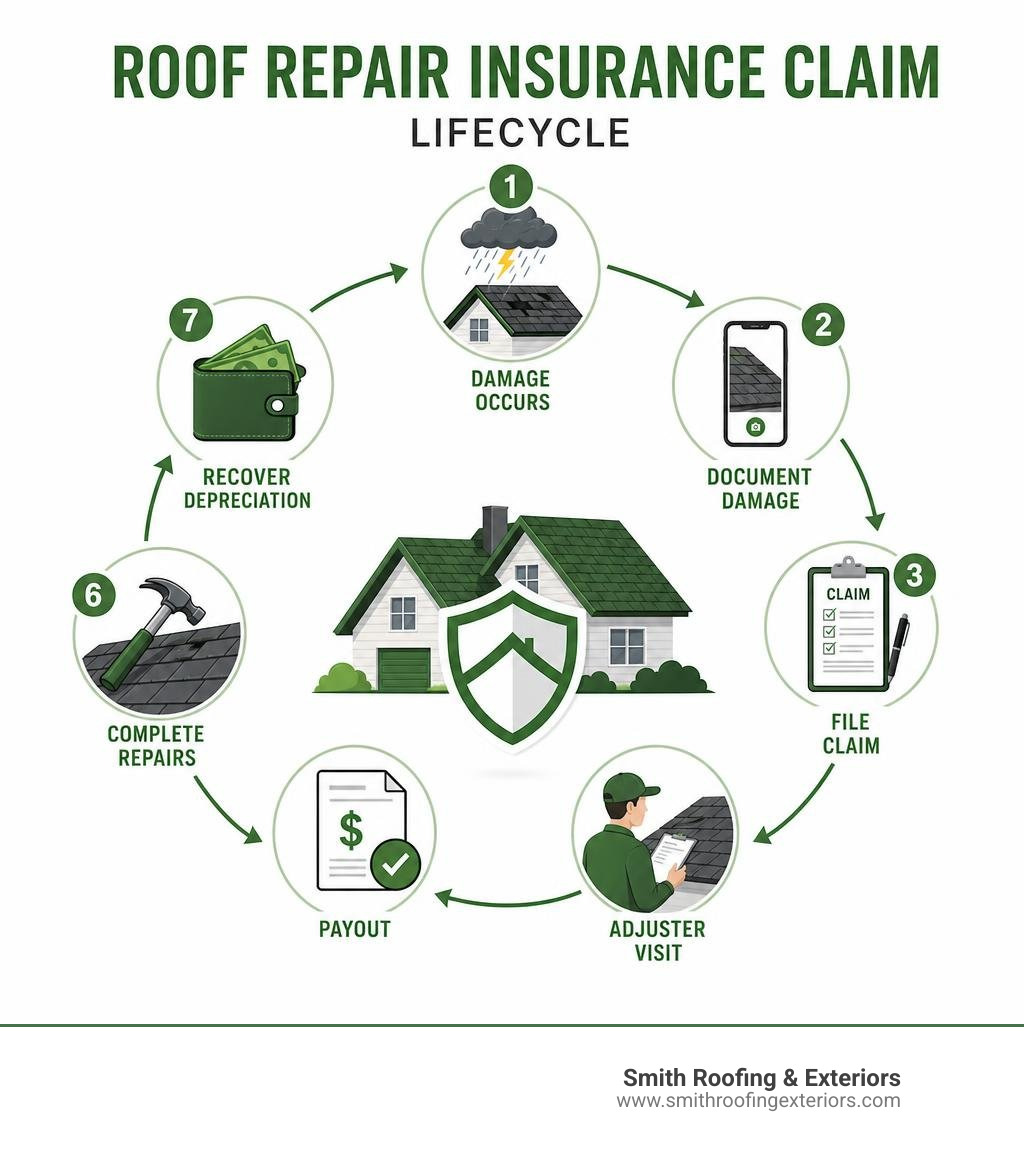
Filing an insurance claim can feel like trying to solve a puzzle where the rules keep changing. However, following a structured process makes a massive difference in your success rate. If you want a quick reference list of the entire journey, read How to File Roof Insurance Claims in 7 Easy Steps.
Documenting Damage and Preparing for the Adjuster
The moment you suspect storm damage, your first priority should be safety. Once it is safe to do so, start gathering evidence.
Take wide-angle and close-up photos of your property from the ground. Look for missing shingles, dented gutters, damaged siding, or fallen tree limbs. If you have interior water stains, photograph those as well.
Before you call your insurance company to open a claim, we highly recommend scheduling a professional inspection with an independent local roofing contractor. Why? Because insurance adjusters are trained to look for reasons to limit their company’s liability. Having a professional roofer inspect your roof first gives you an objective, expert assessment of the damage.
For homeowners in Burlington WI, Delavan WI, Elkhorn WI, Walworth WI, or Lake Mills WI, working with local experts who understand regional weather patterns is invaluable. A trusted local contractor can provide a detailed, honest assessment of your roof’s condition and help you document the damage accurately.
When the insurance adjuster visits your property, try to have your roofing contractor present. Your contractor can walk the roof with the adjuster to ensure they don’t miss key damage points, such as subtle hail bruises or damaged flashing. For a step-by-step guide on how to manage this process in our local area, read Navigating Your Insurance Roof Claim in Burlington Like a Pro.
The Supplemental Claims Process and Recoverable Depreciation
Once the adjuster completes their inspection, they will write up an estimate using industry-standard pricing software like Xactimate. This initial estimate is rarely perfect. It is highly common for adjusters to miss specific line items, such as the cost of removing old shingles, local building code requirements, or specialized flashing.
This is where the supplemental claims process comes in. If your contractor starts working and discovers hidden damage (such as rotted plywood decking beneath the old shingles), or if the insurance company’s pricing is too low to cover local material costs, your contractor will submit a “supplement.” This is a request for additional funds, backed by photographic evidence and material invoices, sent directly to your insurance provider. To learn why sharing your initial insurance paperwork with your contractor is so important for this process, read Estimate Escape Room: Why Contractors Need Your Insurance Paperwork.
If you have an RCV policy, you also need to understand how to claim your recoverable depreciation. As shown in our earlier table, the insurance company will withhold a portion of your payout until you prove the work has been completed. Once your roof is fully replaced, your contractor will send a final invoice to the insurance company. The insurer will then release the remaining withheld funds (the depreciation check) so you can pay your contractor in full. Be careful: most policies have strict deadlines (often 180 days from the date of the loss) to submit this proof, or you forfeit the depreciation money entirely.
What to Do If Your Claim Is Denied or Underpaid
If your insurance company denies your claim or offers a payout that is far too low to cover basic repairs, do not panic. You have rights as a policyholder.
First, request a detailed denial letter in writing that references the exact policy language they are using to reject your claim. Next, review this with your roofing contractor to see if you can provide additional evidence (such as pre-storm photos or manufacturer specifications) to dispute their decision.
If you cannot reach an agreement, you have a few options:
- Request a Re-Inspection: You can ask your insurance company to send a different adjuster to look at your roof.
- Invoke the Appraisal Clause: Most policies contain an appraisal clause. This allows you and your insurance company to hire independent appraisers to negotiate a fair settlement.
- Hire a Public Adjuster: A public adjuster is an independent claims professional you hire to advocate on your behalf. They will document the damage and negotiate directly with your insurer, usually in exchange for a percentage (10% to 15%) of the final payout. To learn more about how this works, read Public Adjusters and Roof Claims: What Your Insurance Company Won’t Tell You.
Frequently Asked Questions About Roof Repair Insurance
Navigating insurance rules can feel like learning a foreign language. Here are some of the most common questions we hear from homeowners in Southeastern Wisconsin.
Can replacing my roof lower my insurance premiums?
Yes! Because a new roof dramatically reduces the risk of leaks, water damage, and structural issues, insurance companies love them. Replacing an old, worn roof with a new one can lower your homeowners insurance premiums by 5% to 35%.
You can maximize these discounts by choosing impact-resistant shingles or metal roofing materials. In areas prone to severe storms, installing wind-resistant roofing systems or wind-mitigation features can yield the highest premium discounts. Always ask your insurance agent what discounts are available before selecting your replacement materials.
Do I have to use my insurance company’s preferred contractor?
Absolutely not. You have the legal right to hire any licensed, professional roofing contractor you trust to work on your home.
While insurance companies may suggest “preferred” contractors from their network, these contractors often have agreements with the insurer to keep costs as low as possible. Hiring an independent local contractor ensures that your roof is repaired using high-quality materials and that your advocate’s sole priority is the safety and longevity of your home. If you want to know what to look for when hiring help, read What to Expect from Emergency Roof Repair Contractors After a Storm.
How long do I have to file a roof insurance claim?
Filing deadlines vary by insurance company and state law, but most policies require you to file a claim within one to two years of the date the storm or damage occurred.
However, we strongly advise filing your claim as soon as possible. If you wait a year to report storm damage, it becomes much harder to prove that the damage was caused by that specific storm rather than normal wear and tear. Prompt reporting also prevents minor roof leaks from turning into major structural mold issues. To understand the timeline of what happens after a major weather event, read When to Call for Emergency Roof Repair and What Happens Next.
Conclusion
Dealing with a damaged roof is stressful, but navigating the roof repair insurance process doesn’t have to be. By understanding your policy, documenting damage thoroughly, and partnering with a trusted local professional, you can ensure your home is restored quickly and correctly.
At Smith Roofing & Exteriors, we have spent years serving our neighbors across Southeastern Wisconsin. From our home base in Fort Atkinson, WI, to Lake Mills, Jefferson, Burlington, Delavan, Elkhorn, Lake Geneva, Walworth, and Edgerton, our experienced local team is committed to providing superior materials, transparent pricing, and 24/7 emergency storm response.
We don’t just install roofs — we help you navigate the entire insurance restoration process from start to finish, ensuring your carrier treats you fairly. If your home has been hit by a recent storm, don’t wait for a small drip to become a major headache. Schedule a professional storm damage inspection with us today, and let us give you the peace of mind you deserve.