Why Getting Hardie Panel Flashing Right Protects Your Entire Home
Hardie panel flashing is the system of metal trim and barrier layers that directs water away from joints, windows, and floor breaks in a fiber cement panel installation. Get it wrong, and water finds its way behind the wall — rotting framing, growing mold, and voiding your warranty.
Quick answer — what you need to know about Hardie panel flashing:
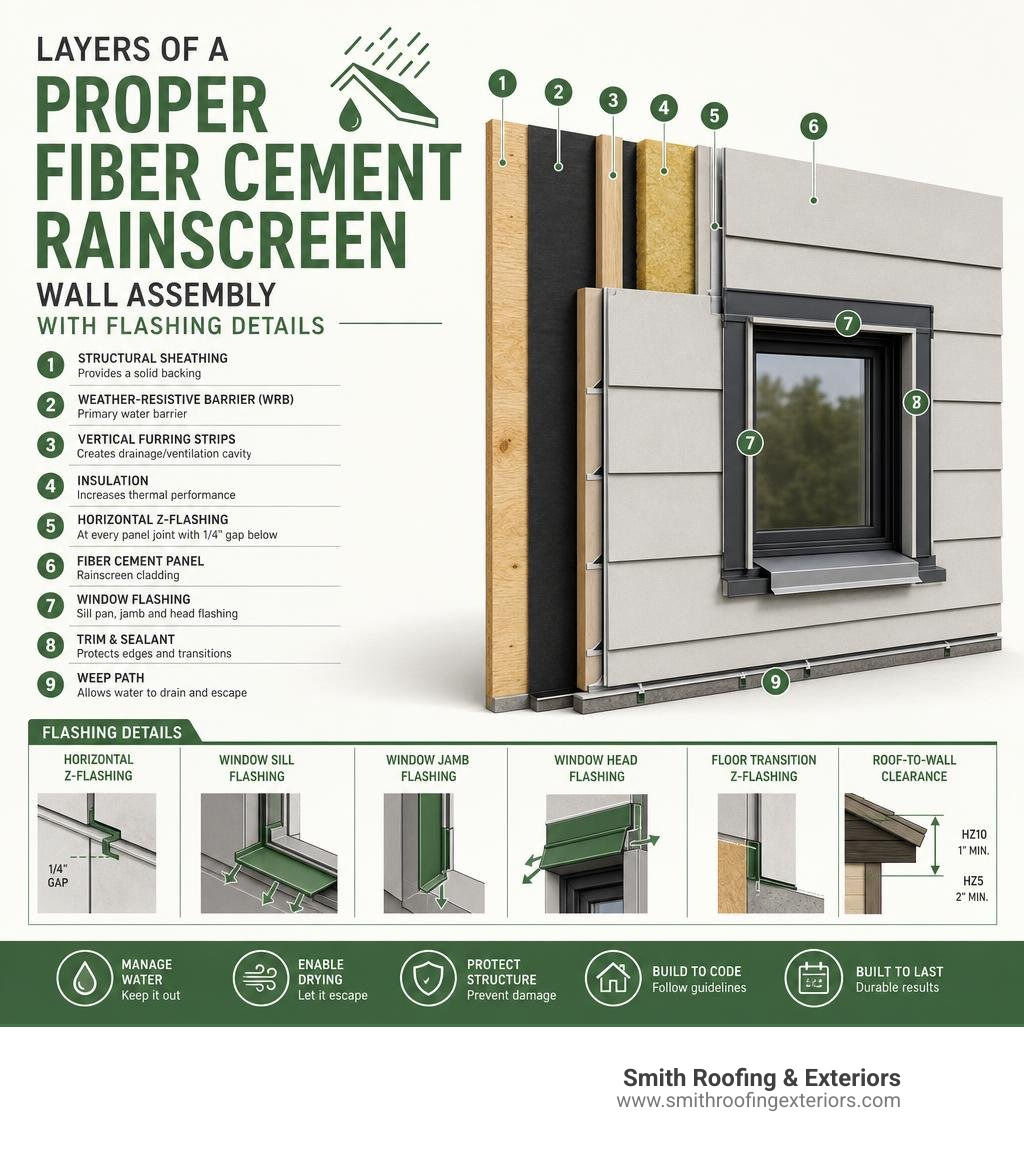
- Z-flashing is required at every horizontal panel joint, with a 1/4 inch open gap below (never caulked)
- Aluminum flashing must be painted or coated to resist corrosion from contact with cement
- WRB (weather-resistive barrier) must go on before flashing, with flashing lapped shingle-style over it
- Panels cannot bridge floor breaks — Z-flashing or trim is required at every floor transition
- Roof-to-wall clearance is 1 inch minimum (HZ10 climates) or 2 inches (HZ5 climates)
- Cut edges and fastener holes must be primed, caulked, or painted to prevent moisture intrusion
Getting these details right is not optional. James Hardie’s own installation guidelines make clear that failure to follow written instructions can void the product warranty and violate local building codes.
Wisconsin’s freeze-thaw cycles and wind-driven rain make these details especially unforgiving. A small flashing gap in July can become a serious leak by March.
I’m Matt Smith, owner of Smith Roofing & Exteriors, and over the years I’ve seen how improper hardie panel flashing leads to costly repairs that could have been avoided with the right installation from the start. Let’s walk through exactly how to do it correctly.
Glossary for hardie panel flashing:
The Critical Role of Flashing in Fiber Cement Siding Systems
When we talk about the building envelope, we are talking about your home’s shield against the elements. Fiber cement panels are incredibly durable, but they are not a waterproof barrier on their own. They rely on a system of bulk water management to shed rain, snow, and ice.
Without proper flashing, water that runs down the face of the panels can seep into horizontal joints, get trapped behind window casings, or pool at roof-wall intersections. Once moisture gets behind the siding, it hits your wall sheathing. If your weather-resistive barrier (WRB) is compromised or improperly integrated with the flashing, structural rot is only a matter of time.
For a complete breakdown of how the whole system fits together, take a look at our ultimate guide to Hardie board panel siding installation.
Choosing the Right Hardie Panel Flashing Materials
Choosing the right trim and flashing profiles is critical for both the architectural look and the longevity of the system. Depending on your design, you will use different profiles:
- Z-Flashing: This is the workhorse of horizontal joints. It sits on top of a lower panel and steps out and down to shed water over the face of the panel below. An excellent choice is the Hardie Architectural Collection 1.87 in. x 0.37 in. x 10 ft. Aluminum Horizontal Z Flashing Trim.
- T-Trim and H-Trim: These profiles are used for vertical joints. H-trim hides the edges of two adjacent vertical panels, creating a clean, modern reveal.
- Y-Trim: Used to achieve a distinct V-groove aesthetic at vertical joints.
For custom projects, high-end commercial-grade trims from manufacturers like Fry Reglet (such as their H11 Panel Flashing) or prefinished solutions from Simplicity Tool offer highly specific reveals and color-matched aesthetics. Simplicity Tool, for example, manufactures junction flashing from 0.016-inch primed aluminum prefinished to match James Hardie’s Statement Collection colors with precise color and sheen.
To keep your joints protected from the inside out, some installers also rely on specialized joint flashing membranes like Bear Skin Flashing, which provides an extra layer of protection behind butt joints.
Preventing Aluminum Corrosion in Contact with Fiber Cement
Here is a technical detail that trips up many DIYers and inexperienced contractors: raw aluminum corrodes when it comes into direct contact with wet cement products.
Because fiber cement contains alkaline materials, unpainted or uncoated aluminum flashing will degrade over time when exposed to constant moisture against the panel. To prevent this chemical reaction, we follow three strict industry rules:
- Use Painted or Coated Aluminum: James Hardie explicitly recommends painted or coated aluminum flashing. The factory paint acts as a physical barrier preventing the alkaline cement from reacting with the metal.
- Use Protective Tape: If raw aluminum must be used, or as an extra layer of insurance, apply a high-quality flashing tape over the metal where it will make contact with the panel.
- Choose Hot-Dipped Galvanized or Stainless Steel: In highly demanding areas, hot-dipped galvanized steel or stainless steel flashing is an excellent alternative that resists both chemical and environmental corrosion.
For a deeper dive into preventing joint failures, read our guide on how to prevent Hardie board seams from becoming a nightmare.
Best Practices for Installing Hardie Panel Flashing
Proper flashing installation is all about playing by the rules of gravity. The golden rule of water management is shingle-lapping: every higher layer must overlap the layer below it so water naturally sheds outward.

When installing horizontal Z-flashing, the process follows a strict sequence to ensure the weather-resistive barrier (WRB) and the metal work together:
- Install the lower siding panel.
- Install the Z-flashing over the top edge of the lower panel.
- The back leg of the Z-flashing must extend up the wall, flat against the sheathing, behind the WRB or properly integrated with flashing tape.
- Install the upper siding panel, leaving a strict 1/4-inch gap above the Z-flashing. Never caulk this gap.
For the manufacturer’s step-by-step breakdown on handling these panels, you can refer directly to the official guide on how to install Hardie® Architectural Panels.
Integrating Flashing with the Weather-Resistive Barrier (WRB)
The flashing is only as good as the WRB behind it. To maintain a continuous drainage plane:
- The WRB must be installed flat and tight to the sheathing.
- The top flange of your window head flashing and horizontal Z-flashing must slip under the WRB. If you are retrofitting, you must cut a slit in the WRB, slip the flashing flange up underneath, and seal the cut with approved flashing tape.
- For horizontal panel installations, James Hardie requires a weather-resistive barrier that meets a minimum 90% drainage efficiency when tested in accordance with ASTM E2273. This is typically achieved using a drainable WRB (which has built-in spacers or grooves to channel water) or a dedicated rainscreen system.
Treating Cut Edges and Fastener Holes
Cutting fiber cement panels exposes the raw, unsealed core of the material. If these edges are left untreated, they will absorb moisture over time, leading to swelling, delamination, and paint failure.
- Seal Every Cut: Every single field-cut edge must be primed, painted, or sealed before installation. For prefinished ColorPlus panels, use James Hardie touch-up kits. For primed panels, apply a high-quality 100% acrylic primer or paint.
- Sealant Requirements: Where panels butt up against trim or corners, apply a continuous 1/8-inch bead of high-performance elastomeric joint sealant meeting ASTM C920 Class 25 or higher.
- Fastener Holes: Any exposed or over-driven nail heads must be sealed and touched up to prevent water from entering the panel core.
If you are dealing with existing damage from unsealed cuts, read our practical guide on fixing fiber cement siding for a flawless exterior.
Clearance and Detail Requirements for Windows, Roofs, and Floor Breaks
Water does not just run straight down; it splashes, pools, and blows sideways. That is why specific clearance rules are written into building codes and manufacturer specifications.

At roof-to-wall junctions, step flashing must be installed on the roof, but the siding cannot sit flush against the shingles. Water running down the roof will wick into the bottom of the panels. To prevent this, you must maintain a clear gap and install kickout flashing at the bottom of the roofline.
Per IRC code R905.2.8.3, kickout flashing must be at least 4 inches high and 4 inches wide. We recommend installing it at an angle of 100° to 110° to maximize water deflection away from the siding and directly into the gutter. Always maintain a minimum 1-inch gap between gutter end caps and the siding.
For more on vertical panel layouts, you can review the HardiePanel Vertical Siding Installation Instructions.
Managing Floor Breaks and Horizontal Joints
Wood-framed buildings shrink and settle over time. Because of this natural movement, Hardie panels cannot bridge floor breaks. If you run a single panel across the band joist between the first and second floors, the settling of the framing will crush or buckle the panel.
Instead, a horizontal expansion joint is required at every floor break. This joint must be flashed using horizontal Z-flashing or an approved decorative horizontal trim band. A strict 1/4-inch clearance gap must be left between the bottom edge of the upper panel and the horizontal flashing. Do not caulk this joint; it is a primary drainage path for moisture.
Window, Door, and Corner Clearance Specifications
Windows and doors require meticulous flashing to prevent structural damage.
- Window Head Flashing: A metal drip cap (Z-flashing) must be installed above all window and door casings. The flashing must extend past the edges of the casing and feature small “end dams” turned up at each end to prevent water from spilling off the sides into the wall assembly.
- Clearance Gaps: Maintain a 1/4-inch gap between the siding panels and the horizontal window flashing.
- Corner Details: For inside and outside corners, panels should butt up against corner trim with a 1/8-inch gap, sealed with an ASTM C920 compliant elastomeric caulk. Alternatively, metal corner profiles (like Y-trim or square corner keys) can be used to manage water shed without relying entirely on sealant.
Climate-Specific Drainage and Fastening Specifications
In Southeastern Wisconsin, we experience severe weather variations. From hot, humid summers in Lake Geneva and Delavan to freezing, snow-heavy winters in Fort Atkinson and Jefferson, our local climate dictates how we manage moisture behind siding.
James Hardie categorizes the country into two primary climate zones: HZ5 (freeze-thaw climates, which includes all of Wisconsin) and HZ10 (warm, humid, high-rainfall climates). Because we are in the HZ5 zone, our construction details must focus heavily on preventing trapped water from freezing and cracking the panels.
| Siding Detail / Requirement | Dry Climates | Moist / Marine Climates | Severe Wind-Driven Rain / Freeze-Thaw (Southeastern WI) |
|---|---|---|---|
| WRB Requirement | Standard code-approved WRB | Drainable WRB (min. 90% efficiency per ASTM E2273) | Drainable WRB or 3/8″ Rainscreen Air Gap |
| Roof-to-Wall Siding Clearance | 1 inch | 2 inches | 2 inches (HZ5 requirement) |
| Horizontal Joint Treatment | Z-Flashing or Caulked Joint | Z-Flashing (1/4″ open gap, no caulk) | Z-Flashing (1/4″ open gap, no caulk) |
| Fastener Material | Hot-dipped galvanized | Hot-dipped galvanized or Stainless | Stainless Steel (highly recommended near water) |
In severe freeze-thaw zones, installing a 3/8-inch rainscreen air gap behind the panels provides a clear path for ventilation and drainage. This ensures that any moisture that bypasses the siding can dry quickly before it can freeze and cause structural damage.
To understand how these climate-specific details impact your project budget, check out our analysis of the real cost of Hardie panel siding in 2026.
Fastener Selection and Depth Control
Proper fastening is just as critical as the flashing itself. If you over-drive a nail, you break the face of the fiber cement panel, stripping away its holding power and creating an entry point for water.
- Nail Specifications: Use minimum 16-gauge straight stainless steel finish nails (at least 1-1/2 inches long) for Hardie Architectural Panels. For standard vertical siding, use corrosion-resistant hot-dipped galvanized or stainless steel siding nails.
- Fastening Pattern: Fasten Architectural Panels at every stud, spaced 4 inches on center along the panel edges. Nails must be positioned a minimum of 3/8 inches from panel edges and no closer than 2 inches from corners.
- Pneumatic Depth Control: Set your compressor pressure (typically between 75 and 90 PSI) and adjust the depth-of-drive tool on your nailer so nails are driven flat and flush with the panel surface.
- Proud Nailing: If you are worried about marking the panels, it is best practice to drive the nails slightly proud (sticking out) and tap them flush with a smooth-faced hammer.
Frequently Asked Questions about Hardie Panel Flashing
Should you caulk the gap above horizontal Hardie panel flashing?
No. Never caulk the 1/4-inch gap above horizontal Z-flashing. This gap is designed to act as a weep hole, allowing water that gets behind the siding or runs down the drainage plane to escape. Caulking this gap traps moisture behind the panels, which will rot your wall sheathing, cause the panel edges to swell, and completely void the James Hardie product warranty.
What is the minimum clearance for panels at roof-to-wall transitions?
In Wisconsin (HZ5 climate zone), the minimum clearance between the bottom edge of the siding panels and the roofing surface is 2 inches. In warmer HZ10 zones, the minimum is 1 inch. This clearance, combined with step flashing and a 100°-110° kickout flashing, prevents water from wicking up into the fiber cement material.
How do you prevent aluminum flashing from corroding against fiber cement?
Always use painted, coated, or anodized aluminum flashing when installing it in contact with fiber cement. The factory coating prevents the alkaline compounds in the cement from chemically reacting with and corroding the aluminum. For added protection, you can apply a self-adhering flashing tape to isolate the metal from the siding.
Conclusion
Mastering hardie panel flashing is the difference between a siding system that lasts for decades and one that fails within a few seasons. From maintaining a strict 1/4-inch uncaulked gap at horizontal joints to managing roof-to-wall transitions with kickout flashing, every detail matters.
If you are planning a siding project in Fort Atkinson, Lake Mills, Jefferson, Burlington, Delavan, Elkhorn, Lake Geneva, Walworth, or Edgerton, our team at Smith Roofing & Exteriors is here to help. We bring years of local expertise, premium materials, and meticulous craftsmanship to every home we touch.
Explore our siding installation services to see how we can protect and beautify your home, or reach out to us today for a transparent, professional consultation.