What a Dripping Gutter Joint Can Cost You

Gutter repair for leaks is one of the highest-leverage home maintenance tasks you can do — a $10 tube of sealant today can prevent thousands in foundation or fascia damage later.
Quick answer: How to repair a leaky gutter
- Locate the leak — inspect seams, end caps, corners, and downspout connections
- Clean the area — remove debris, scrape old sealant, degrease, and dry completely
- Seal small holes — apply roofing cement or butyl/tripolymer sealant directly over the gap
- Patch large holes — cut aluminum flashing at least 1 inch larger than the hole and embed in roofing cement
- Fix seams and miter joints — apply a continuous bead of butyl rubber sealant from the inside of the joint
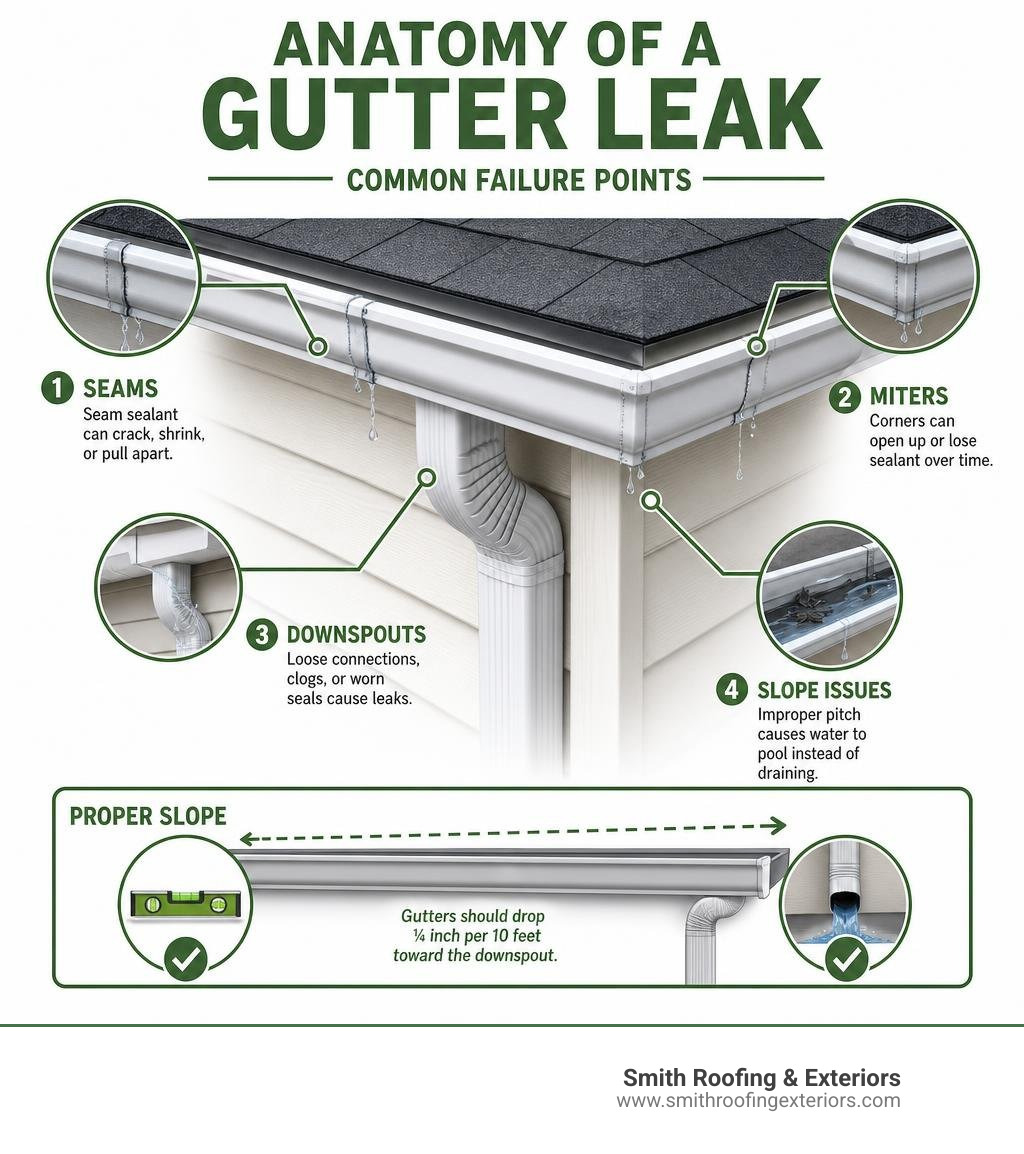
- Check the slope — gutters should drop ¼ inch per 10 feet toward the downspout
- Test with a hose — run water and confirm it drains without dripping or pooling
Gutters do a quiet job. Until the day they don’t.
A small drip at a seam or corner might seem harmless. But left alone, that drip works its way into your fascia board, down your siding, and eventually toward your foundation. Fascia rot alone can cost $500 to $2,000 to fix. Foundation crack repairs can run $2,000 to $8,000. A tube of sealant costs about $10.
The math isn’t complicated.
In Wisconsin, the problem is even more urgent. Freeze-thaw cycles, heavy snowmelt, and spring storms put serious stress on gutter joints and seams every single year. What looks like a minor leak in March can become a rotted fascia board by June.
The good news? Most gutter leaks — seams, small holes, downspout connections — are genuinely fixable without calling a contractor. This guide walks you through every step.
I’m Matt Smith, owner of Smith Roofing & Exteriors, and I’ve spent years helping Wisconsin homeowners tackle gutter repair for leaks before small drips turn into serious structural damage. Whether it’s a failed seam on a 10-year-old aluminum system or a sagging run pulling away from the fascia, I’ve seen what happens when these problems get ignored — and I’m here to help you fix it right the first time.
Gutter repair for leaks terms made easy:
Common Causes and Safe Inspection of Gutter Leaks
Before you grab a ladder and a caulking gun, you need to understand exactly what you are dealing with. If you simply slap sealant over a wet, dirty gutter seam, we promise you’ll be right back up on that ladder next season. Understanding why gutters fail and how to safely find the source of the trouble is the critical first step in protecting your home.
When you take care of your gutters, you are directly protecting the structural integrity of your property. Neglecting a small leak can quickly escalate into rot, mold, and structural shifting. To understand the full scope of how these systems interact, look at How Gutter Repair Can Help Protect Your Roof and Foundation.
Identifying the Root Causes of Gutter Failures
Gutters fail for a handful of very predictable reasons. In our years serving Southeastern Wisconsin, we have found that almost every leak traces back to one of these four culprits:
- Clogged Gutters: When leaves, twigs, and roof grit pile up, water has nowhere to go. It pools in the channel, adding immense weight. This standing water accelerates rust in steel gutters and puts constant hydraulic pressure on aluminum seams. If you want to dive deeper into the financial impact of neglecting your cleaning routine, read about how clogged gutters damage your home and your wallet.
- Thermal Expansion: Metal gutters expand and contract significantly as outdoor temperatures swing. In places like Fort Atkinson and Lake Mills, WI, where we experience hot summers and freezing winters, this constant movement stresses joints. Over time, the sealant stretches, cracks, and eventually splits apart.
- Seam Separation: Sectional gutters (the kind sold in 10- or 12-foot lengths at home improvement stores) have a joint every dozen feet. These joints rely entirely on mechanical fasteners (like rivets or screws) and a thin bead of sealant. Once the sealant degrades or the fasteners loosen, water easily slips through.
- Sagging Runs: Older gutter systems installed with spike-and-ferrule hangers tend to pull away from the fascia board. As the wood expands and contracts, the spikes back out. The gutter begins to sag, water pools in the low spots, and the extra weight pulls the seams apart.
How to Safely Inspect and Locate Gutter Leaks
Finding a leak is easy when it is pouring rain, but working on a wet, slippery ladder during a thunderstorm is a recipe for disaster. Instead, we recommend performing a dry-day inspection.
First, prioritize safety. Ensure your ladder is set on stable, level ground. If you are working near the roofline, use a ladder stabilizer to avoid crushing your gutters, and always maintain three points of contact. If you have a multi-story home or feel uncomfortable with heights, it is always best to call in a local professional.
Once you are safely positioned, look for these key visual signs of trouble:
- Water Stains and Peel: Look at the underside of your gutters and the face of your fascia boards. Grayish-black water stains, green algae, or peeling paint are clear indicators of a leak directly above.
- Rust and Corrosion: Even on aluminum gutters, look for orange rust streaks coming from steel screws or fasteners that have begun to corrode.
- The Garden Hose Test: If the source of the leak isn’t obvious, grab a helper and a garden hose. Run water at a moderate rate (about 2 gallons per minute) starting at the high point of the gutter run. Have your helper stand safely on the ground and watch the underside of the system. Note exactly where the drips appear and mark those spots with a pencil so you can find them easily once the metal dries.
For a broader look at the consequences of letting these leaks go unchecked, check out Gutter Repair: The Dangers of Ignoring.
Essential Tools and Preparation for Gutter Repair for Leaks
To perform a professional-grade gutter repair for leaks, you need the right gear. Using standard bathroom silicone or cheap acrylic caulk will only lead to failure within a year because those materials cannot handle the constant moisture and thermal expansion that gutters experience.
Before you begin, gather the following essential tools and materials:
- A sturdy ladder (Type IA rated for safety)
- Safety glasses and heavy-duty work gloves
- A stiff wire brush and a plastic putty knife
- A high-quality caulking gun
- Professional-grade tripolymer or butyl rubber sealant (such as Geocel 2320 or Ruscoe)
- Denatured alcohol or isopropyl alcohol for degreasing
- Clean, lint-free rags
- For holes: Aluminum flashing patches, tin snips, and plastic roofing cement
For an excellent classic reference on handling these tools safely, you can also consult the guide on How To Repair a Leaky Gutter – This Old House .
Cleaning and Preparing the Leak Area
Ask any seasoned gutter technician and they will tell you: 90% of a successful repair is in the prep work. If you apply sealant over dirt, old degraded caulk, or damp metal, the new sealant will simply bond to the debris and peel away.
Follow this step-by-step preparation process to ensure maximum adhesion:
- Clear the Debris: Scoop out all leaves, mud, and organic sludge from the repair area.
- Scrape Away Old Sealant: Use your plastic putty knife or a specialized scraper to completely remove the old, failed sealant. Be gentle so you don’t puncture the aluminum, but be thorough. New sealant will not bond to old sealant.
- Scrub with a Wire Brush: Use a stiff wire brush to clean away rust, scale, and stubborn dirt. This slightly “roughs up” the metal surface, creating a better mechanical bond for the new sealant.
- Degrease the Surface: Wipe down the entire area with a clean rag soaked in denatured alcohol or isopropyl alcohol. This removes invisible oils, tree sap, and fine dust.
- Dry Completely: Let the area dry thoroughly. Unless you are using a specialized wet-weather tripolymer sealant, applying product to a damp surface will ruin the bond. If you are in a hurry, a leaf blower or hair dryer can speed up the process.
Step-by-Step Guide to Repairing Gutter Leaks

Now that your gutters are clean, dry, and prepped, it is time to perform the actual repairs. Different types of leaks require different techniques. Whether you are dealing with a leaking seam, a rust hole, or a sagging bracket, follow these instructions to secure a watertight seal.
If you want to understand why choosing high-quality sealants is so important, and why cheap mastic or sloppy patches fail, take a look at Don’t Let Gutter Leaks Ruin Your Home – No Mastic Required.
Sealing Leaking Gutter Seams and Corner Miters
The vast majority of gutter leaks occur at the seams where two sections overlap, or at the corner miters where two runs meet. Because these areas experience the most stress from water flow and thermal movement, they require a robust, flexible seal.
Note: Always apply sealant to the inside of the gutter. Sealing a joint from the outside is a temporary band-aid that will peel away under the weight of standing water within a season.
- Check the Fasteners: Before sealing, ensure the seam is mechanically tight. If the rivets or screws holding the joint together are loose or missing, replace them with stainless steel or aluminum zip screws.
- Apply the Sealant: Load your tripolymer or butyl rubber sealant into the caulking gun. Cut the nozzle at a 45-degree angle to create a ¼-inch bead. Apply a continuous, unbroken bead directly over the seam on the inside of the gutter. Ensure the bead extends at least one inch past the seam on both sides.
- Tool the Bead: Wear a gloved finger dipped in soapy water or alcohol to smooth and tool the sealant. Press it firmly into the seam to eliminate air pockets. You want to create a smooth, concave profile that allows water to glide right over it without catching.
- Let It Cure: Most professional sealants require 24 to 48 hours to fully cure. Avoid running water through the system during this time.
For more detailed technical insights on miter joints and corner sealing, you can read the step-by-step guide on How to Seal Gutter Joints Properly (Step-by-Step Guide) .
Patching Small vs. Large Holes in Metal Gutters
If you have older steel or aluminum gutters, you might encounter holes caused by physical damage or localized rust.
- For Small Pinholes: If the hole is smaller than a nail head, you can easily seal it using a dab of high-quality sealant or plastic roofing cement. Apply a small dollop over the hole from the inside, smooth it flat, and feather the edges so water doesn’t pool behind it.
- For Large Holes: If rust or a fallen branch has created a larger hole, you need to patch it.
- Clean the area thoroughly and scrape away any loose rust. Apply a metal primer to stop the corrosion from spreading.
- Cut a patch from aluminum flashing or a scrap piece of gutter material. Ensure the patch is at least one inch larger than the hole on all sides.
- Apply a thick layer of plastic roofing cement or tripolymer sealant around the perimeter of the hole on the inside of the gutter.
- Press the aluminum patch firmly into the cement, squeezing out any air bubbles.
- Cover the entire patch and its edges with another layer of roofing cement, smoothing it out so water can flow over it easily.
Fixing Downspout Connections and Replacing Gaskets
Leaks at the downspout connection often happen when the outlet drop tube separates from the gutter bed or when the elbow joints loosen.
To fix this, check the small screws holding the downspout elbow to the outlet tube. If they are rusted or stripped, back them out and replace them with new, color-matched aluminum zip screws. Clean the joint inside the gutter around the outlet flange, scrape away old caulk, and apply a fresh bead of silicone or butyl sealant around the perimeter of the drop tube to prevent water from bypassing the downspout and running down your siding.
Correcting Improper Gutter Slope to Prevent Standing Water
Sometimes, a leak isn’t caused by a hole or a failed seam, but by standing water that has overwhelmed the system. If water sits in your gutters instead of draining, your slope is off.
Gutters must be angled slightly toward the downspouts. The industry standard is a ¼-inch drop for every 10 feet of gutter run.
To correct a sagging run:
- Locate the high point of the gutter run and the downspout at the low point.
- Use a level (or a snapped chalk line) to verify the slope.
- If the gutter is sagging in the middle, remove the old hangers or spikes in that section.
- Gently lift the gutter to the correct height and install modern, heavy-duty hidden screw-in hangers. Space them every 24 inches (or 18 inches if you live in heavy snow areas like Burlington or Delavan, WI) to prevent future sagging.
- Run a hose test to verify that water drains completely within a few seconds without pooling.
Gutter Repair vs. Replacement: Making the Right Choice
As a homeowner, you always want to make the most cost-effective decision. Sometimes, repairing a leak is a quick, sensible fix. Other times, throwing money at old, failing gutters is just delaying the inevitable.
| Feature / Condition | Choose Gutter Repair | Choose Gutter Replacement |
|---|---|---|
| Gutter Age | Under 20 years old | 25 to 30+ years old |
| Leak Location | Isolated to 1 or 2 seams or a single corner | Widespread leaks across multiple seams and runs |
| Physical Condition | Metal is structurally sound; brackets are loose | Metal is thin, warped, or pulling away entirely |
| Rust / Corrosion | None, or limited to minor surface rust | Widespread rust holes and corroded fasteners |
| System Type | Sectional or seamless in good shape | Old, leaky sectional gutters with spike hangers |
If you are trying to decide whether to repair or replace, look for key warning signs of systemic failure. For more details, consult 5 Indications That It’s Time for Gutter Repair.
When Gutter Repair for Leaks is the Best Option
Repairing your gutters makes perfect sense if the system is relatively young (under 20 years old) and the issues are isolated. If you have a single dripping seam over your front door, or a loose downspout bracket after a windy night, a quick repair will restore your system’s performance and easily extend its lifespan for several years.
When to Choose Full Gutter Replacement
If your gutters are over 25 years old, constantly sagging, or showing widespread rust and corrosion, repairs are no longer cost-effective.
In these cases, we highly recommend upgrading to seamless aluminum gutters. Seamless gutters are custom-extruded on-site to fit your home perfectly. Because they only have seams at the corners, they eliminate 99% of the potential leak points that plague traditional sectional systems.
Preventive Maintenance to Stop Future Gutter Leaks
Once your gutters are repaired or replaced, a little preventive maintenance goes a long way.
- Clean Gutters Twice a Year: Clean your gutters in the spring and late autumn. If your property is surrounded by mature trees, you may need to clean them more frequently. If you want to know more about keeping your system clear, read about our reliable gutter cleaning services to protect your home.
- Install Leaf Guards: High-quality micro-mesh gutter guards keep leaves, pine needles, and debris out of your channels while letting water flow freely. This prevents the heavy clogs that cause standing water and stressed seams.
- Schedule Professional Inspections: Having a professional team check your hangers, downspouts, and seals once a year can catch minor issues before they turn into costly water damage. Learn more about setting up a regular schedule with our Stop the Clog with Gutter Maintenance Seasonal Service.
Frequently Asked Questions about Gutter Maintenance
How Often Should You Perform Gutter Repair for Leaks?
You should inspect your gutters at least twice a year during your seasonal cleanings. Actual repairs should be performed immediately as soon as a leak, sagging run, or loose bracket is identified. Ignoring a minor leak for even a few months can lead to rotten wood or water pooling near your foundation. If you want to understand why speed is so important, read 5 reasons to fix gutter problems ASAP.
What is the Best Sealant for Gutter Joints?
For aluminum and steel gutters, professional-grade butyl rubber or tripolymer sealants are the top choices. These products offer incredible flexibility (often up to 900% elongation), adhere beautifully to metal, and resist UV degradation and standing water. Standard silicone caulk is acceptable for quick, temporary fixes, but it lacks the long-term elasticity required to handle thermal expansion.
Can I Seal Gutter Joints from the Outside?
No, you should never seal gutter joints from the outside. Water flowing inside the gutter will easily find its way behind an exterior patch, trapping moisture against the metal and causing the sealant to peel away within a single season. Always clean, prep, and seal your gutter joints from the inside of the channel.
Conclusion
A leaky gutter system is more than just an annoying drip — it is a direct threat to your home’s roof, siding, and foundation. Whether you choose to tackle your gutter repair for leaks as a weekend DIY project or prefer to hand the job over to experienced local professionals, taking action today will save you thousands of dollars in structural repairs down the road.
At Smith Roofing & Exteriors, we have spent years providing honest, transparent, and reliable gutter and roofing services across Fort Atkinson, Lake Mills, Jefferson, Burlington, Delavan, Lake Geneva, and the surrounding Southeastern Wisconsin communities. We use only the highest-quality materials, and our experienced local team is always ready to help keep your home safe and dry.
If you would rather leave the ladder climbing and sealant tooling to the pros, we are here for you. Schedule a professional inspection with Smith Roofing & Exteriors today, and let us make sure your gutters are ready for whatever Wisconsin weather comes next!