What Is the Real Cost to Cedar Shake a House?
The cost to cedar shake a house is usually $12.28 to $19.58 per square foot installed for real cedar shake or shingle siding in 2026. That puts a typical 2,000-square-foot siding project at roughly $24,560 to $39,160, before major repairs, premium wood upgrades, or complex design work.
| Cedar shake siding option | Typical installed cost |
|---|---|
| Real cedar shakes or shingles | $12.28-$19.58 per sq. ft. |
| Faux or composite cedar shake siding | $8.50-$14.50 per sq. ft. |
| Old siding removal and disposal | Often $1-$3 per sq. ft. extra |
The final price depends on the exterior wall area, cedar grade, labor access, trim details, existing siding removal, and whether your home needs staining, fire treatment, or repairs beneath the old siding. In rural Wisconsin, snow, wind, moisture, and freeze-thaw cycles can make correct installation and drainage details especially important.
I’m Matt Smith, owner of Smith Roofing & Exteriors. I help homeowners understand the cost to cedar shake a house by looking beyond a single price per square foot and accounting for the work needed to protect the home for years ahead.
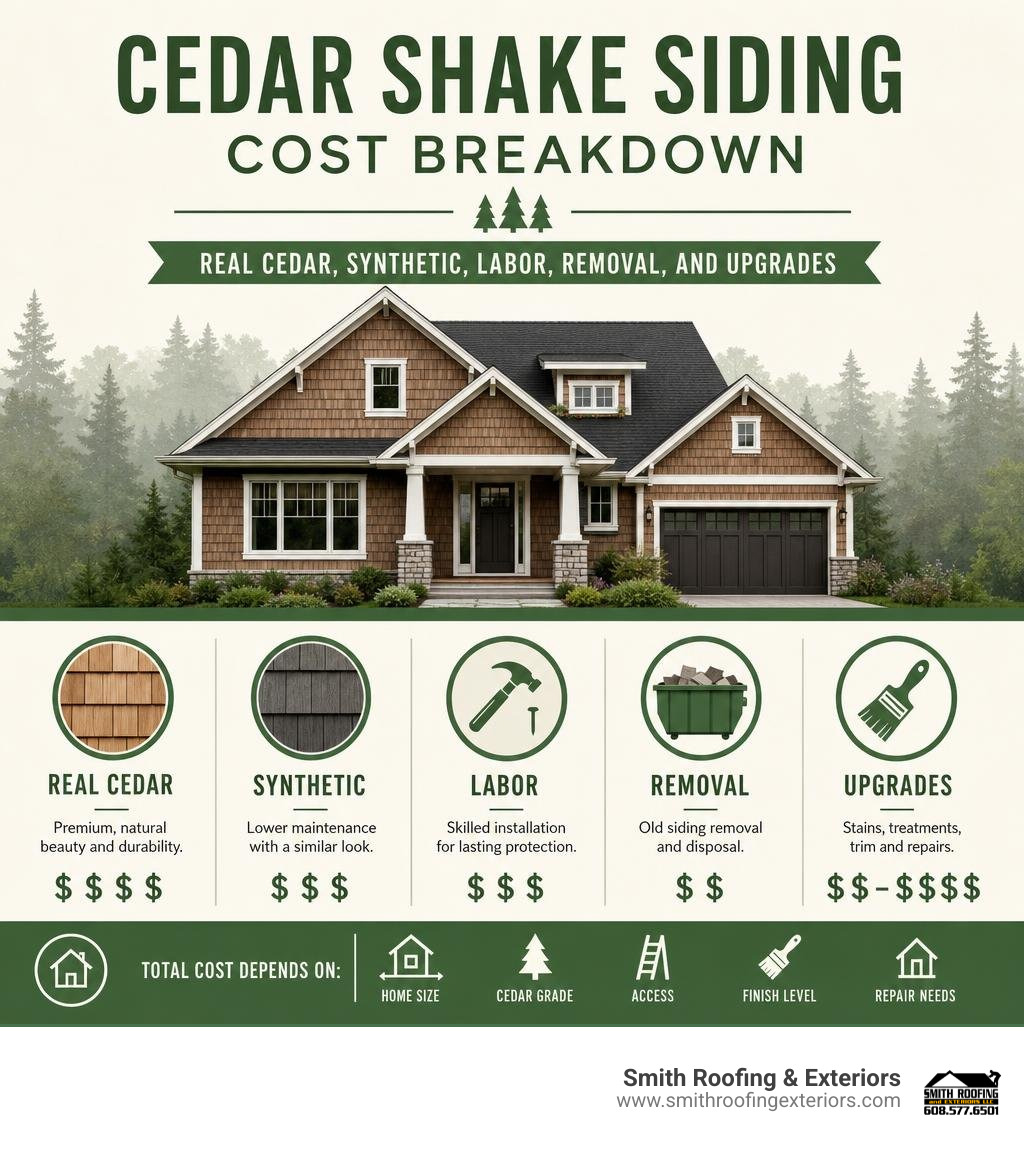
Cost to cedar shake a house basics:
Average Cost to Cedar Shake a House in 2026
When homeowners ask us about the total cost to cedar shake a house, they are often surprised by the range in nationwide and local estimates. For 2026, most full-house cedar siding installations land between $24,000 and $45,000 for standard mid-sized homes. However, smaller projects like gables or partial sidewalls can start as low as $6,000, while expansive luxury estates with complex architectural features can reach $64,350 or more.
To break down these numbers accurately, siding contractors measure exterior work in wall square footage or “squares” (one square equals 100 square feet of coverage). On average, material unit costs for natural cedar range between $5.50 and $9.50 per square foot, while specialized installation labor adds another $6.50 to $12.50 per square foot depending on job complexity.
To learn more about how wood shingle products are priced across different regions, check out this comprehensive guide on How Much Does Cedar Shake and Shingle Siding Cost? .
If you are also evaluating roofing alongside your wall exterior, cedar shake roof replacements typically average between $15,800 and $30,000, or roughly $8.00 to $16.00 per square foot installed. Combining roofing and siding into a single comprehensive project can often save money on scaffolding, permitting, and equipment mobilization.
Calculating the Cost to Cedar Shake a House by Home Size
The total exterior wall surface area of your home is the single biggest factor driving overall price. It is essential to remember that living area square footage is not the same as exterior wall square footage. A multi-story home with high gables, dormers, and bump-outs will have significantly more exterior surface area than a single-story ranch with the exact same floor plan.
Below is a breakdown comparing home size, estimated exterior wall surface area, and typical project cost ranges in 2026:
| Home Size (Interior Sq. Ft.) | Estimated Wall Surface Area (Sq. Ft.) | Base Project Cost Range (Installed) | Average Project Total |
|---|---|---|---|
| Small Home / Cottage (1,000 sq. ft.) | 800 – 1,200 sq. ft. | $9,820 – $23,500 | $15,200 |
| Mid-Size Suburban Home (1,500 sq. ft.) | 1,300 – 1,800 sq. ft. | $15,960 – $35,200 | $24,800 |
| Standard Two-Story Home (2,000 sq. ft.) | 1,800 – 2,400 sq. ft. | $22,100 – $47,000 | $33,500 |
| Large Two-Story Home (2,500 sq. ft.) | 2,300 – 3,000 sq. ft. | $28,240 – $58,700 | $41,200 |
| Executive / Luxury Estate (3,500+ sq. ft.) | 3,200 – 4,500+ sq. ft. | $39,300 – $88,000+ | $62,000 |
Here in Southeastern Wisconsin—from Jefferson and Lake Mills to Delavan and Lake Geneva—weathering conditions like harsh winter freezes and humid summer spells require meticulous moisture barriers behind every cedar shake, which keeps local installations toward the middle-to-upper end of these national benchmarks.
Cedar Species and Wood Material Grades
Not all cedar is created equal. The wood species and quality grade you select directly dictate both raw material pricing and overall weather resistance.
- Western Red Cedar: Considered the undisputed industry standard for residential exteriors. Western Red Cedar is naturally rich in natural oils and tannins that resist insect decay, rot, and moisture damage. Expect to pay premium material rates ($6.00 to $12.00+ per sq. ft. for raw stock).
- Alaskan Yellow Cedar: The densest and most durable cedar species available. It cures to a beautiful silvery-gray patina and withstands heavy snowpack and harsh moisture exposure. It typically costs 20% to 30% more than Western Red Cedar.
- Eastern White Cedar: A tight-grained, lighter wood that is widely used along the East Coast and Midwest. It is 15% to 25% less expensive than Western Red Cedar, making it a popular budget-friendly choice ($4.00 to $7.00 per sq. ft. raw stock).
In addition to species, the timber grade makes a major difference in appearance and longevity:
- Grade 1 (#1 Blue Label): 100% clear heartwood with 100% straight edge grain and zero knots. This top-tier option offers maximum stability, minimal warping, and the longest useful lifespan.
- Grade 2 (#2 Red Label): Contains minor knots and flat grain patterns. Excellent for rustic accents, sidewalls, or outbuildings, but slightly more prone to cupping over time.
- Knotty Grade / Common Grade: Features tight knots and varied grain patterns. Highly affordable ($2.50 to $5.00 per sq. ft.), providing a charming rustic aesthetic, though it requires more frequent sealing and maintenance.
Key Factors Influencing Cedar Shake Siding and Roofing Costs
Understanding the underlying cost drivers of a cedar shake project helps you identify where your money is going and where you can safely trim expenses.
Beyond basic raw material choices, four main variables dictate total investment:
- Surface Geometry & Pitch: Steeply pitched rooflines, high gables, multi-level turrets, and tight dormers increase labor time and safety setup.
- Exposure Style: Standard 5-inch exposure uses fewer shakes per square foot, whereas narrower exposures or dramatic staggered patterns require double the amount of individual shakes and fasteners.
- Corner Finish Details: Woven corners—where individual shakes are hand-trimmed to interlock seamlessly at outside wall corners—require high artisan skill and add $300 to $1,500+ in labor compared to standard corner trim boards.
- Underlayment and Rain Screen Systems: Cedar cannot be nailed directly to solid sheathing without an airspace. Ventilated rain screen mats (such as Mortairvent or CedAir-Mat) add $0.75 to $2.00 per square foot, but they prevent hidden wood rot and double the life of the siding.
Labor Rates and Specialist Installation Complexity
Unlike long vinyl panels or hardie plank strips that cover broad wall sections in single passes, installing genuine cedar shake siding is an intricate, piece-by-piece craft. Each individual shake must be hand-selected, spaced precisely 3/8-inch apart to allow natural humidity expansion, and nailed with dual corrosion-resistant fasteners.
For this reason, labor represents 50% to 60% of the total cost of a cedar shake project. Siding crews typically charge between $45 and $85 per hour per installer, or roughly $6.50 to $12.50 per square foot in pure labor overhead.
To review interactive unit-cost labor tools and job site supply rates, review this helpful Cedar shake siding cost: 2026 Installed Price Calculator .
Hidden Costs: Tear-Off, Building Permits, and Fire Treatments
When budgeting for a project, homeowners are sometimes caught off guard by “line-item surcharges” that aren’t included in basic material estimates.
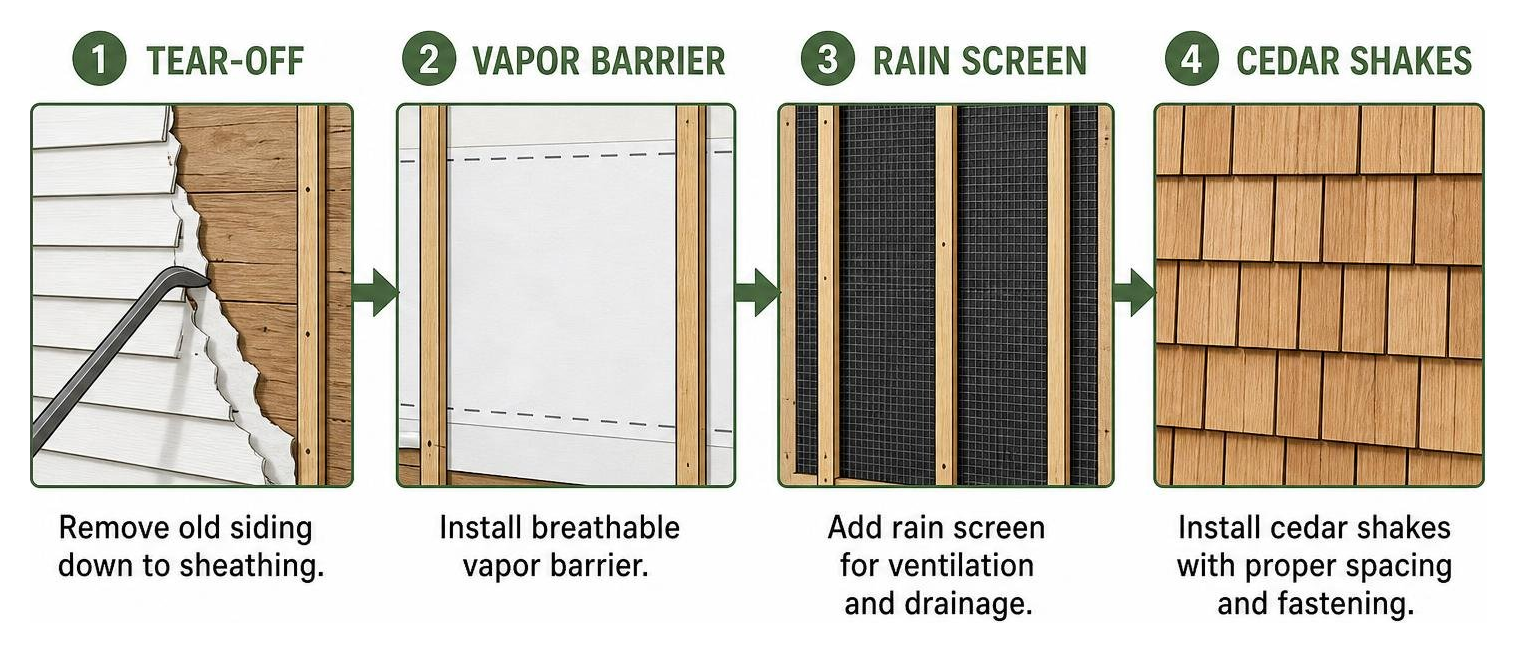
Here are the most common hidden expenses to keep in mind:
- Tear-Off and Old Siding Removal: Stripping old vinyl, wood lap, or asbestos siding and hauling debris to local disposal facilities typically costs $1.00 to $3.00 per square foot.
- Wall Sheathing Repairs: If old siding leaked, replacing water-damaged plywood or OSB sheathing costs $70 to $150 per 4×8 sheet.
- Building Permits & Municipal Fees: Local building permits across Fort Atkinson, Elkhorn, and Burlington generally run between $100 and $500 depending on total project valuation.
- Fire Retardant Treatments: In fire-sensitive areas or high-density neighborhoods, local building codes may require factory pressure-treated Class A or Class B fire-retardant shakes. Pressure treatment adds $1.50 to $4.00 per square foot to material costs.
- Custom Trim and Accessories: Coordinating cedar corner boards, window casings, fascia, and soffits adds $3.00 to $8.00 per linear foot.
For a helpful cost comparison on how tear-off fees and sub-framing work affect alternative materials, see our detailed guide on How Much Does It Cost To Reside A House With Hardie Board.
Real Cedar Shakes vs. Synthetic Composite Alternatives
As timber prices have risen over the last decade, high-tech composite and synthetic cedar shake alternatives have gained huge popularity among Midwestern homeowners.
Modern synthetic composite shakes (manufactured from recycled polymers and minerals) accurately replicate the hand-split grain, varied widths, and deep shadow lines of authentic wood, but without the organic vulnerabilities of natural timber.
Below is a direct comparison between genuine cedar shakes and synthetic options:
| Feature / Metric | Real Wood Cedar Shake | Synthetic Composite Shake |
|---|---|---|
| Upfront Installed Cost | $12.28 – $19.58 / sq. ft. | $8.50 – $14.50 / sq. ft. |
| Average Service Lifespan | 25 – 40 Years (With Maintenance) | 50+ Years |
| Maintenance Requirement | High (Seal/Stain Every 5-7 Years) | Virtually Zero (Occasional Hose Off) |
| Fire Resistance Rating | Class C Untreated (Class A Treated) | Class A Built-In |
| Wind Resistance | Up to 110 MPH | Up to 180+ MPH |
| Rot & Insect Resistance | Moderate (Tannins help, but organic) | 100% Impervious to Rot & Insects |
| Warranty Coverage | 15 – 25 Year Limited | 50-Year to Lifetime Warranties |
Pros and Cons of Real Cedar vs. Composite Siding
Choosing between real cedar and synthetic composite comes down to weighing traditional authenticity against long-term convenience:
Pros of Real Cedar:
- Unmatched natural beauty, authentic wood fragrance, and subtle aging characteristics.
- Outstanding thermal insulation—wood offers double the R-value of standard asphalt shingles.
- Environmentally renewable resource when harvested from certified sustainable forests.
Cons of Real Cedar:
- Higher ongoing lifetime cost due to mandatory re-staining every 5 to 7 years ($1.69 to $4.02 per sq. ft. per maintenance cycle).
- Vulnerability to moisture rot, moss growth, wood-boring insects, and UV degradation.
- Higher fire risk and potential homeowners insurance surcharges in certain regions.
Pros of Synthetic Composite Shakes:
- Lower upfront installation cost and complete elimination of routine staining expenses.
- Class A fire rating and Class 4 impact resistance against hail damage.
- Impervious to freeze-thaw cracking, salt air corrosion, and rot.
Cons of Synthetic Composite Shakes:
- Synthetic materials lack the distinct natural aroma of real Western Red Cedar.
- Premium synthetic brands can still rival real wood in initial purchase price.
If you are open to engineered wall coverings, explore our comprehensive Fiber Cement Siding Cost Guide From Materials To Labor for another durable option.
Long-Term Maintenance Expenses and Expected Lifespan
Real cedar shake siding is an organic material that requires active stewardship. When properly maintained with clear sealants or breathable semi-transparent stains, a high-grade cedar exterior lasts between 25 and 40 years. However, neglecting a real cedar home can reduce its useful life to 15 years or less due to moisture trapping and sun cracking.
To keep real cedar in peak condition:
- Re-Stain / Re-Seal Every 5 to 7 Years: Expect to budget $1.69 to $4.02 per square foot for professional cleaning, soft washing, and re-staining.
- Gutter Maintenance: Overflowing gutters dump concentrated water streams down cedar walls, causing rapid rot and black mold staining.
- Vegetation Trimming: Overhanging trees and dense bushes trap moisture against wood shakes and block sun drying.
Over a 30-year span, routine maintenance on a 2,000-square-foot real cedar shake house will total between $6,000 and $15,000. Factoring this long-term upkeep into your initial decision is vital when evaluating your overall exterior budget.
For a deeper dive into maintenance routines and long-term costs, visit our article on Cedar Shake Siding Is It Worth The Maintenance.
Is the Cost to Cedar Shake a House Worth the Investment?
Despite higher initial costs and regular maintenance needs, real cedar shake siding remains one of the most desirable exterior upgrades on the market.
Real cedar siding delivers a solid resale cost recovery (ROI) of 55% to 72% at home sale, averaging roughly 63.5% nationally. Beyond strict financial ROI, cedar shake provides unmatched architectural prestige that immediately sets a home apart in competitive housing markets like Lake Geneva, Walworth, or Edgerton.
For historic architectural styles—such as Cape Cod, Craftsman, Shingle-Style, or rustic lake houses—natural cedar delivers curb appeal that synthetic knockoffs simply cannot match. Furthermore, cedar’s natural wood cell structure acts as an excellent insulator, helping keep home interiors cozy during freezing Wisconsin winters and cooler during summer heatwaves.
Proven Strategies to Save Money on Your Cedar Shake Project
If you love the timeless aesthetic of cedar shakes but need to keep your budget under control, consider these practical cost-saving strategies:
- Use Cedar Shakes as Accent Features: Instead of residing your entire home in real cedar, install genuine cedar shakes on focal points like gables, dormers, or entryway porticos, while using cost-effective fiber cement, vinyl lap, or brick on lower main walls.
- Schedule Work in the Off-Peak Season: Siding contractors are busiest during late spring and summer. Scheduling your project in late fall or early winter can often unlock lower labor rates and faster scheduling.
- Choose Mid-Grade or Knotty Cedar: Selecting #2 Red Label or tight-knot cedar instead of clear Grade 1 heartwood can trim 20% to 40% off raw material pricing while delivering a charming rustic aesthetic.
- Handle Teardown and Site Prep Yourself: If you are comfortable with basic DIY work, removing your old siding and disposing of debris yourself can save $1,000 to $3,000 in labor charges.
- Combine Roofing and Siding Updates: Tackling your roof and siding concurrently allows your contractor to optimize scaffolding setup, dumpsters, and labor scheduling.
To read more about balancing different exterior wall systems, review our complete overview on All About Roofing And Siding.
Frequently Asked Questions About Cedar Shake Costs
How much does it cost per square foot to install cedar shake siding?
In 2026, installing real cedar shake siding costs between $12.28 and $19.58 per square foot, combining raw material costs ($5.50 to $9.50/sq. ft.) with specialized labor and job site supplies ($6.50 to $12.50/sq. ft.). Faux or composite cedar shake options generally range from $8.50 to $14.50 per square foot installed.
How often does real cedar shake siding require re-staining?
Real cedar shake siding requires professional cleaning and re-staining or re-sealing every 5 to 7 years. Homes exposed to harsh direct sunlight, heavy coastal fog, or dense tree shade may require attention every 3 to 5 years to protect the wood from UV graying and moisture absorption.
What is the expected lifespan of cedar shake siding?
With proper installation, breathable rain screen underlayment, and consistent maintenance, real cedar shake siding lasts between 25 and 40 years. Synthetic composite shakes can easily last 50 years or more with almost zero upkeep.
Conclusion
The cost to cedar shake a house represents a meaningful investment in your home’s protection, charm, and long-term resale value. Whether you choose the natural beauty of genuine Western Red Cedar or the low-maintenance durability of modern composite shakes, working with an experienced local contractor ensures your exterior is built to withstand Wisconsin’s seasonal shifts.
At Smith Roofing & Exteriors, we bring decades of hands-on expertise to every residential project across Fort Atkinson, Lake Mills, Jefferson, Burlington, Delavan, Elkhorn, and surrounding Southeastern Wisconsin communities. We pride ourselves on transparent pricing, clear communication, and craftsmanship that stands the test of time.
Ready to transform your home’s exterior? Get an Exterior Consultation Today and let our team create a customized quote tailored to your style and budget.