What a Metal Roof Inspection Actually Covers (And Why It Matters)
A thorough metal roof inspection can mean the difference between a minor repair bill and a full roof replacement — especially after Wisconsin’s brutal winters and storm seasons.
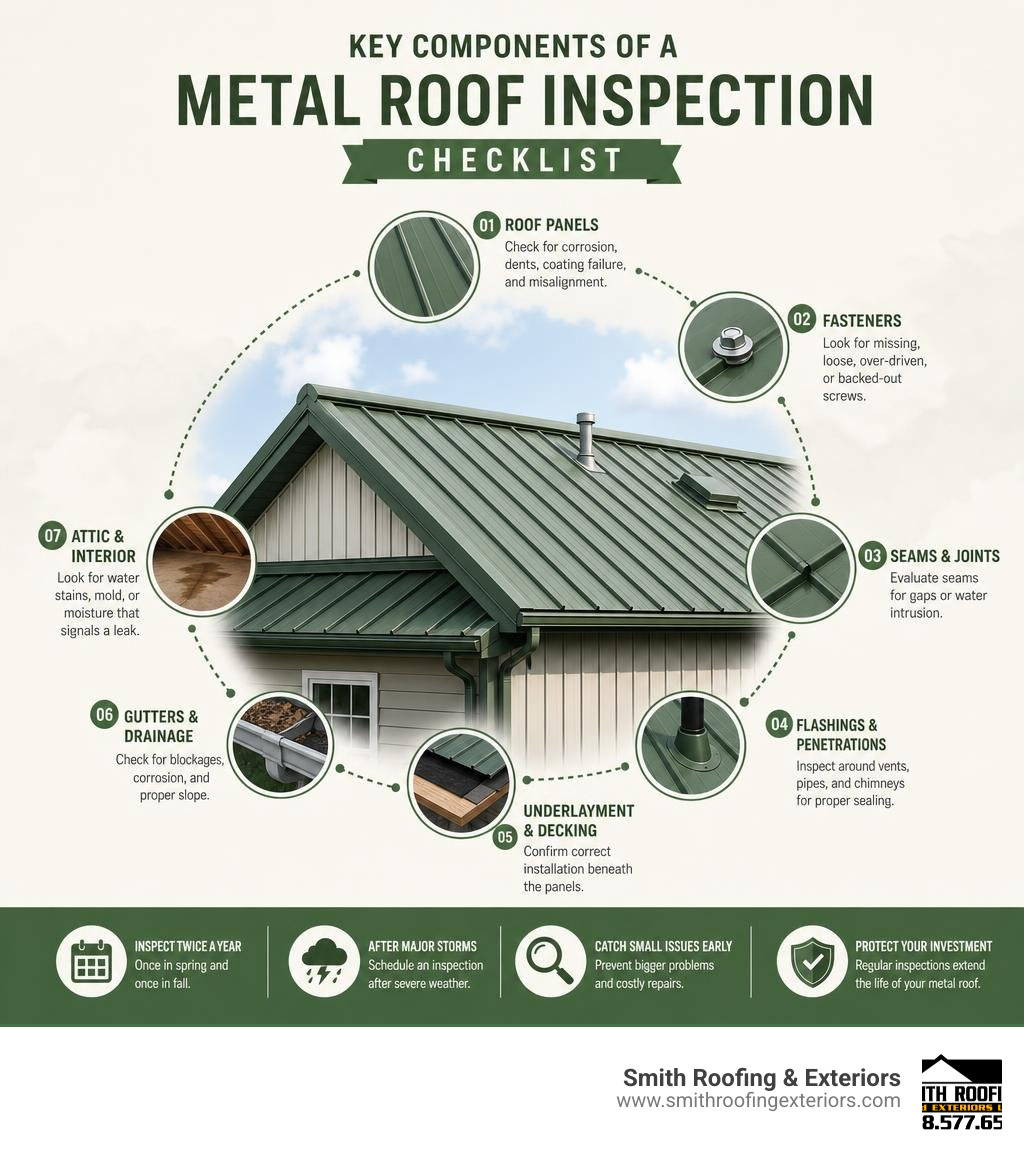
Here’s what a metal roof inspection typically covers:
- Roof panels — checking for corrosion, dents, coating failure, and improper alignment
- Fasteners — looking for missing, loose, over-driven, or backed-out screws
- Seams and joints — evaluating standing seams, flat seams, and overlapping seams for gaps or water intrusion
- Flashings and penetrations — inspecting around vents, pipes, and chimneys for proper sealing
- Underlayment and decking — confirming correct installation beneath the panels
- Gutters and drainage — checking for blockages, corrosion, and proper slope
- Attic and interior — looking for water stains, mold, or moisture that signals a hidden leak
Experts recommend inspecting your metal roof at least twice a year — once in spring and once in fall — plus after any major storm. Industrial and commercial buildings in exposed environments may need checks even more frequently.
Metal roofs can last 40 to 70 years, but only when problems are caught early. A small fastener issue or a patch of failing coating today can become a serious leak — or structural damage — if left unchecked through a Wisconsin freeze-thaw cycle.
I’m Matt Smith, owner of Smith Roofing & Exteriors, and after years of hands-on experience performing metal roof inspections across rural Wisconsin, I’ve seen how early detection saves homeowners thousands of dollars. In this guide, I’ll walk you through everything you need to know to evaluate your metal roof’s condition.
Simple metal roof inspection word guide:
Understanding Metal Roofing Systems and Panel Profiles
Before climbing up a ladder or launching a drone, an inspector must understand exactly what type of metal system they are looking at. Metal roofs are not one-size-fits-all. The panel profile, material type, and structural design dictate how the roof handles water, wind, and thermal expansion.
From standing seam panels to stamped metal shingles and tiles designed to mimic traditional slate or cedar, each system carries distinct performance characteristics. If you want a deep dive into the panel types themselves, check out our resource on Heavy Metal for Your Home: A Guide to Metal Panel Roofing Systems.
To help categorize what we typically see during a metal roof inspection, let’s look at how architectural and structural panels compare:
| Feature | Architectural Metal Panels | Structural Metal Panels |
|---|---|---|
| Supporting Deck | Requires solid sheathing or closely spaced boards | Can be installed over open framing/purlins |
| Water shedding | Hydrokinetic (water-shedding; requires steep slope) | Hydrostatic (waterproof; can handle low slope) |
| Common Uses | Residential homes, steep-slope commercial | Industrial warehouses, low-slope commercial |
| Underlayment | Highly critical (protects against condensation/abrasion) | Often omitted (installed directly over purlins) |
| Panel Thickness | Typically thinner (24 to 29 gauge) | Typically thicker (22 to 24 gauge) |
Architectural vs. Structural Panels
The fundamental difference between architectural and structural panels lies in how they support themselves and shed water.
Architectural panels require a continuous supporting deck—usually solid plywood or OSB sheathing. These systems are hydrokinetic, meaning they rely on gravity and a steep slope to shed water quickly. Because they are not completely watertight under standing water, they must be installed on roofs with adequate pitch. According to the InterNACHI Metal Roof Guide, steep-slope metal systems are generally defined as having a pitch of 3:12 or greater, though some architectural products can go down to 2:12 depending on the manufacturer’s specific guidelines.
Structural panels, on the other hand, are engineered with enough load-bearing capacity to span open framing like steel purlins or wood rafters without a solid deck. These are hydrostatic systems, meaning they feature heavily sealed, mechanical seams that can withstand standing water and hydrostatic pressure. This makes them ideal for low-slope applications (often as low as 1/4:12). During an inspection, identifying whether a roof is architectural or structural tells us whether to look for deck deflection underneath or to focus heavily on the structural integrity of the purlin attachments.
Evaluating Seams and Fastening Systems in a Metal Roof Inspection
Once we identify the panel type, we must evaluate how the panels are joined and secured. The seam and fastening design is the roof’s primary defense against wind uplift and water intrusion. For a broader look at these mechanics, you can read The Complete Guide to Metal Roofing.
We generally encounter three main seam types:
- Standing Seams: These seams are elevated above the water-shedding plane. They are joined using concealed clips that allow the metal to slide freely during thermal expansion and contraction. This design offers the highest level of weather resistance.
- Flat Seams: Often used on very low-slope copper or tin roofs, these seams are folded flat over one another and soldered or heavily sealed to create a continuous, watertight skin.
- Overlapping Seams: Common in corrugated and R-panel roofs, these panels overlap at the ribs and are secured using exposed fasteners that pierce directly through the metal.
The choice of fastening system—through-fastened vs. concealed clips—is critical. Through-fastened systems use thousands of screws with neoprene rubber washers. Over time, daily temperature swings cause the metal panels to expand and contract. This thermal movement puts immense stress on the fasteners, often causing the screws to back out or the rubber washers to dry out, crack, and split. Concealed clip systems, conversely, hide the fasteners beneath the seams, allowing the panels to slide back and forth without creating direct puncture points in the metal.
Corrosion, Coatings, and Material Degradation
Metal exists in nature as an oxide, which is its lowest, most stable energy state. The manufacturing process forces metal into a high-energy, refined state. Consequently, nature is constantly trying to return that metal to its original oxide form. This natural process is what we call corrosion.
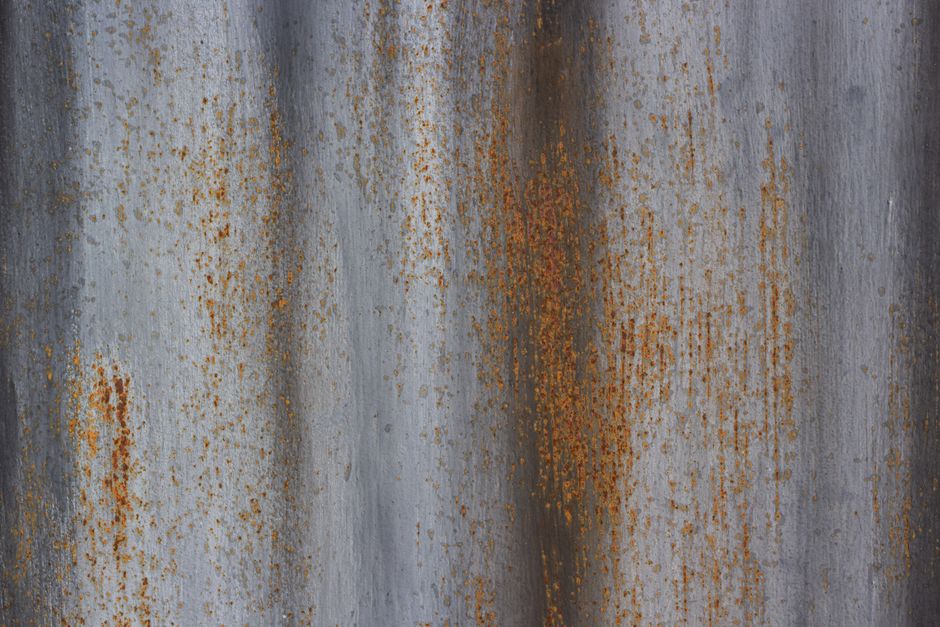
To prevent oxidation, manufacturers apply various protective coatings. These coatings fall into two categories: barrier coatings (like paint or polymers that physically block moisture) and sacrificial coatings (like zinc, which corrodes preferentially to protect the underlying steel). If the coating fails, the anode (the bare steel), the cathode (the protected metal), and the electrolyte (water or humidity) align, initiating rapid material degradation.
Identifying Galvanic, Crevice, and Filiform Corrosion
During a metal roof inspection, we look for three distinct types of corrosion:
- Galvanic Corrosion: This occurs when two dissimilar metals (such as copper and aluminum, or stainless steel and carbon steel) come into contact in the presence of an electrolyte (rainwater). The less noble metal will rapidly corrode. We often see this around cut edges, copper chimney flashings touching steel panels, or where non-compatible metal fasteners were mistakenly used.
- Crevice Corrosion: This occurs in tiny, shielded gaps—often only a few thousandths of an inch wide—where stagnant water becomes trapped. We look for this beneath failing fastener heads, under thick layers of accumulated leaves or pine needles, and at overlapping panel joints where moisture cannot easily evaporate.
- Filiform Corrosion: This looks like fine, thread-like webs or worm-like filaments crawling beneath paint or organic coatings. It typically starts at cut panel edges or deep scratches where the paint bond has been broken. It thrives in high-humidity environments (between 65% and 90% relative humidity) and can slowly lift the paint film, exposing the raw metal underneath. For detailed guidelines on spotting these chemical breakdowns, refer to the technical insights in Mastering Roof Inspections: Metal Roofs, Part 7 – InterNACHI® .
Coating Failures: Paint, Galvanized, and Galvalume Defects
Modern steel roofs are coated with protective metallic layers to stop rust before it starts. The two most common are galvanized steel (coated in pure zinc) and Galvalume (a patented alloy of 55% aluminum and 45% zinc). Galvalume offers superior overall corrosion resistance, but because aluminum is less active than zinc, it does not provide the same level of self-healing “sacrificial” protection at cut edges or deep scratches as galvanized steel does.
Over time, these coatings and their top paint layers can degrade. We carefully check for several surface defects:
- Tension-Bend Staining: During manufacturing, when metal panels are bent into sharp ribs or standing seams, the protective coating stretches thin. This can create micro-cracking along the folds, leading to early rust staining.
- Chalking and Fading: UV radiation breaks down the binders in paint coatings, leaving a powdery white residue (chalking) and causing the color to fade unevenly.
- Peeling and Adhesion Loss: If the metal substrate was not properly cleaned or primed before painting, the topcoat will blister, peel, and flake away, leaving the bare metallic coating vulnerable to atmospheric wear.
Critical Installation Defects and Weather Damage
Even the highest-grade metal panels will fail prematurely if they are installed incorrectly. A major component of a metal roof inspection is verifying that the original installation complies with manufacturer specifications and local building codes.

One area where we see frequent mistakes is underlayment selection. Synthetic underlayment is highly preferred beneath metal panels because it is durable and does not tear easily. Traditional asphalt felt paper can stick to the underside of metal panels; as the metal expands and contracts with daily temperature swings, it can tear the felt, leaving the wood deck exposed to condensation.
Furthermore, using a mineral-surfaced underlayment (like standard roll roofing) beneath metal panels is a major defect. In climates with extreme temperature swings—like what we experience in Southeastern Wisconsin—the rough mineral surface acts like a belt sander, grinding away the protective coating on the underside of the metal panels as they move.
Common Installation Errors and Slope Requirements
When performing an inspection, we watch for several classic installation errors:
- Improper Slope: Installing a hydrokinetic, overlapping panel system below its manufacturer-recommended minimum slope (usually 3:12) is a recipe for disaster. Even with high-quality underlayment, water can back up under the laps during heavy rains or ice damming.
- Backed-Out and Over-Driven Fasteners: Thermal movement can slowly back fasteners out of the wood purlins or decking. Conversely, installers sometimes over-drive screws, which splits the neoprene rubber washers and creates an immediate pathway for water. Under-driven screws, or screws driven at an angle, fail to compress the washer properly, leaving a visible gap.
- Poor Penetration Flashing: Relying solely on caulking or sealant around vent pipes, chimneys, and skylights is a major installation defect. Sealants eventually dry out, shrink, and crack, requiring constant maintenance. Penetrations must be flashed using mechanical boots, metal collars, and proper apron flashing. We frequently find defective DIY repairs where expanding foam was sprayed around a leaking pipe boot—a temporary fix that traps moisture and accelerates rust. For structural and panel layout guidelines, surveyors often consult the Guide for Inspecting Metal Building Systems .
Assessing Wind and Hail Damage During a Metal Roof Inspection
Wisconsin storms can subject metal roofs to extreme wind and hail. When inspecting for storm damage, we divide our assessment into wind forces and hail impact.
Wind damage occurs when high winds create uplift forces (a vacuum above the roof) and inflation forces (air pressure entering beneath the panels). The most vulnerable areas are the panel edges at the eaves, the rakes (the sloping edges of the gable), and the ridge caps. If the trim or edge flashing is loose or poorly fastened, the wind can peel the panels back like an open tin can.
Hail damage requires a careful distinction between cosmetic and functional damage. Cosmetic damage consists of shallow, visible dents that do not compromise the roof’s weatherproofing ability. Functional damage, however, occurs when a hailstone impacts a panel hard enough to crack the protective paint coating, puncture the metal, or create micro-fissures in the zinc-aluminum protective layer. On metal shingles or tiles, hail can crimp or distort the interlocking seams, breaking the watertight lock. If you suspect your roof has been hit by a recent storm, read our guide on Hail Damage Roof 101 to understand how these impacts are assessed for insurance purposes.
Executing a Safe and Thorough Metal Roof Inspection
Climbing onto a metal roof requires specialized safety gear, physical caution, and a systematic approach. Whether we are inspecting a home in Fort Atkinson, WI, or a commercial warehouse in Burlington, WI, safety is always our top priority.
A comprehensive inspection must evaluate the roof’s structural integrity, weatherproofing elements, and drainage systems, as outlined in our Ultimate Checklist for Roof Inspection.
Safety Protocols and Best Practices for Walking Metal Roofs
Walking on metal requires extreme care. Metal panels have very low traction, and even a light morning dew, frost, or a thin layer of dust can turn the surface into an ice rink.
Our team follows strict safety protocols:
- Appropriate Footwear: We always wear soft-soled, high-traction roof boots or specialized athletic shoes. Stiff, hard-soled work boots can easily scratch the protective paint coating and offer poor grip on smooth metal.
- Stepping on Support Structures: We avoid walking on the high ribs of the panels, which can easily crush or dent under foot traffic. Instead, we step only in the flat pans of the panels, directly over the fastener lines where we know the underlying wood purlins or roof deck provide solid support.
- Fall Protection: On steep-slope roofs, we utilize approved personal fall arrest systems (PFAS), including safety harnesses, ropes, and non-marring roof anchors.
- Drone Inspections and Photogrammetry: To eliminate safety risks on highly steep, fragile, or complex roofs, we utilize advanced drone technology. Drone-based inspections capture high-resolution aerial imagery. Using photogrammetry, we can construct detailed 3D models of the roof, allowing us to locate, measure, and annotate defects safely from the ground. This modern approach is highly beneficial for documenting conditions on new construction and large commercial properties, as detailed by Metal Roof Inspections for New Construction – Metal Construction News .
Indirect Leak Indicators and When to Call a Professional
Sometimes, the most telling signs of a roof leak are not found on the metal panels themselves, but rather in the surrounding environment. We look closely for these indirect indicators:
- Rust Staining: Reddish-brown rust streaks running down the exterior siding, fascia boards, or brickwork point to failing metal trim, rusted fasteners, or water pooling in the gutters.
- Interior Water Marks: Water stains on attic rafters, damp insulation, or drywall water rings on ceilings indicate that water has bypassed the metal panels and the underlayment.
- Clogged or Corroded Gutters: Heavy debris buildup in gutters traps water against the eave panels, leading to cut edge corrosion. In industrial buildings, we often find gutters with insufficient slope (falls), leading to standing water and premature perforation of the gutter metal.
- Profile Filler Failure: Beneath ridge caps and eave closures, foam profile fillers are installed to keep driving rain, wind, and pests out. If these foam strips degrade, blow out, or rot, fine black soot-like staining often appears along the ridge line inside the attic—a clear sign of wind-driven water and air infiltration.
For commercial properties, professional surveyors utilize standardized checklists to track these structural and drainage anomalies. You can review this methodology in the Industrial Metal Roof Inspection Checklist for Building Surveyors .
Frequently Asked Questions About Metal Roof Inspections
How often should a metal roof be inspected?
For residential homes, we recommend scheduling a professional metal roof inspection twice a year—once in the spring to evaluate winter ice and snow damage, and once in the fall to ensure the system is ready for the upcoming freeze-thaw cycles.
For commercial and industrial properties, annual inspections are the absolute minimum. If your building is located in an exposed or harsh environment (such as near a chemical plant or in areas prone to high winds), quarterly checks are highly recommended to protect your warranty and spot minor defects before they lead to structural rot.
How much does a professional metal roof inspection cost?
On average, a professional roof inspection can range from $75 to $675 depending on the size of the building, the roof slope, the complexity of the design, and the technology used (such as high-resolution drone photogrammetry).
A standard residential inspection typically takes 30 to 45 minutes, while large commercial or industrial warehouses can take 1 to 2 hours. Investing in regular inspections is highly cost-effective; catching a loose fastener or a failing seal early can prevent thousands of dollars in water damage repairs.
Can rusted metal roof panels be repaired without replacing the entire roof?
Yes! If the rust is caught early and the underlying metal panels remain structurally sound, you do not need a full roof replacement.
Surface rust can be treated by pressure washing the roof, removing the loose rust with a wire brush, and applying a specialized cut edge corrosion treatment or a rust-inhibiting primer. Once primed, we can apply a high-performance protective coating (such as a liquid-applied polyurethane or elastomeric coating reinforced with polyester fabric over the seams) to seal the roof and extend its service life for years to come.
Conclusion
A metal roof is a premium investment that offers incredible durability, energy efficiency, and protection for your home or business. However, even the toughest steel, aluminum, or standing seam system requires regular maintenance and professional oversight to reach its full 40-to-70-year lifespan.
By identifying minor issues like backed-out fasteners, failing sealants, and early edge corrosion before they turn into major structural leaks, you can protect your property and save thousands of dollars in emergency repairs. If you want to see exactly how much you can save, read our detailed breakdown on How Roof Inspections Can Save Homeowners Thousands in Repairs.
At Smith Roofing & Exteriors, we are proud to serve our neighbors throughout Fort Atkinson, WI, and the surrounding areas, including Lake Mills, Jefferson, Burlington, Delavan, Elkhorn, Lake Geneva, Walworth, and Edgerton. Our experienced, local team combines superior materials, advanced drone technology, and honest, transparent pricing to give you complete peace of mind.
Whether you need a routine seasonal checkup, a post-storm damage assessment, or a comprehensive commercial evaluation, we are here to help. Contact us today to schedule your professional metal roof inspection!