Why a Storm Proof Roof Upgrade Is Worth the Investment
A storm proof roof upgrade helps your home resist high winds, hail, and wind-driven rain. Start with UL 2218 Class 4 impact-resistant architectural shingles, then make sure the installation includes a sealed roof deck, proper deck fastening, secure flashing, and correctly installed starter and ridge components.
For Wisconsin homes, the goal is not to make a roof indestructible. It is to reduce the risk that a hail strike, lifted shingle, or driving rainstorm turns into an expensive interior leak. A Class 4 shingle can better withstand hail and debris, while the layers below it help keep water out if the outer roofing is damaged.
The visible shingles matter, but installation matters just as much. A roof can lose its wind rating when nails miss the nailing zone, ridge caps are not sealed, or flashing and drip edges are installed incorrectly.
I am Matt Smith, owner of Smith Roofing & Exteriors, and I help homeowners understand the short- and long-term value of a storm proof roof upgrade before they invest. The sections below explain the risks your roof faces and the practical upgrades that offer the strongest protection.
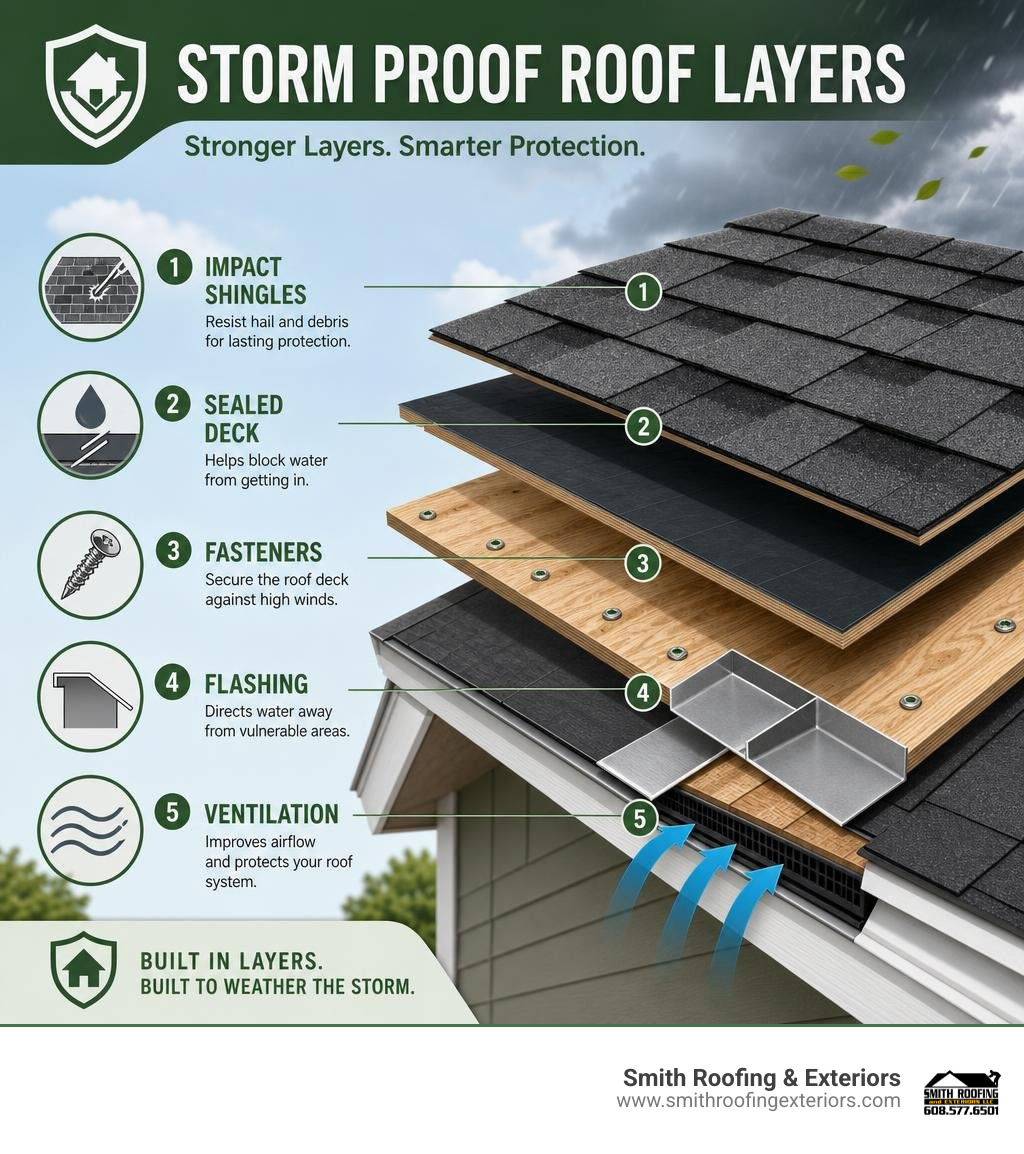
Basic storm proof roof upgrade vocab:
Severe Weather Vulnerabilities: Wind Uplift, Hail Impacts, and Water Leaks
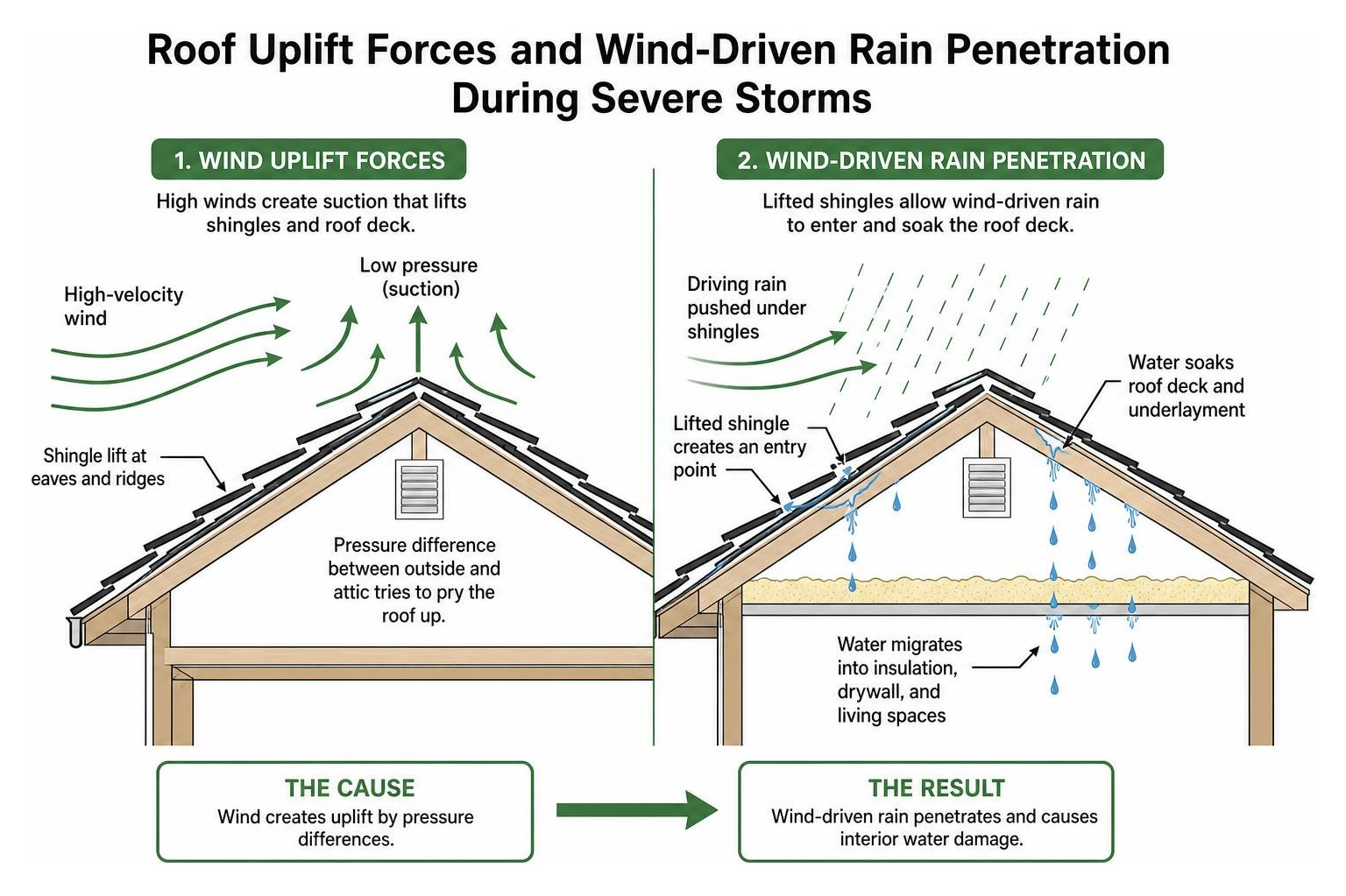
When severe weather sweeps through Southern Wisconsin, your roof is your home’s primary line of defense. The forces exerted during a severe thunderstorm, high-wind derecho, or hail event are multifaceted. Wind does not simply blow across your roof; it creates dynamic aerodynamic uplift forces. As high-velocity air rushes over the eaves, ridges, and valleys, drastic air pressure differentials form between the exterior surface and the attic interior. This creates suction that actively tries to pry the roof deck and shingles away from the framing.
Standard building practices often fall short under these extreme conditions. Traditional 3-tab shingles, rated only for 60 to 80 mph gusts, frequently tear off, leaving underlayment exposed. To protect against severe uplift, modern storm-resilient assemblies rely on materials meeting stringent standards such as ASTM D7158 Class H and ASTM D3161 Class F. These standards certify that shingles can withstand uplift pressures generated by 130 to 150 mph winds.
Understanding how wind tears through an unreinforced roof is essential. For a deeper breakdown of how pressure dynamics compromise structures, check out A Homeowner’s Guide to Wind Damage. When wind lifts the perimeter of a shingle, wind-driven rain penetrates underneath, exploiting unsealed seams and soaking the wood decking. Without a secondary defense, that water quickly migrates into ceiling drywall, insulation, and living spaces.
The Engineering Behind UL 2218 Class 4 Impact Resistance
Hail represents the other major threat to roof integrity. Standard shingles become brittle over time; when hailstones strike, the fiberglass mat fractures, loosening protective granules and exposing the asphalt core to rapid UV degradation.
To objectively measure impact performance, the industry relies on the UL 2218 standard. In this rigorous laboratory test, steel balls ranging from 1.25 inches (Class 1) to 2 inches (Class 4) are dropped from heights up to 20 feet directly onto the shingle surface—twice in the exact same spot. A shingle earns a Class 4 rating only if it shows zero cracking, splitting, or structural tearing on its backside after absorbing this massive kinetic energy.
To achieve this level of toughness, manufacturers incorporate polymer-modified asphalt (PMA) or styrene-butadiene-styrene (SBS) technology. These rubberizing polymers give the shingle core elastomeric flexibility, allowing it to cushion and absorb hail strikes without fracturing. For example, TAMKO StormFighter FLEX® – Polymer Modified Impact Rated Shingles utilize advanced polymer additives that maintain flexibility and impact resistance even when installed in temperatures down to 25°F. If you suspect your current system has suffered from a recent storm, learning How to Tell if a Hail Storm Wreaked Havoc on Your Roof will help you spot early signs of granular bruising and internal mat fractures before water starts leaking into your home.
Common Installation Mistakes That Compromise Storm Ratings
Even the highest-rated Class 4 shingles will fail if installation shortcuts are taken. Shingle wind ratings assume flawless mechanical attachment according to manufacturer specifications.
- High-Nailing Defects: Driving fasteners above the designated nailing zone reduces the shingle’s pull-through wind resistance by 60% to 80%. When the fastener misses the underlying double-layer common bond, wind easily tears the shingle loose.
- Inadequate Fastener Patterns: Standard installations often use a 4-nail pattern, which typically carries an 110 mph wind rating. Upgrading to a 6-nail pattern increases wind resistance to 130 mph or more, providing vital resistance against severe gusts.
- Using Smooth-Shank Fasteners: Smooth-shank roofing nails have lower withdrawal resistance under aerodynamic suction. Using ring-shank nails ensures deep mechanical interlock into the roof deck.
- Unsealed Hip and Ridge Caps: Ridge caps experience the highest uplift pressures on the entire roof. Omitting specialized adhesive or failing to hand-seal each cap according to manufacturer high-wind instructions drastically reduces ridge blow-off resistance.
- Improper Starter Strip Adhesion: Starter shingles provide the initial seal along eaves and rakes. Skimping on dedicated starter strips or placing them without proper adhesive alignment allows wind to peel up the edges of the roof.
Essential Components for a Complete Storm Proof Roof Upgrade
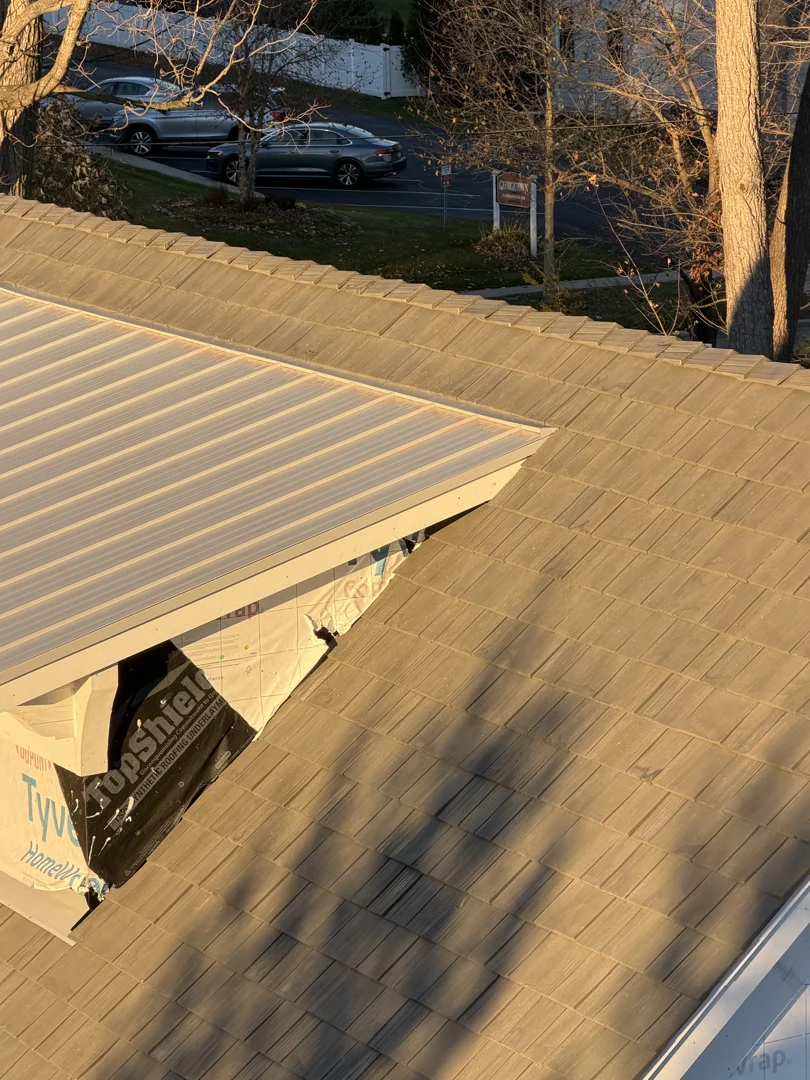
True storm resistance is a multi-layered structural system. While surface materials take the brunt of weather impacts, the sub-layers hold the building envelope together. The Insurance Institute for Business & Home Safety (IBHS) developed the FORTIFIED Roof standard to codify this layered defense. A complete upgrade integrates a continuous load path from the rafters down through the walls, reinforced sheathing attachments, and redundant waterproofing.
Roof Deck Fastening and Structural Hurricane Strapping
The roof deck is the foundation of your roof system. If the wood sheathing detaches from the trusses, the entire roof assembly fails regardless of how durable the surface shingles are.
During a storm-ready upgrade, old smooth nails or staples are replaced or supplemented with 8d ring-shank nails (2-3/8 inches long with annular threads). These nails are installed at 6-inch intervals along panel edges and 12-inch intervals in the field. Ring-shank nails nearly double the withdrawal resistance compared to smooth nails, locking the plywood or OSB firmly to the rafters.
Below the deck, roof-to-wall connections tie the structural framing together:
- Toe-Nail Connections (Standard): Traditional framing secures rafters using 2 or 3 smooth toe-nails driven at an angle, providing only about 110 pounds of uplift resistance per connection.
- Retrofit Hurricane Straps and Clips: Heavy-gauge galvanized steel straps physically wrap over rafters and anchor directly into the top wall plates. This continuous load path delivers 830 to 990 pounds of uplift resistance per truss, preventing the roof framing from lifting off during extreme updrafts.
Sealed Roof Decks and Secondary Water Barriers
A sealed roof deck (also known as Secondary Water Resistance, or SWR) is one of the highest-value upgrades you can install. If severe winds manage to rip shingles away, an unsealed deck with standard felt underlayment quickly tears, letting gallons of water pour directly through the plywood seams into your attic.
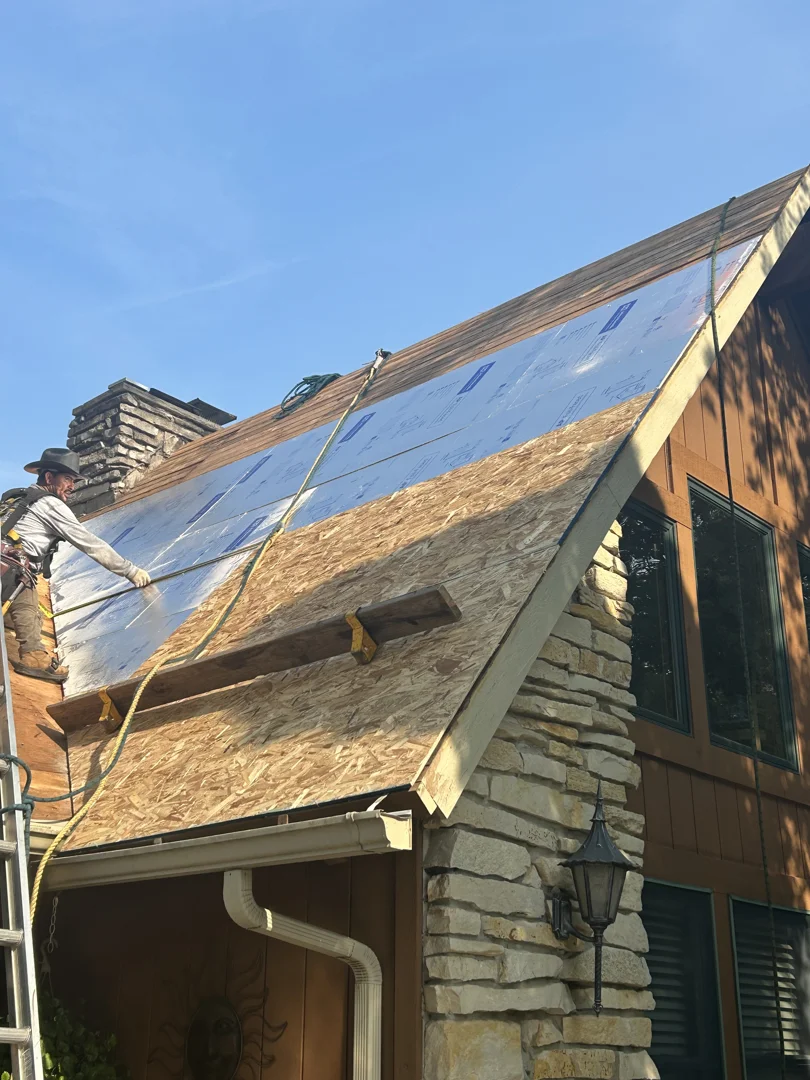
To create an impermeable barrier, we install a continuous layer of ASTM D1970 self-adhering modified bitumen underlayment (peel-and-stick) across the entire roof deck, or tape all sheathing seams with high-adhesion flashing tape before applying premium synthetic underlayment. This secondary membrane seals tightly around every nail penetration. Even if a tornado or storm strips the outer shingles bare, the home remains completely watertight.
Perimeter Drip Edges, Baffled Vents, and Flashing Reinforcement
Perimeter edges and roof penetrations represent the most frequent initiation points for wind uplift and water intrusion.
- Heavy-Gauge Drip Edge: Standard thin-gauge aluminum drip edges can bend and pull free in high winds. Installing 26-gauge galvanized steel drip edge overlapping the underlayment and secured with mechanical fasteners prevents edge lifting.
- Baffled, Wind-Driven Rain Vents: Traditional attic vents often allow horizontal rain to enter the attic during severe storms. Upgrading to TAS100A-tested baffled ridge and off-ridge vents blocks wind-driven rain while maintaining essential attic ventilation.
- Reinforced Step and Kick-Out Flashing: Step flashing along sidewalls and chimneys must feature heavy-gauge metal integrated with self-adhering membrane. Kick-out flashing at roof-to-wall step intersections channels high-volume runoff away from exterior siding, preventing hidden wall rot.
Step-by-Step Implementation and Material Selection
Choosing the right material combination depends on your budget, aesthetic preferences, and long-term architectural goals.
| Roofing Material | Wind Uplift Rating | Impact Rating (UL 2218) | Expected Lifespan | Primary Advantages |
|---|---|---|---|---|
| Standard Architectural Shingles | 110–130 mph (with 6 nails) | Class 1 to 3 | 15–20 Years | Cost-effective, wide aesthetic availability |
| Class 4 Impact-Resistant Shingles | 130–150 mph | Class 4 (2″ hail) | 25–30 Years | Exceptional hail resilience, insurance discounts, flexible PMA core |
| Standing Seam Metal Roofing | 140–180+ mph | Class 4 | 50+ Years | Concealed fasteners, interlocking seams, unmatched wind resistance |
| Concrete / Synthetic Tile | 130–150 mph | Class 3 to 4 | 40–50 Years | Heavy mass, excellent fire and rot resistance, long lifespan |
Evaluating Material Options for Your Storm Proof Roof Upgrade
For asphalt systems, premium shingles like DURATION STORM incorporate reinforced polymeric backing and advanced woven fabric nailing strips to achieve UL 2218 Class 4 impact resistance and 130 to 150 mph wind resistance warranties. These shingles provide high storm defense for homeowners who prefer a traditional architectural shingle profile.
For property owners seeking permanent, maximum-level defense, metal roofing provides exceptional structural performance. As detailed in The Complete Guide to Metal Roofing, standing seam systems utilize concealed clips and mechanically seamed joints that lock panels together. Because there are no exposed fastener holes to degrade or back out over time, standing seam metal can withstand wind speeds exceeding 160 mph without panel uplift. Exploring What Are the Top Benefits of Installing a Metal Roof highlights how metal delivers outstanding long-term durability, fire safety, and energy efficiency across decades of Midwest seasons.
Calculating the Cost and Insurance ROI of a Storm Proof Roof Upgrade
A full storm-proof upgrade generally adds a premium of $3,000 to $8,000 over the cost of a baseline roof replacement, depending on home square footage and chosen components (such as ring-shank re-nailing, full peel-and-stick membranes, hurricane clips, and Class 4 impact shingles).
This upfront investment generates clear, measurable financial returns:
- Insurance Premium Reductions: Most major insurance carriers offer substantial discounts for certified storm-mitigation features. Installing UL 2218 Class 4 impact-resistant shingles typically earns a 10% to 35% discount on the wind/hail portion of your homeowners policy. Retrofitting hurricane straps and a secondary water barrier can add another 10% to 20% in policy credits.
- Avoided Storm Deductibles: Wind and hail insurance deductibles often range from 1% to 5% of a home’s total insured value (or flat deductibles of $1,500 to $5,000+). Preventing a single major claim saves this out-of-pocket expense immediately.
- Rapid Payback Period: In regions with frequent severe thunderstorms, the combined annual insurance savings and avoided maintenance allow most homeowners to recoup the cost premium of their storm-proof upgrade within 5 to 7 years.
If a severe storm does impact your neighborhood, knowing What to Expect from Emergency Roof Repair Contractors After a Storm ensures you work with licensed, local professionals rather than transient storm chasers.
Frequently Asked Questions About Storm Proofing Your Roof
Can an existing roof be retrofitted to become storm resistant?
Yes, several critical components can be retrofitted without completely replacing a structurally sound roof covering. Hurricane straps and truss clips can often be installed directly from inside your attic space to reinforce the roof-to-wall connections.
Additionally, closed-cell spray polyurethane foam can be applied to the underside of the roof sheathing along truss joints to boost uplift resistance and provide secondary water resistance. However, the most cost-effective and comprehensive time to install a sealed deck, ring-shank re-nailing, and Class 4 shingles is during a full roof replacement when the deck is completely exposed.
How much does an impact-resistant shingle upgrade lower homeowner insurance?
Installing certified UL 2218 Class 4 impact-resistant shingles can reduce your annual homeowners insurance premiums by 10% to 35%, depending on your insurance carrier and geographic location.
To claim this discount, request a wind and hail mitigation certificate or proof of product classification from your roofing contractor after installation, then submit it directly to your insurance agent. Over a 10-year span, these premium credits can save thousands of dollars, directly offsetting the initial material upgrade costs.
What should I do immediately if my roof suffers storm damage?
If severe winds or hail breach your roof, safety is your immediate priority:
- Never climb onto a damaged or wet roof yourself.
- Document all interior and exterior damage from ground level using detailed, time-stamped photographs and video.
- Contact a reputable local roofer for 24/7 emergency tarping to prevent water intrusion into ceilings and insulation.
- Notify your insurance carrier to open a claim before cleanup begins.
For a complete step-by-step recovery process, follow our guide on Emergency Roof Repair After a Storm: What to Do.
Conclusion
A storm proof roof upgrade is a comprehensive, engineered defense system designed to safeguard your home against intense wind uplift, driving rain, and damaging hail. By combining structural deck fastening, hurricane-rated framing connections, a sealed secondary water barrier, and UL 2218 Class 4 impact-resistant shingles or standing seam metal, you protect your home’s structural integrity while locking in substantial long-term insurance discounts.
At Smith Roofing & Exteriors, we deliver transparent pricing, superior materials, and certified installation across Southeastern Wisconsin. Whether you need an emergency post-storm inspection or want to fortify your home with a resilient new roof system, trust our local team for expert Fort Atkinson residential storm damage repair and storm-ready roof replacements.