Why Choosing Between a Builder and a Specialist Roofer Could Cost You Thousands

Roofers and waterproofers are specialized tradespeople — and they’re very different from your general builder.
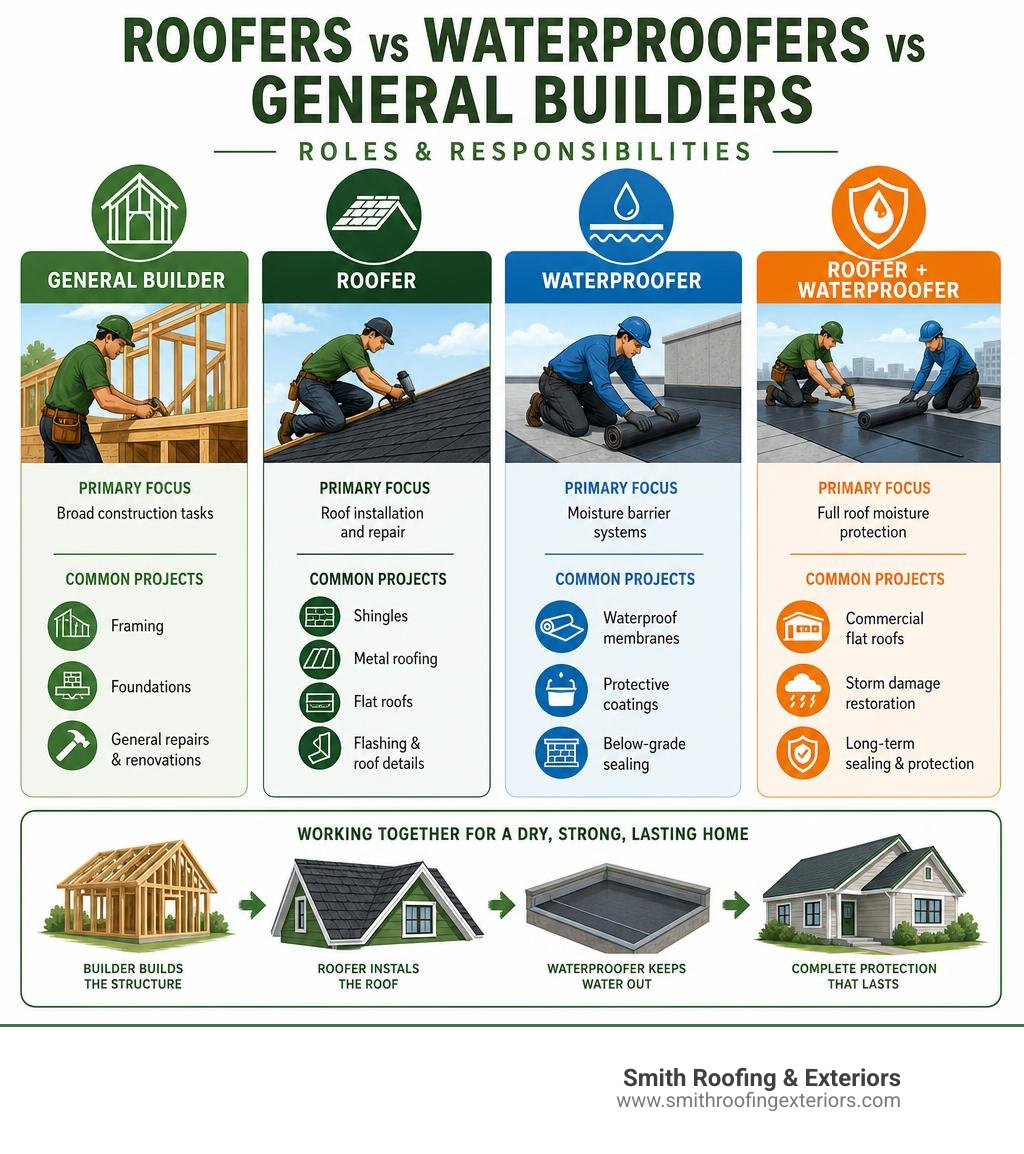
Here’s a quick breakdown of who does what:
| Role | Primary Focus | Common Projects |
|---|---|---|
| General Builder | Broad construction tasks | Framing, foundations, general repairs |
| Roofer | Roof installation and repair | Shingles, metal roofing, flat roofs, flashing |
| Waterproofer | Moisture barrier systems | Membranes, coatings, below-grade sealing |
| Roofer + Waterproofer | Full roof moisture protection | Commercial flat roofs, storm damage, long-term sealing |
When water gets into your home, it doesn’t care who installed the roof. What matters is whether the right specialist did the job correctly.
Wisconsin homeowners face some of the harshest conditions in the country — heavy snow loads, freeze-thaw cycles, and spring rain that exposes every weak point in a roof or wall system. A general builder may handle the basics, but protecting your home from water damage long-term takes a different level of expertise.
A small leak ignored today can become a mold problem, a structural repair, or a five-figure insurance claim by next winter.
I’m Matt Smith, owner of Smith Roofing & Exteriors, and after years working alongside professional roofers and waterproofers across Wisconsin, I’ve seen what happens when the wrong contractor takes on a job that demands a specialist. In this guide, I’ll walk you through exactly what separates general builders from specialized roofing and waterproofing professionals — so you can make the right call for your home.
Roofers and waterproofers helpful reading:
Understanding the Roles of Roofers and Waterproofers

When it comes to protecting a building from the elements, we must look at the structure as a complete system. The building envelope is designed to keep the interior dry, comfortable, and structurally sound. Within this envelope, roofers and waterproofers play distinct but heavily overlapping roles.
While a general builder understands how to construct the frame and walls, they often lack the specialized training required to seal the envelope against Wisconsin’s challenging elements. Professional roofers and waterproofers focus entirely on preventing water ingress, which is the single greatest threat to structural longevity.
| Feature / Task | Professional Roofer | Professional Waterproofer |
|---|---|---|
| Primary Zone | Roof deck and above-grade roof structures | Substructures, foundations, plazas, and flat decks |
| Primary Materials | Asphalt shingles, standing seam metal, EPDM, TPO | Liquid polyurethane, crystalline injections, bituminous sheets |
| Common Tools | Pneumatic nail guns, seam welders, slate cutters | High-pressure injection pumps, squeegees, spray rigs |
| Key Objective | Shedding water and protecting against overhead weather | Creating a continuous, impermeable seal on multiple planes |
Key Differences Between Roofers and Waterproofers
The primary difference between these two trades lies in how they manage water. A roofer is generally focused on shedding water. They install steep-slope systems like asphalt shingles, slate, or metal panels that rely on gravity to direct water into gutter systems. For example, when we install metal systems, we rely on precise pitches and interlocking seams, as detailed in The Complete Guide to Metal Roofing.
A waterproofer, on the other hand, is focused on stopping water that may be standing, pooling, or under hydrostatic pressure. Waterproofers work with seamless liquid membranes, below-grade bentonite sheets, and crystalline systems that chemically react with concrete to block moisture pathways. While a roofer ensures your shingles are aligned, a waterproofer ensures that a below-grade basement or a flat concrete plaza deck remains completely bone-dry even when submerged under water.
How Professional Roofers and Waterproofers Collaborate on Complex Projects
On large commercial facilities or custom modern homes with flat roofs, the line between roofing and waterproofing blurs. This is where the two specialties must collaborate closely. A classic example is the integration of flashing at joint intersections. If a building features a flat roof that transitions into a green garden terrace, a roofer may install the primary membrane, but a waterproofer is needed to seal the expansion joints and apply root-barrier coatings.
Ensuring a seamless transition between the horizontal roof plane and the vertical parapet wall requires specialized sealants. Choosing the correct product is critical, which we discuss in The Best Roof Sealant for Flat Roofs and Where to Find Them. Without this collaborative precision, water can migrate behind the flashing, bypassing the roof entirely and rotting the wood framing beneath.
Professional Training, Safety Standards, and Worker Qualifications
The level of training required for professional roofers and waterproofers is incredibly rigorous. Unlike general builders who may learn on the job without formal certifications, professional specialty contractors undergo years of structured training to meet strict safety and quality standards.
The Path of Professional Apprenticeship and Safety Standards
In the skilled trades, safety and expertise are built through structured apprenticeship programs. Organizations like the United Union of Roofers, Waterproofers and Allied Workers place a massive emphasis on education. For example, Roofers Local 11, which operates a South Central Wisconsin Training Center in Milton, WI, ensures that apprentices complete thousands of hours of classroom and on-the-job training.
Under the guidance of experienced journeymen, apprentices learn the chemistry of modern liquid-applied membranes, the physics of wind-uplift pressures, and strict OSHA safety protocols. This training is particularly critical when dealing with weather-related safety hazards. Working on a roof in the summer heat or during freezing Wisconsin winters requires strict adherence to heat-illness prevention and fall-protection standards.
Economic Benefits and Career Growth for Skilled Tradespeople
Choosing a career in these specialized trades offers substantial economic benefits, which translates directly to higher-quality workmanship for property owners. Well-trained, union-represented professionals receive competitive wages and comprehensive benefit packages.
For instance, Journeyman wages in various regional locals reflect the high value placed on these specialized skills:
- In some regional locals, such as Local 37, journeymen receive a total package of $53.42 per hour (comprising a $35.54 hourly wage plus $17.88 in benefits).
- Apprentice wages in structured programs often start around $24.73 per hour, supplemented by robust health and pension benefits.
These competitive packages ensure that the industry attracts and retains dedicated, highly skilled craftsmen. This contrasts sharply with states or sectors with weaker trade protections. According to data from the Bureau of Labor Statistics, workers living in right-to-work states earn about $1,500 less per year than workers in states without these laws. Furthermore, the rate of employer-sponsored health insurance in right-to-work states is 2.6 percentage points lower, and workplace death rates are statistically higher. By investing in highly compensated, properly trained professionals, we ensure our crews are safe, focused, and equipped to build roofs that last.
Climate-Specific Challenges and Advanced Waterproofing Systems
Southeastern Wisconsin presents a brutal climate for any building envelope. From the humid summer heat of Lake Geneva to the bitter winter freezes of Fort Atkinson, our buildings undergo constant expansion and contraction. To survive these conditions, you need a specialized Southeastern Wisconsin Roofing Contractor who understands how materials behave in extreme weather.
Flat Roof Vulnerabilities and High-Humidity Solutions
Flat roofs are incredibly popular for commercial buildings and modern residential designs in areas like Lake Mills and Jefferson, WI. However, because they lack a natural slope, they are highly vulnerable to water pooling. During a typical Wisconsin winter, pooled water freezes, expands, melts, and refreezes. This freeze-thaw cycle can open up tiny hairline cracks in a roof’s surface, leading to catastrophic leaks.
To prevent this, advanced drainage systems and highly flexible membranes are required. If you are dealing with flat roof issues on a tight budget, it is critical to understand your options, which we cover in How to Repair Flat Roof on a Budget.
Innovations in Materials and Reflective Coatings
The technology behind roofing and waterproofing has advanced dramatically. Today, we utilize high-performance polyurethane coatings and liquid-applied membranes that cure to form a completely seamless, monolithic barrier directly over the roof substrate. These systems are highly elastic, allowing them to stretch and contract during extreme temperature swings without cracking.
Additionally, many of these modern coatings are highly reflective. Reflective coatings reduce heat absorption, which can cut building cooling costs by up to 15%. However, keeping a roof dry and energy-efficient isn’t just about the outer coating; it also requires proper airflow underneath the deck. To learn how insulation and airflow work together to protect your roof deck, read The Complete Guide to Roof Ventilation.
Maintenance, Leak Detection, and Emergency Repairs
A high-quality roof is a major investment, and protecting that investment requires proactive care. While a general builder might offer to “take a look” at a leak, professional roofers and waterproofers utilize specialized scientific tools to locate and resolve moisture issues before they cause visible damage.
Proactive Leak Detection and Emergency Tarping
Water is incredibly sneaky. It can enter a roof at one point, travel horizontally along a structural beam, and drip down into your living room thirty feet away. Professional technicians use advanced moisture-detection tools, thermal imaging, and electronic leak detection to trace water back to its exact source.
If your property experiences sudden storm damage, fast action is required to prevent mold and rot. We provide 24/7 emergency services to seal and protect your home immediately. For immediate DIY steps you can take before our team arrives, check out The Easiest Way to Fix Roof Leak. If the leak is originating near a rooftop window, you can find targeted advice in Don’t Let a Leaky Skylight Dampen Your Spirits: A Repair Guide.
Coordinating with Insurance and Property Developers
When a major storm hits communities like Walworth, Delavan, or Elkhorn, coordinating repairs can be incredibly stressful. Professional roofing contractors use industry-standard estimating software like Xactimate to provide insurance companies with highly detailed, line-item documentation of the damage. This professional transparency ensures that your claim is processed quickly and accurately, allowing us to deliver the high-quality Expert Solutions for Commercial Roofing or residential restorations you deserve.
Frequently Asked Questions About Roofing and Waterproofing
How long does professional roof waterproofing typically last?
Most high-quality waterproofing systems provide 15 to 25 years of reliable moisture protection, depending on the material used and local weather exposure. Applying a professional elastomeric or silicone coating can also extend an existing roof’s lifespan by up to 10 years. However, regular bi-annual inspections are key to reaching this lifespan. To understand why even minor moisture issues should be addressed immediately, read Why You Should Never Ignore a Residential Roof Leak Even If It Is Small and explore the 5 Reasons to Fix Roof Leaks ASAP.
Can you waterproof a roof without removing the existing material?
Yes! In many cases, we can apply advanced liquid-applied membranes or silicone coatings directly over your existing roof material, provided the underlying deck is structurally sound and free of trapped moisture. This can save property owners thousands of dollars in tear-off and disposal costs. For temporary or emergency sealing options, you can read The Ultimate Guide to Flex Sealing Your Leaky Roof and learn how to Seal Your Shingles and Stop the Leak.
What is the cost range for professional roof waterproofing?
The cost of professional roof waterproofing varies widely based on the size of the roof, the materials selected, and the complexity of the prep work. Minor repairs or localized coating applications can cost a few hundred dollars, while comprehensive, multi-layer commercial waterproofing systems for large flat roofs can range significantly higher. The long-term ROI is substantial, as waterproofing prevents rot and structural damage, saving you from incredibly expensive structural rebuilds down the road.
Conclusion
At the end of the day, your roof is your property’s first and most important line of defense. While a general builder is fantastic for framing walls or remodeling a kitchen, they simply do not have the specialized training, equipment, or materials required by professional roofers and waterproofers to secure a building against Wisconsin’s extreme climate.
At Smith Roofing & Exteriors, we are proud to be your trusted, local, veteran-led roofing specialists. From our home base at N2603 Kutz Rd in Fort Atkinson, WI, we deliver expert residential and commercial roofing, siding, and gutter services to our neighbors across Southeastern Wisconsin.
Whether you need a specialized installation in Lake Mills, a repair in Jefferson, or emergency service in Burlington, our experienced local team is here to help with superior materials, 24/7 emergency response, and 100% transparent pricing.
Ready for complete peace of mind from above? Contact us today to schedule your professional consultation with a certified Southeastern Wisconsin Roofing Contractor.
Resources for Property Owners:
- For global perspectives on advanced combo roofing and architectural waterproofing systems used in extreme climates, you can reference the engineering work of WP Waterproofers | Specialist Waterproofing & Combo Roof Systems | Trusted Across Dubai.