When Hail Hits Your Roof: What Wisconsin Property Owners Need to Know
TPO roof hail damage is one of the most deceptive problems a Wisconsin property owner can face — because the worst of it often hides where you can’t see it.
Here’s a quick overview of what you need to know:
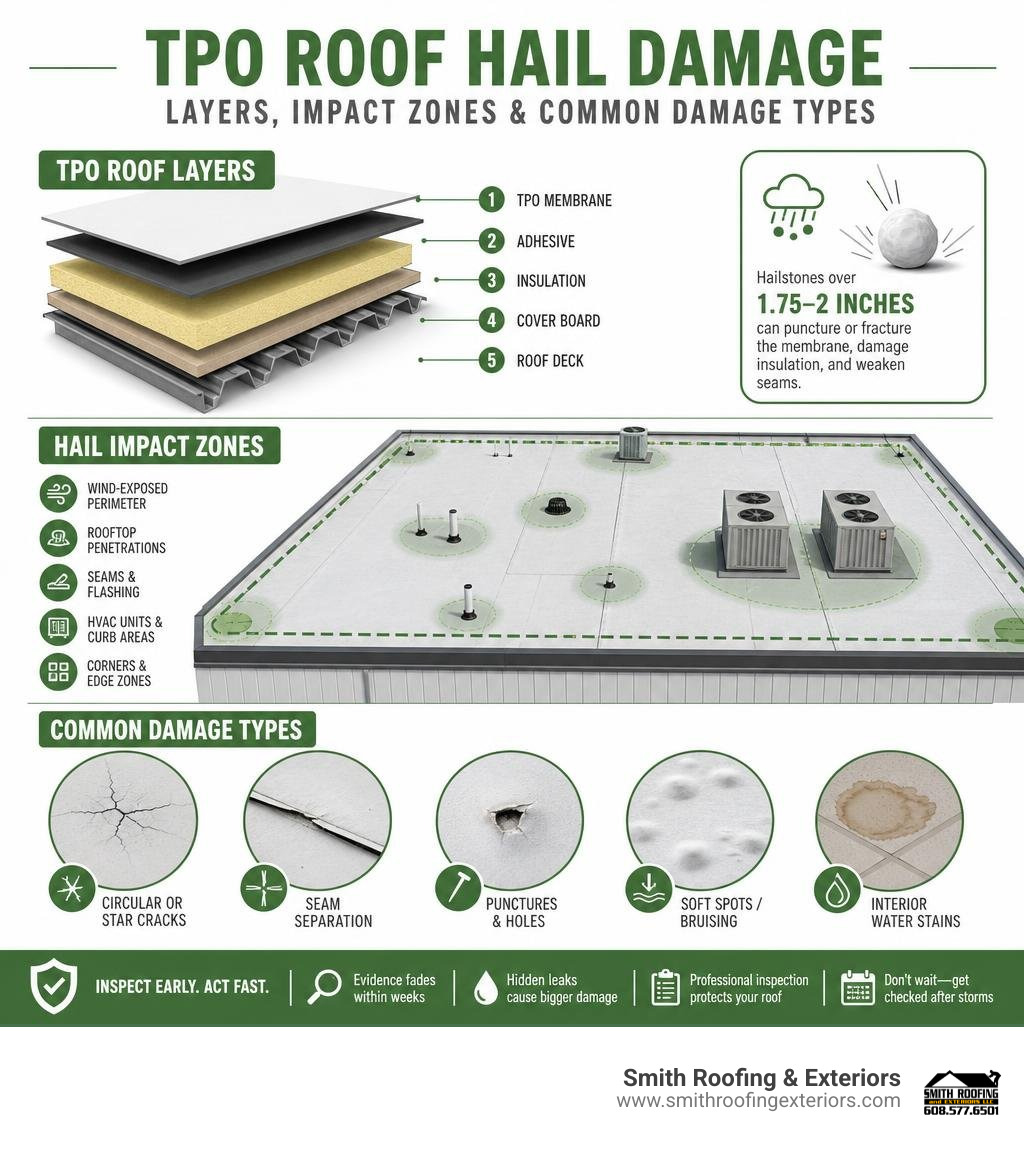
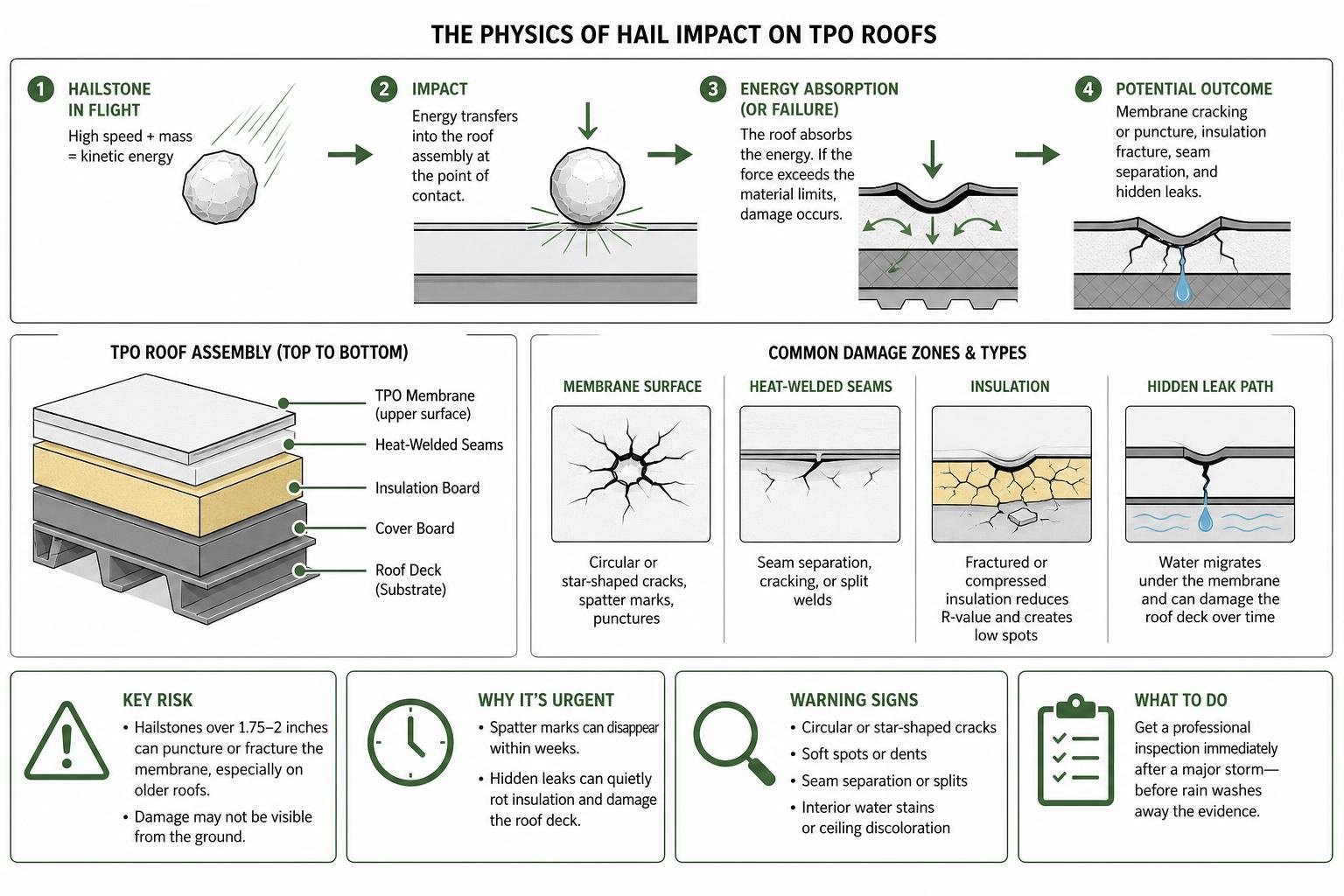
- What gets damaged: The TPO membrane surface, heat-welded seams, and the insulation underneath
- Warning signs: Circular or star-shaped cracks, soft spots, seam separation, interior water stains
- Key risk: Hailstones over 1.75–2 inches can puncture or fracture the membrane, especially on older roofs
- Why it’s urgent: Damage evidence (spatter marks) can disappear within weeks, and hidden leaks can quietly rot your roof deck
- What to do: Get a professional inspection immediately after a major storm — before rain washes away the evidence
A TPO roof can take a direct hit, look completely fine from the ground the next morning, and still be leaking into your insulation by the following month. That’s the part that catches most property owners off guard.
Wisconsin’s hail season is no joke. Storms here can push hailstones at speeds approaching 100 mph — with enough force to crack a membrane, fracture the insulation board beneath it, and compromise the seams that hold everything together.
I’m Matt Smith, owner of Smith Roofing & Exteriors, and I’ve helped property owners across southeastern Wisconsin assess and recover from TPO roof hail damage — from small punctures to full system replacements driven by hidden structural failures. In this guide, I’ll walk you through exactly what to look for, what it means, and what to do next.
Simple guide to tpo roof hail damage:
Understanding TPO Roof Hail Damage: Causes and Vulnerabilities
Thermoplastic Polyolefin (TPO) is a highly popular single-ply roofing membrane favored for its energy efficiency, UV reflectivity, and heat-welded seams. However, when a severe Wisconsin storm rolls through Jefferson or Walworth County, the physics of falling ice can overwhelm even high-quality single-ply systems.
The severity of tpo roof hail damage depends on a combination of factors: hailstone size, wind-driven velocity, the temperature of the membrane during impact, and the structural integrity of the underlying substrate. When a hailstone strikes a low-slope roof, the kinetic energy must be absorbed by the assembly. If the energy exceeds the tensile strength of the membrane or the compressive strength of the insulation board beneath it, physical failure occurs.
Research on the structural mechanics of single-ply membranes shows that impacts cause localized stress concentrations. According to a study on the (PDF) Progressive failure from Deformation of TPO membranes from hail impacts , the physical deformation of the TPO sheet under high-velocity impact can lead to progressive micro-fractures in the polymer matrix. This mechanical stress is highly influenced by whether the building utilizes a flat or sloped design. For a deeper look at how roof design influences storm vulnerability, explore our comparison on Flat vs. Sloped Commercial Roofing: Which is Best?.
How Age and Condition Affect TPO Roof Hail Damage
A brand-new TPO roof is highly flexible. The modern formulation of thermoplastic polyolefins allows the membrane to stretch and absorb impact energy, frequently allowing smaller hailstones to bounce off without causing structural harm.
However, as a TPO roof ages under the intense Wisconsin sun—experiencing hot summers in Edgerton and freezing winters in Lake Mills—it undergoes gradual UV degradation and thermal aging. Over time, the membrane loses its essential plasticizers and flexibility, becoming increasingly brittle.
When a mature TPO membrane loses its elasticity, its threshold for hail damage drops significantly. What once would have been a harmless bounce now becomes a star-shaped fracture or a clean puncture. An older TPO system is far more susceptible to cracking along the weathering ply, exposing the polyester scrim reinforcement beneath.
The Role of Roof Pitch and Hailstone Velocity
The angle of impact plays a massive role in how much damage a hailstone inflicts. On a low-slope or flat commercial roof, hailstones typically strike at or near a 90-degree angle. This direct perpendicular impact transfers 100% of the hailstone’s kinetic energy straight into the roof assembly.
Furthermore, gravity is reinforced by wind velocity. A golf ball-sized hailstone (about 1.75 inches in diameter) doesn’t just fall; when propelled by wind speeds approaching 100 mph, it can fall at speeds of 100 mph. Compared to smaller stones falling at 30 mph, these high-velocity impacts dramatically elevate the risk of severe membrane punctures and fractured substrates.
Cosmetic vs. Functional Damage: What Property Owners Must Know
When an insurance adjuster steps onto your roof in Fort Atkinson or Delavan after a storm, they will look at the damage through a specific lens: cosmetic vs. functional impairment.
| Feature | Cosmetic Damage | Functional Damage |
|---|---|---|
| Definition | Surface blemishes, scuffs, or minor discolorations that do not affect the roof’s lifespan or waterproofing. | Structural failures that compromise the watertight integrity, wind uplift resistance, or thermal performance of the roof. |
| Visual Signs | Shallow dimples, superficial scuffs, temporary spatter marks. | Concentric cracks, star-shaped punctures, fractured cover boards, split seams. |
| Water Intrusion | None. | High risk of active leaks or saturated insulation. |
| Insurance Coverage | Often excluded or disputed by carriers. | Typically fully covered under standard commercial property policies. |
For a comprehensive guide on how to navigate these distinctions with your insurance company, check out our resource on How to Spot Hail Damage and Get Your Insurance to Pay.
Does Substrate Denting Affect Insulation R-Value?
One of the most common debates during a TPO hail claim is whether physical dents in the underlying polyisocyanurate (polyiso) insulation degrade the building’s energy efficiency.
Fortunately, scientific testing provides some clarity. In a landmark laboratory case study using a Heat Flow Meter (HFM) in accordance with ASTM C518 and ASTM C1058 standards, researchers analyzed the thermal performance of dented insulation substrates. The testing simulated an extreme density of 900 hail-caused dents per square (100 square feet).
The results showed that even under these extreme, highly dense denting conditions, the measured R-value differences remained within +/- 2% of the baseline. Because this falls entirely within the standard margin of error for the testing equipment, the study concluded that physical denting of the polyiso substrate has no measurable effect on insulation thermal performance.
In real-world storm events, the density of substrate dents is far lower. Forensic case studies of actual hail-struck TPO roofs typically document between two and seven dents per square—roughly 900 times less dense than the laboratory test conditions. Therefore, unless the insulation is physically crushed, broken, or water-saturated, substrate denting alone does not justify an R-value loss claim.
Can Hail Impacts Lead to Water Intrusion and Leaks?
While dry dents might not ruin your R-value, physical punctures and fractured insulation facers absolutely will. When hail punctures a TPO membrane, water gain is inevitable.
In a documented case study of a distribution center, a 60 mil TPO system subjected to large hail developed 8 distinct leaks, manifesting as visible water spots on interior suspended ceiling tiles. In another severe case, a hail-struck TPO roof exhibited approximately 100 brownish-yellow discolorations (ranging from 6 to 12 inches in diameter) with inch-long gashes in the center. These discolorations were the direct result of water intruding through the punctures, saturating the underlying insulation, and rust-staining the components from the inside out.
When water enters the system, the polyiso insulation loses its structural integrity and its thermal R-value drops to near zero. Trapped moisture also creates a “water bag” effect between layers, rotting the roof deck and structural wood. For more information on how flat roof leaks develop after a storm, read our Commercial Roofing in Fort Atkinson, WI: Storm Damage Guide.
How to Inspect and Identify TPO Roof Hail Damage
Evaluating a low-slope single-ply roof after a storm requires a trained eye and specialized tools. Unlike asphalt shingles, which shed granules when damaged, TPO behaves differently.
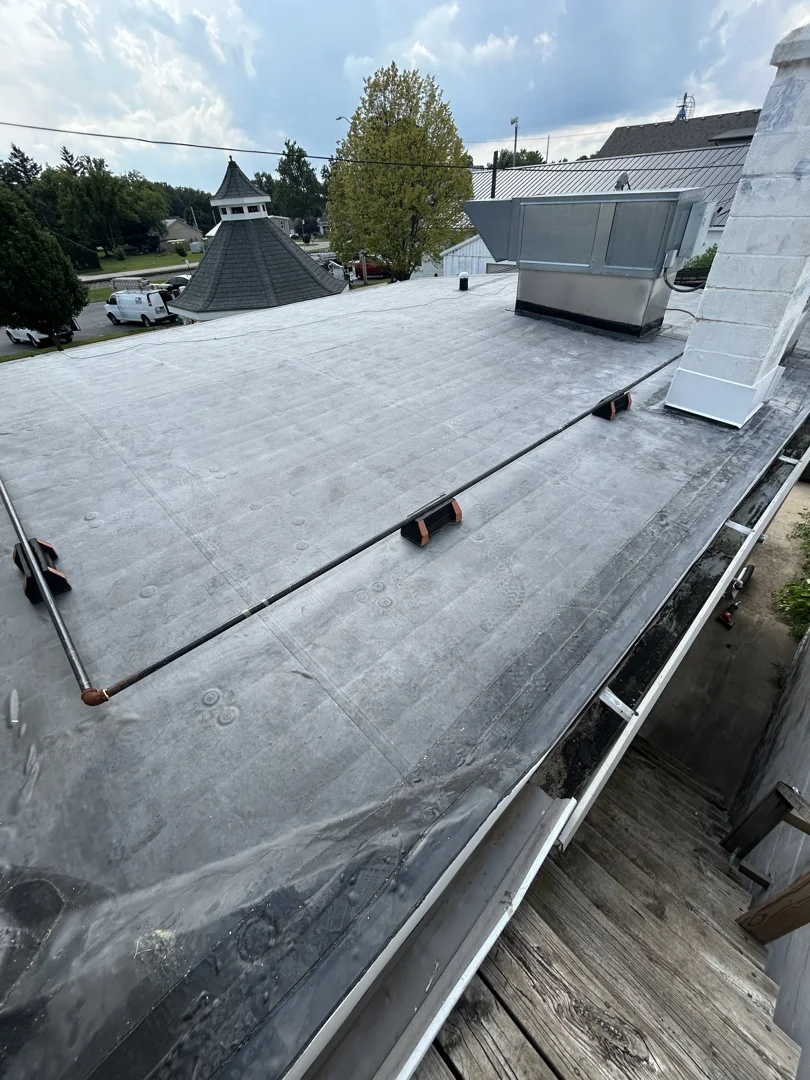
A major challenge is that physical evidence on TPO can be incredibly short-lived. Field observations show that hail spatter marks—the clean spots left on a dirty roof where hail knocked away dust and biological contaminants—can diminish or become completely obscured within weeks. Rainfall quickly redistributes airborne particulates and surface contaminants across low-slope roofs, masking the impact points. This makes immediate post-storm inspections absolutely vital. Learn how to safely perform a preliminary check in our guide on How to Check Your Flat Roof for Hail Damage After a Storm.
Identifying the Signs of TPO Roof Hail Damage
To successfully identify functional damage on a TPO membrane, look for the following physical markers:
- Concentric or Star-Shaped Fractures: These appear as circular impact fractures in the top weathering ply of the membrane. They indicate that the impact fractured the polymer layer, even if the polyester scrim reinforcement is not yet fully torn.
- Seam Splitting and Micro-Fractures: The kinetic energy of a hailstone striking near a heat-welded seam can micro-fracture the weld. This weakens the seam’s resistance to wind uplift and water intrusion.
- Surface Abrasions and Bluish Tinting: Severe hail scrubbing can wear away the reflective white top layer of the TPO, sometimes revealing a bluish tint or exposing the darker core material underneath.
- Subsurface Soft Spots: Even if the membrane looks intact, pressing on the impact point can reveal a soft, bruised spot where the underlying insulation or cover board has fractured.
For an in-depth look at proving these specific failure modes to insurance companies, you can read about TPO & EPDM Hail Damage: How to Prove Functional Impairment | JustClaims . More general repair insights can also be found at Hail Damage to TPO Roofing: Inspection, Repair, and Prevention – New England Metal Roof .
Step-by-Step Post-Storm Inspection Protocol
Our team at Smith Roofing & Exteriors follows a rigorous, multi-step protocol when inspecting TPO systems in Southeastern Wisconsin:
- Safety and Debris Clearance: We clear any storm debris and ensure all roof drains and downspouts are clear of blockages.
- Visual Mapping and Spatter Analysis: We map out the impact clusters, using macro photography to document fresh spatter marks and physical membrane fractures.
- Tactile Substrate Probing: We physically feel the membrane in impact areas to check for crushed insulation or fractured cover boards.
- Seam Testing: We use a specialized seam probe to physically check the integrity of all heat-welded laps, looking for micro-fractures or separation.
- Core Sampling: When subsurface damage is suspected, we take physical core samples down to the roof deck to inspect for hidden moisture, fractured insulation facers, or multi-layer roof systems.
- Thermal Imaging: We utilize infrared thermography after sunset to locate trapped moisture within the insulation layers, mapping out the exact boundaries of water migration.
Repairing TPO Roofs and Navigating Insurance Claims
Once tpo roof hail damage has been identified and documented, the next step is determining the appropriate path to restoration.
TPO Repair Methods: Patching vs. Replacement
If the hail damage is isolated to a few minor punctures and the underlying insulation is dry, a repair is often the most practical solution.
TPO repairs must be performed using manufacturer-approved materials to preserve the system’s warranty. The standard repair method involves hot-air welding a target patch of new TPO membrane over the damaged area.
- The damaged area is thoroughly cleaned and prepared.
- A patch extending at least 2 inches beyond the damage zone is cut.
- A professional hot-air welder is used to fuse the patch directly to the existing membrane, creating a monolithic, watertight seal.
However, if the inspection reveals widespread punctures, fractured cover boards, or saturated insulation, localized patching is merely a temporary band-aid. In these cases, a partial or full membrane replacement is required. If you are dealing with broader storm damage across your property, our guide on Hail Damage Roof 101 provides excellent context on what to expect. Additional technical repair steps can be reviewed in How To Repair TPO Roofing After Hail Damage: A Step-by-Step Guide .
Proving Functional Impairment to Insurance Carriers
Navigating a commercial insurance claim for a TPO roof can be challenging. Insurance adjusters are trained to look for reasons to classify impact marks as cosmetic, which is why having comprehensive, professional documentation is vital.
To build a strong insurance claim, we gather circumstantial and physical evidence, including:
- Localized Weather Data: We cross-reference meteorological reports to match the storm date with documented hail sizes and wind speeds. For instance, in a past claim, weather data from a storm on 5/19/24 identified 1.75-inch to 2-inch hail and 100 mph winds as the definitive cause of membrane failure.
- Physical Core Samples: Showing a physical cross-section of a fractured insulation board or a wet substrate is undeniable proof of functional impairment.
- Building Code Compliance: Local municipal building codes in Wisconsin strictly regulate roofing assemblies. Most jurisdictions enforce a two-roof limit, meaning a building cannot support more than two roofing systems. If a core sample reveals a hidden third layer (such as an old EPDM or asphalt roof beneath the TPO), a complete tear-off down to the deck is legally mandated. Furthermore, building codes prohibit leaving water-soaked insulation in place, forcing carriers to cover the cost of insulation replacement rather than a cheap recovery board overlay.
For more strategic advice on navigating claims, check out the Hail Damage TPO Roof Guide for DFW Property Owners – #1 DFW ROOFING COMPANY , which outlines excellent universal practices for property owners.
Frequently Asked Questions About Flat Roof Storm Damage
What size of hail will damage a TPO roof?
Generally, new TPO membranes can resist hailstones up to 1.75 inches in diameter. However, hailstones over two inches wide (such as golf ball or baseball-sized hail) can easily cause serious dents, cracks, or punctures in the membrane. As a TPO roof ages and loses its flexibility, even smaller hail (1 to 1.5 inches) can cause functional damage.
How does TPO hail damage compare to asphalt shingles or PVC?
Asphalt shingles damage manifests as granule loss and bruised fiberglass mats. PVC membranes are highly durable but can become brittle over time and shatter under extreme impact. TPO typically damages through circular, star-shaped cracking of its top weathering ply or by transferring energy to fracture the rigid insulation board beneath it. Unlike EPDM, which is rubber and rebounds after impact, TPO is a more rigid plastic that is more prone to direct puncture under high-velocity hits.
Does insurance typically cover storm damage on a TPO membrane?
Yes, standard commercial property insurance policies cover sudden storm damage, including hail. However, policies often exclude cosmetic damage. To get your claim approved, you must prove functional impairment, such as membrane punctures, compromised heat-welded seams, or fractured underlying substrates that affect the roof’s waterproofing performance.
Conclusion
TPO roof hail damage is a quiet threat. It can leave your building vulnerable to structural rot, mold, and severe energy loss long before a single drop of water drips onto an office ceiling.
If your commercial or residential property in Fort Atkinson, Lake Mills, Jefferson, Burlington, Delavan, Elkhorn, Lake Geneva, Walworth, or Edgerton has recently experienced a hailstorm, do not wait for a leak to appear. Our experienced local team at Smith Roofing & Exteriors is here to provide honest assessments, transparent pricing, and expert storm restoration services.
Schedule a professional storm damage inspection with us today, and let us protect your investment with superior materials and unmatched local expertise.